How Much Does a Robot Hand Cost? Cheaper Isn't the Same as Proven.
Why it matters: price stopped being the barrier. This is what replaced it.
By Embodied AI Frontier
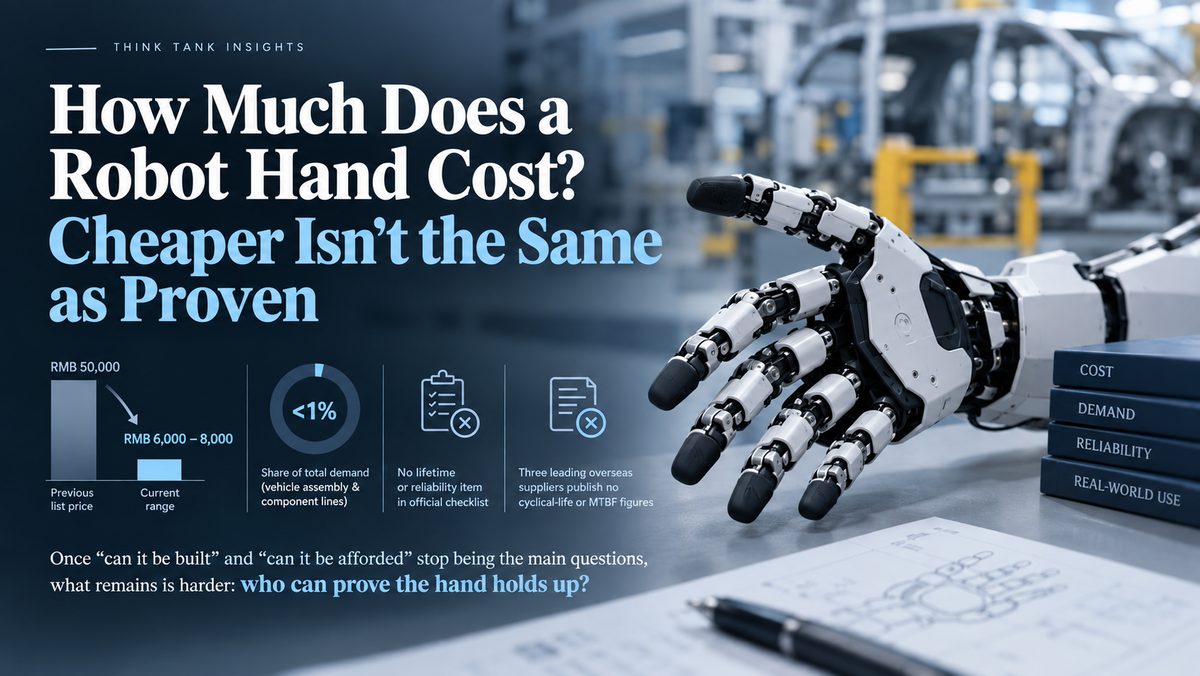
Chinese suppliers have pushed the list price of a mainstream six-degree-of-freedom (DoF) dexterous hand from RMB 50,000 to between RMB 6,000 and RMB 8,000, a drop of roughly 80 percent, according to Chinese media reports. Yet set against the two demand breakdowns in MIR Databank's white paper, the hands actually deployed on vehicle and component lines in 2025 accounted for less than 1 percent of total demand, a share this publication calculated from MIR's own figures. Meanwhile the official verification checklist contains no lifetime or reliability item, and three of the most established overseas suppliers publish no cycle-life or reliability figures either. Once "can it be built" and "can it be afforded" stop being the main questions, what remains is harder to establish: who can prove the hand holds up38The implementation plan for long-term care insurance is published via XinhuaView the entry below →.
Article structure
- 1. Why the Hand Is the Last Mile
- 2. The Work Is Already There: What the Demand Side Wants
- 3. Do We Need a Human Hand? An Unsettled Argument
- 4. Three Rulers: Standards Test Parts, Competitions Test Tasks, Deployments Test Lifespan
- 5. China's Position: Price, Volume, and Two Sides
- 6. Where Did the Capacity Go?
- 7. Another Road: The Home
- 8. Conclusion: From "Can It Be Built" to "Can It Be Proven"
1. Why the Hand Is the Last Mile
1.1 Motion Has Converged; the Difficulty Has Moved to the End Effector
Making a humanoid robot run stopped being hard in 2026. Sprinting, obstacle courses, consecutive jumps: over the past two years these went from laboratory demonstrations to routine events at competitions. The part still without an answer sits at the end of the arm. What can this machine actually do with its hands?
The question is being asked worldwide at the same moment.
On July 9, 2026, the American robotics company 1X Technologies unveiled a 25-DoF tendon-driven hand for its NEO humanoid. Its two selling points were distributed tactile sensing and force-controlled joints, and it was aimed explicitly at the home16NEO's Hands: An API to the Physical WorldView the entry below →. In the same year Tesla's Optimus hand went through a generational change, and its degree-of-freedom and actuator counts became benchmarks the industry measures itself against, though most of those figures come from media paraphrase rather than company disclosure. South Korea's Wonik Robotics did not release a five-fingered model of its own until September 7, 2026, when it launched the Allegro Hand V6 F; its mainstay products had been four-fingered until then18Wonik RoboticsView the entry below →. In China, a group of suppliers pushed prices down and simultaneously put standardisation onto the table.
These four threads converge within a single year, mostly in the third quarter, pointing at one technical node: the motion capability of robot bodies is converging, and differentiation is concentrating in manipulation.
1.2 Three Quantifiable Reasons
There are three reasons the hand became the dividing line, and each can be quantified.
First, it is where cost and difficulty intersect. A teardown estimate by Morgan Stanley, the American investment bank, puts the dexterous hand at roughly 17 percent of the bill-of-materials cost of an Optimus Gen 2, or about USD 9,50032Morgan Stanley's estimate that dexterous hands account for 17 percent of bill-of-materials cost has no public source document; citations in Chinese and English are second-handView the entry below →. That estimate has no public source document; citations in both Chinese and English trace back to second-hand references, while practitioners put the range at 10 to 20 percent. Other estimates circulate at 14 percent, 18 percent, or "potentially above 30 percent in future," Each is based on a different machine and a different accounting basis, so they cannot be compared side by side. The bases are inconsistent, but the order of magnitude is not: the dexterous hand sits in the double digits as a share of bill-of-materials cost, while occupying a small fraction of the machine's volume.
Second, it sets the ceiling on what work the machine can do, and this has nothing to do with how good the demo looks. Two-finger grippers handle structured actions: pick up, place, grasp. Tasks such as driving a screw, inserting a connector, opening a package or routing cables require the fingers to keep adjusting force and posture during contact. In its product launch material, the American robotics company 1X wrote that a two-finger gripper, the two-jaw end effector common on industrial arms, exposes only three verbs to developers: pick up, put down, push16NEO's Hands: An API to the Physical WorldView the entry below →. The implication is that what software can build depends on what action space the hardware exposes.
Third, it pushes the question of usability from software back to physics. Wang Xingxing, founder of Unitree, locates the missing "GPT moment" elsewhere: every input and output of a robot carries deviation from the physical world, and the final centimetres, sometimes millimetres, of tactile correction cannot be completed, which drags down the success rate23Embodied AI Leaders Fall Out Over These QuestionsView the entry below →.
1.3 The Question This Article Addresses
Together these observations point to the question this article addresses. The industry is no longer short of answers on whether the hand can be built, nor on whether it is expensive. What is missing is more basic: how to prove it works.
The sections that follow take up five questions in order. First, what work is waiting on the demand side, and what threshold a workstation imposes. Second, where the argument about whether a human-like hand is necessary currently stands, and why it has not converged even inside the United States. Third, what the three rulers used to define "qualified" each measure, and why they do not connect. Fourth, how far China's price and volume advantage has run, and why that capacity has not gone to the shop floor. And finally, another possible road, in case the hand's eventual destination is the home.
2. The Work Is Already There: What the Demand Side Wants
2.1 Three Tiers of Tasks, and the Third Is What Moves the Hand Forward
Capacity, funding and shipment volumes are the usual entry points when people discuss dexterous hands. But all three presume something prior: a specific workstation waiting to be taken over. That premise deserves a look of its own.
Sorting the applications with verifiable evidence along three dimensions, namely motion precision, object uncertainty and cycle-time requirements, yields a tiered picture.
Tasks with low uncertainty, high cycle times and low precision, such as loading and unloading, transfer and palletising, are already within reach of two- or three-finger grippers at very low cost. This is the mainstay of industrial automation today.
Tasks with high uncertainty and low cycle times, such as opening parcel boxes, sorting mixed materials or organising cables, require the machine to keep readjusting its posture against objects of varying shape and material. People still do most of this work.
Tasks with high precision and high certainty, such as driving standard screws, inserting connectors or assembling small parts, require the fingers to adjust force continuously through contact. These fall in the human hand's comfort zone, and at the difficult edge of current electromechanical designs.
Of the three, it is the third tier that pushes dexterous hands forward. Its defining feature is that the motion itself is not complicated; the difficulty lies in continuous force control.
2.2 Who Does This Work Today
Two- and three-finger grippers cover most structured industrial operations at a cost far below multi-fingered hands, and that is their advantage. One claim circulates widely: simple grippers can cover 80 to 90 percent of standard pick-and-place and structured tasks33The claim that simple grippers cover 80 to 90 percent of standard operations is an industry commonplace; no primary source was verified, and the article qualifies it accordinglyView the entry below →. That ratio has no verifiable primary source in the public record. It is often attributed to a research report by an investment bank, but searches show the report does not contain the statement. What can be confirmed is the direction: grippers remain clearly the better value in structured settings.
Purpose-built non-humanoid automation carries another share. Its advantage is verified cycle time and stability; its cost is poor flexibility and expensive line changeovers. People handle the remaining long tail.
2.3 The Threshold a Workstation Imposes
The threshold a workstation imposes is the crux of this section. Two sets of practitioner estimates, one from the demand side and one from a supplier, can be strung together into a process.
The first comes from a factory. Huang Yunbao, an executive at Foton Cummins, a joint-venture engine manufacturer in China, described the deployment sequence this way: run the scenario through a world model first, and only move on site once the success rate clears the bar, which compresses debugging time27STAR Market DailyView the entry below →. The operative phrase is "only after it clears the bar." Whether the robot enters the site is decided by a metric measured off site.
The second comes from a supplier. Tan Min, chief brand officer of UBTECH, a Hong Kong-listed Chinese robotics company, offered more specific numbers: for a mature standard scenario, mapping, localisation and process configuration finish on day one; day two is spent debugging and observing; and the staff can leave after two or three days. A fully customised task takes two to three weeks. He attached a precondition to that speed: the simulation fidelity has to reach 90 percent before going on site27STAR Market DailyView the entry below →.
Both accounts point to the same working method, namely build the success rate up in a virtual environment and then enter the site. That method also explains why "taking over" is measured in days.
The same interviewee listed three hard barriers: battery life, payload and positioning accuracy. The judgement was a restrained one: at this stage, he said, robots suit only positions where cycle-time pressure is low and payload and precision tolerances are loose, and they cannot yet fully replace a worker.
The judgement to carry out of this section is that price is absent from the threshold checklist. Reliability, lifespan, maintainability, integration time and cycle rate share one property: none of them yields to a price cut. A hand that has fallen to the RMB 6,000 range still faces the same threshold, which means the problem is not the buyer's budget.
3. Do We Need a Human Hand? An Unsettled Argument
3.1 An Argument Whose Record Is Public
There is a genuine argument inside the industry about the technical route to dexterous manipulation. Both sides have spoken on the record, so the argument needs no construction.
The case for a human-like hand comes from 1X, the American robotics company. In its official article releasing the NEO hand, 1X offered a framing: a humanoid robot is a computer whose API is its hands16NEO's Hands: An API to the Physical WorldView the entry below →. The same article noted that a gripper exposes developers to only three verbs, and drew the conclusion that the ceiling is not in the software but at the end of the arm16NEO's Hands: An API to the Physical WorldView the entry below →. The value of this framing is that it moves the question from what a hand costs to what action space it gives developers. On that logic, the capability of the hand sets the boundary of the application ecosystem.
The case that a human-like hand is not necessary comes mainly from Chinese suppliers.
Su Jiuyu, chief executive of Xuanxiang Robotics (a Chinese developer of dexterous hands), put it plainly: in industrial settings a dexterous hand is not the optimal choice, and many tasks can be done with a three-finger gripper or even a suction cup at lower cost23Embodied AI Leaders Fall Out Over These QuestionsView the entry below →. He added that a hand with six motors typically manages only basic motions such as thumb abduction, thumb flexion and flexion of the other four fingers, and that without side-to-side spread across the fingers many everyday actions become impossible, down to picking up a phone. In his view, a purely six-degree-of-freedom hand has no deployment value and is mostly good for simple grasping demonstrations in showrooms23Embodied AI Leaders Fall Out Over These QuestionsView the entry below →.
Han Zheng, co-founder and chief executive of SuDo Technology (a Shanghai embodied-AI company), locates the problem in reliability: for embodied intelligence to scale, a high reliability above 99 percent is an unavoidable precondition23Embodied AI Leaders Fall Out Over These QuestionsView the entry below →. He noted that mainstream imitation-learning routes can reach roughly 80 percent success on benchmarks, but success rates fall markedly once a robot leaves the laboratory and faces changes in environment or objects23Embodied AI Leaders Fall Out Over These QuestionsView the entry below →.
Wang Xingxing of Unitree put it more briefly: the reason the product has not scaled is that efficiency and generality are still not good enough23Embodied AI Leaders Fall Out Over These QuestionsView the entry below →.
There is also evidence from procurement practice. According to reporting by Dingjiao, a Chinese technology outlet, the body maker Galaxea AI once bought dexterous hands externally and was forced to switch to in-house development because of compatibility and stability problems; AGIBOT also relied on external hands for data collection and, after multiple attempts fell short, chose to develop its own22RMB 25 Billion in Half a Year, and Still No Standard HandView the entry below →.
3.2 The Same Argument Inside the United States
The argument has not converged inside the United States either.
Agility Robotics, the American humanoid developer, has explicitly chosen not to build a five-fingered hand. Its Digit robot uses an ISO-standard flange interface with a parallel two-finger gripper inspired by high-performance prosthetics, prioritising a 25-kilogram tote payload and reliability. Apptronik, also American, takes a third route: its Apollo robot carries interchangeable end effectors, shipped with a gripper by default and supporting the Ability Hand made by PSYONIC, a US maker of prosthetic and robotic hands.
3.3 Japan: Let the Scenario Decide the Form
Japan offers a different answer: let the scenario decide the form. In care and rehabilitation settings, Japanese companies have prioritised waist-assist exoskeletons and soft rehabilitation gloves rather than high-degree-of-freedom dexterous hands. The logic of that route is that if a scenario calls for help standing up or for hand rehabilitation training, the most suitable product may not be a hand at all.
Placed side by side, the three routes share one feature: each side answers the question of what its own scenario needs, and the answer follows from the scenario, with technical ceilings acting only as a constraint. A human-like hand costs complexity, maintenance and money; a gripper costs the ceiling on its task range.
The judgement to carry out of this section is that no single form is correct across all scenarios. Any claim that one form dominates everywhere has to specify the scenario first.
4. Three Rulers: Standards Test Parts, Competitions Test Tasks, Deployments Test Lifespan
4.1 What Standards Measure Is the Part
In May 2026 the China Industrial Internet Research Institute, a research body under China's Ministry of Industry and Information Technology, published T/CIE 387-2026, "General Technical Requirements for Dexterous Hands of Humanoid Robots." Eleven organisations took part in drafting it, among them Unitree, UBTECH and LinkerBot, with the Chinese Institute of Electronics as the administering body1First Batch of Industry Standards for Humanoid Motion Capability and Dexterous HandsView the entry below →. The institute's own website describes the content in only three sentences: requirements on how dexterous hands are classified; requirements on finger capability; requirements on manipulation capability, applicable to testing and evaluation. That is the whole public description.
The caveat comes first: the full text of the standard is not available through public channels. The test items that can be verified come from two public sources. One is the set of verification metrics released during the first round of core-component standard verification, which rests on an industry standard numbered 2025-0487T-YD2First Round of Core-Component Standard Verification OpensView the entry below →. The other is the list of measured items published for the products submitted by participating companies.
Table 1 Performance Categories Covered by the Official Verification Checklist
| Category | Specific metrics |
|---|---|
| Basic performance | Appearance, dimensions, weight, degrees of freedom |
| Mechanical performance | Maximum fingertip force, rated fingertip force, maximum palm force, rated palm force, passive load capacity, force adjustment range |
| Motion control | Joint range of motion, no-load speed, rated speed, joint speed adjustment range, repeat positioning accuracy, absolute positioning accuracy |
Source: verification metrics released during the first round of core-component standard verification
This checklist contains no lifespan item, no reliability item, and no mean time between failures.
This is the most important finding in the article. The official verification framework measures what the hand can do on the day it leaves the factory. What a buyer cares about is what it can do three years later. Between those two questions there is currently no corresponding test item.
The way the standards system is organised offers supporting evidence. In the third batch of industry-standard revision projects for 2026, the Ministry of Industry and Information Technology split "Interface Technical Specification for End Effectors of Humanoid Robots and Embodied Intelligence" into two parts: Part 1 covers dexterous hands, numbered 2026-0579T-SJ, and Part 2 covers gripping end effectors, numbered 2026-0580T-SJ6Ministry of Industry and Information TechnologyView the entry below →. Both were listed in the same batch, under the same administering authority, on the same 12-month timeline.
That is a distinction drawn in official text between a "dexterous hand" and a "gripper," which shows the two-category split has risen from industry shorthand to institutional language. Being listed as two parts does not make the gripper the lesser one; they are parallel.