Microduck: How a $399 Duck Ignited the Physical AI Race
Why read: the $399 duck is the first quantified test of consumer demand for programmable biped robots, and a mirror held up to the whole physical AI supply chain.
By Embodied AI Frontier
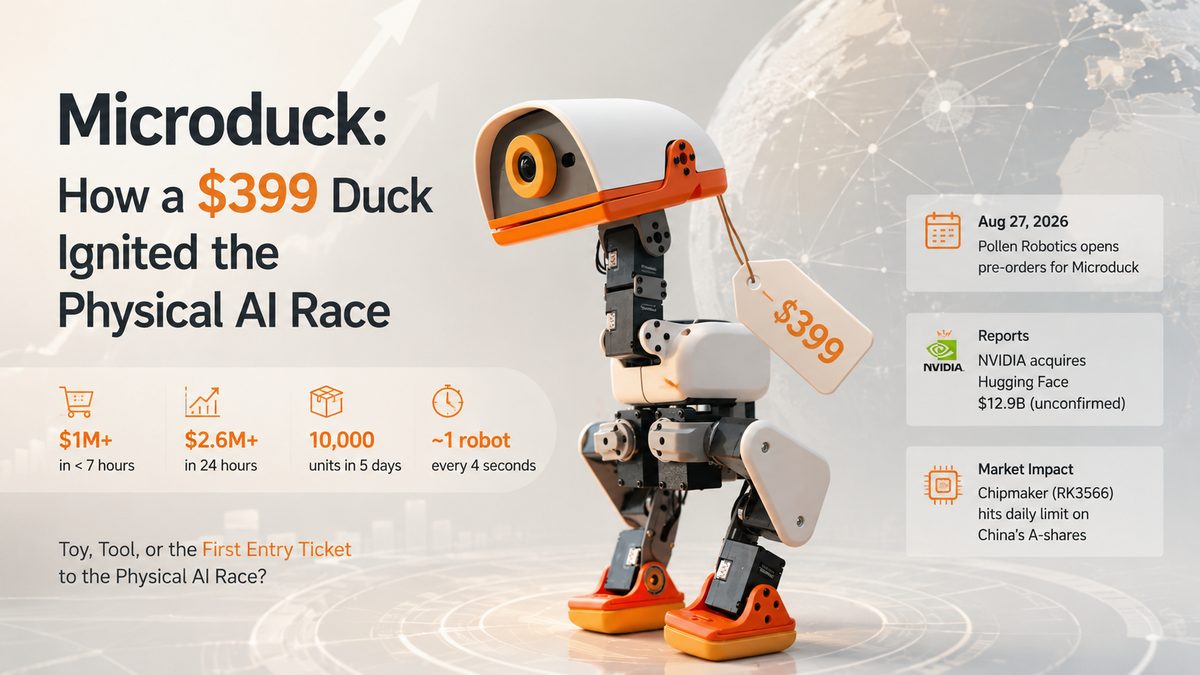
On August 27, 2026, Pollen Robotics, the robotics company Hugging Face acquired in 2025, opened pre-orders for a 25 cm bipedal robot priced at $399.
Pre-orders passed $1 million in less than seven hours, $2.6 million in the first 24 hours, and 10,000 units in five days, a pace of roughly one robot every four seconds.
In the same week, Nvidia was reported to be acquiring Hugging Face for $12.9 billion (unconfirmed by both sides), and on China's A-shares a chipmaker whose RK3566 powers the duck hit its daily price limit.
One duck under 800 grams, cheaper than a mid-range phone, now moves global developers, capital markets and the supply chain at the same time. Is it a toy, a tool, or the first entry ticket to the physical AI race?
Article structure
- 1. Introduction: 48 Hours of a Duck
- 2. Anatomy of a $399 Duck
- 3. The Physics of Falling: Small Is Big
- 4. Bill of Materials: The Global Supply Chain Quotation
- 5. The Chinese Supply Chain in the Mirror
- 6. Three Shocks to the Industry
- 7. Between Toy and Tool: The Duck's Shadow
- 8. Conclusion
1. Introduction: 48 Hours of a Duck
On August 27, 2026, Pollen Robotics, the Bordeaux-based robotics company Hugging Face acquired in April 2025, opened pre-orders for Microduck: a 25 cm biped that the company says weighs "under 800 g" (some outlets report 780 g) and is priced at $399 before tax and shipping, marked as introductory. A plain price; the next 48 hours put the AI community's robotics arm on the industry's front page.
The numbers came in sequence. Hugging Face CEO Clément Delangue's launch post on X drew 4.516 million views that day. Co-founder and Chief Science Officer Thomas Wolf told Bloomberg TV: "We're selling one MicroDuck every four seconds." In a retrospective post he wrote that pre-orders passed $1 million in "less than 7 hours"; the first-24-hour figure was higher: "we've ended at over $2.6M of Microducks ordered in the first 24h." On August 31 Delangue announced more than 10,000 pre-orders in five days, which CNBC estimated at over $4 million of revenue at $399 per unit, a media calculation rather than a company statement. Bloomberg reported the company's own target of 20,000 units.
The same news line carried a second item in the background. The Information reported on August 26 that Nvidia had agreed to buy Hugging Face for $12.9 billion. Neither side has confirmed it; there is no announcement and no regulatory filing. The rumor is not the subject here; it landed in the same week as the duck, and the two read together.
The most revealing reaction was on China's A-shares (shares of companies listed on China's mainland exchanges). On August 31, Rockchip (603893.SH), the fabless chip designer whose RK3566 sits inside Microduck, hit its daily price limit, closing at RMB 194.59 (+10.00%) with a market value of RMB 82.34 billion, about $11.6 billion. CLS, a Chinese financial news service, named MeiG Smart, Fenda, Allwinner, Beken, Espressif and Fibocom as following the move. Nothing had shipped, and the capital market had already priced the "Microduck concept" for the first time.
Which raises the question this article takes on. Why does a $399 duck pull global developers and A-share edge-AI stocks at once, while parts of the industry call it a "hacker toy"? Does it change the price of a product, or the way physical AI is fought?
2. Anatomy of a $399 Duck
2.1 The Spec Sheet, Line by Line
The press kit is unusually restrained: 25 cm tall, 14 cm wide, weight stated only as "under 800 g," 1 GB RAM, 32 GB storage. Official figures plus source-code and third-party verification:
| Item | Spec | Notes |
|---|---|---|
| Size | 25 cm high × 14 cm wide | Official spec |
| Weight | Under 800 g (roughly 737 to 780 g across sources) | Official "under 800 g"; IEEE and store: 780 g; community model: 737 g |
| Actuators | 15 (14 policy-controlled + 1 mouth) | ROBOTIS Dynamixel XL330 series; exact model not confirmed |
| Main compute | Radxa Zero 3W (Rockchip RK3566) | Off-the-shelf module; source code plus community teardowns |
| Memory / storage | 1 GB RAM + 32 GB storage | Official spec |
| Camera | Front wide-angle (Sony IMX219 sensor) | Resolution and FOV marked "Not final yet" |
| Depth sensing | 8×8 ToF matrix (ST VL53L5/L8CX series) | Officially called a "compact LiDAR" |
| IMU | Two marketed, one used by shipped software | In use: LSM6DSV16X; second BMI088 soldered but not enabled |
| Battery | NP-F550 removable camera battery (2,600 mAh, about 1 hour) | Sony L-series standard; mature compatible vendors |
| Wireless | Wi-Fi + Bluetooth (on the Radxa Zero 3W) | Module model not disclosed |
| Control loop | 50 Hz onboard policy loop | Inherited from the Raspberry Pi Zero 2W prototype; not re-verified on the Radxa |
| Price | $399 (before tax and shipping) | Officially marked as introductory |
The same sheet carries "Not final yet" markers for camera resolution and FOV, LiDAR ranging distance, radio version, SDK language and age recommendation. This is a spec still being finalized, not a finished manual.
The most consequential line is the main compute. Media agreed quickly that Microduck uses Rockchip's RK3566; the sharper fact is that the board is off-the-shelf rather than custom. The official open-source code declares device-tree compatible strings "radxa,zero-3w" and "rockchip,rk3566", and the config file states that "/dev/ttyS2 is the Radxa Zero 3W's wiring." Two independent community teardowns, microduck-replica and the X user @tspy, reach the same conclusion. The Radxa Zero 3W is a Raspberry Pi Zero-form-factor board launched in December 2023 from $14.90 (1 GB version), and the 1 GB/32 GB SKU matches the official spec line for line.
One qualification: nothing has shipped, and no physical unit exists. Every component model below is based on the official open-source code plus community cross-verification, not physical disassembly; a wrong device path at runtime means the machine will not boot.
2.2 Fifteen Actuators, and the Fifteenth
The press kit says "15 motors / 15 DOF," while the RL repo says "14 servo joints." Community analysis reconciles them: 15 actuators equal 14 policy-controlled joints plus one mouth servo (ID 34), driven by higher-level logic and outside the policy action space. Shipped policies take 61-dimensional observations and output 14-dimensional actions. The mouth is the switch the duck keeps for its user.
The preset behaviors are officially numbered at 7, though the landing page shows six cards: velocity-tracking gait walking; sit (sit, hold, rise); kicking a ball (one kick, return to walking); pecking pickups (beak to floor, lift, spring upright); roller skating with an optional wheel pack; and fall recovery, getting up from its back. The seventh is unnamed, and the community has three readings: sitting and standing split in two; a controller "roulade" forward roll on the official cheat sheet; and the August 31 Hub release of 9 shipped ONNX policies, a community count that disagrees with the official 7. Confirmed extras: laser-pointer following, NFC triggers and multi-duck chorus.
The software stack is the real product: the Rust runtime (robotd, the 50 Hz loop, plus the robotctl CLI), MuJoCo, mjlab (MuJoCo Warp) with rsl_rl and PPO, ONNX export, Apache-2.0, and both repos open on launch day (5.8k stars SDK, 1.3k RL, snapshotted September 1, 2026). A browser simulation sandbox and cloud training via Hugging Face Jobs close the loop.
2.3 A Duck's Face and the Limits of Open Source
The design is deliberate. The company says the duck shape grew "naturally" from the robot's proportions, beak and waddling gait. It chose not to hide the machinery: "It is still clearly a robot, just one that does not take itself too seriously." On first wake, each unit derives a voice from its SoC serial number, unique for life: the same duck always speaks with the same voice.
"Open source" needs strict limits. The press kit is explicit: the license covers the software stack (Apache-2.0); mechanical and electronic design files are not published, and reporters were asked not to describe the hardware as open. The 3D meshes released, 47 STL files plus the simulation MJCF, carry CC BY-SA-NC. Behaviors can be trained and rewritten freely; the enclosure cannot be copied for commercial production. That boundary is the premise for every judgment that follows.
3. The Physics of Falling: Small Is Big
The industry chased walking for over a decade while avoiding one physical fact: a full-size humanoid falling in a real space is expensive. One crash means hardware repair, safety of the surrounding environment and people, and a halted production line. "Ten thousand trials" is no budget a full-size program can afford in the real world, so demonstrations happen on lab carpets, behind fences and in post-production. The industry is stuck at the demo stage for one reason: falling is the cost, and trial and error is how learning works.
Microduck's answer is to use size to turn falling from an accident into an experiment step. At 25 cm, under 800 grams and $399, a fall on a desk costs about as much as noise. The launch blog states the logic plainly: learning locomotion is "messy," and falls on large robots are expensive and dangerous. Small platforms belong in homes, classrooms and workbenches, because "Self-recovery also means you do not have to pick it up after every failed attempt." Add the fall-recovery policy, a 50 Hz loop, MuJoCo, a PPO stack and ONNX hot-swapping, and the fall, collect, retrain, fall-again loop closes at consumer prices for the first time.
This reorders the physical AI learning path. The mainstream sequence builds a large humanoid first, then teaches it not to fall. Microduck reverses it: build cheap, let it fall, learn one lesson per fall. Wolf supplied the motivation. The cheapest market robots cost several thousand dollars, with tiers from $7,000 to $10,000, $20,000 to $30,000 and up to $50,000; learning legged movement, he argues, should not require a large research platform or a dedicated lab.
The price comparison pins the argument down. Microduck costs $399. Unitree's G1 currently sells at $13,500, down from the $16,000 launch price in May 2024. The 1X NEO runs $20,000 at the official Early Access price. The gap is one to two orders of magnitude, and what it buys is not two or three extra sensors. It buys the removal of trial cost itself. Watching a $13,500 humanoid fall, a developer reaches for the repair bill; watching a $399 duck fall, a developer thinks "again." For an RL practitioner, the second is a sustainable iteration mindset.
4. Bill of Materials: The Global Supply Chain Quotation
4.1 Off-the-Shelf Parts, and the Code as Spec Sheet
Microduck's first layer of magic: almost no custom parts. The core components trace to:
| Component | Finding | Confidence method |
|---|---|---|
| Main compute module | Radxa Zero 3W (Rockchip RK3566, from $14.90 for 1 GB) | Official source device tree + two community reverse-engineering projects |
| Servos ×15 | South Korea's ROBOTIS Dynamixel XL330 series | Official RL repo: "BAM M6 actuator model for the Dynamixel XL330" |
| Camera | Sony IMX219 (same sensor as the Raspberry Pi Camera v2) | Official bringup log: "Model ID 0x0219" |
| Depth sensing | ST VL53L5CX / VL53L8CX (8×8; most units ship with L5CX) | Official sensor driver, auto-detected by version ID at runtime |
| IMU | ST LSM6DSV16X (in use) | Official source code |
| Audio codec | Texas Instruments TLV320AIC3104 | Official device tree |
| Battery | Sony NP-F550 camera battery (L-series standard) | Official press kit; compatible vendors (Pisen, UGREEN, Jupio) |
| Wireless | On the Radxa Zero 3W (Wi-Fi 6 / Bluetooth 5.4) | Radxa official specs; module model not disclosed |
| Structure | Not published (47 STL meshes + simulation MJCF released) | Not published |
| Final assembly | Seeed Studio, Shenzhen | Bloomberg + Seeed Studio's official X post: "official manufacturing partner" |
"Code as spec sheet" is not rhetoric. A Rust runtime that drives real hardware has to hard-code device paths, I2C addresses, register offsets, baud rates and protocols. When the device tree and config files landed in the repo, the hidden parts list surfaced; that byproduct of the fully open software strategy is why this chapter reads as a quotation: the robot is a catalog order.
One caveat: the official BOM and cost breakdown are not published; the cost-structure inference above (off-the-shelf modules, standard parts, Shenzhen manufacturing, volume pricing) is analytical, with no public share breakdown. STAR Market Daily's "memory cost is 10 to 15 percent of the unit" is a media figure, unconfirmed.
4.2 The Replication Paradox
Reverse the arithmetic and the story improves. XL330 units retail in European third-party channels at about €45.76, roughly $54; fifteen come to about €686, roughly $800, double the $399 whole robot. Why does home reverse-engineering cost about twice the official price? Because $399 is volume procurement: bulk servos, five-digit orders, Shenzhen assembly and testing, while retail absorbs warehousing, distribution and single-unit shipping. That gap is the most direct quantified footnote to Shenzhen supply chains and scale economics.
4.3 Two Details in the Engineering Trade-Offs
The first IMU (LSM6DSV16X) is the one shipped software uses. The second (BMI088) is soldered onto the HAT board, with an official device-tree comment calling it "dormant": unused but connected. Marketing says two IMUs; factory software uses one. Both facts coexist: a rare public case of marketing and implementation diverging, and an ordinary example of trimming cost while keeping optionality.
The second detail is the NPU. Armbian on the Radxa Zero 3W ships with the NPU node set to "disabled," requiring a manual overlay to activate, with rknn-toolkit2 pinned in Cargo.toml. The advertised "AI accelerator" is off by default.