AGIBOT: The Underrated No.1 in China's Humanoid Race
Why it matters: the gap between AGIBOT's records and its market price, and what would re-rate it.
By Embodied AI Frontier
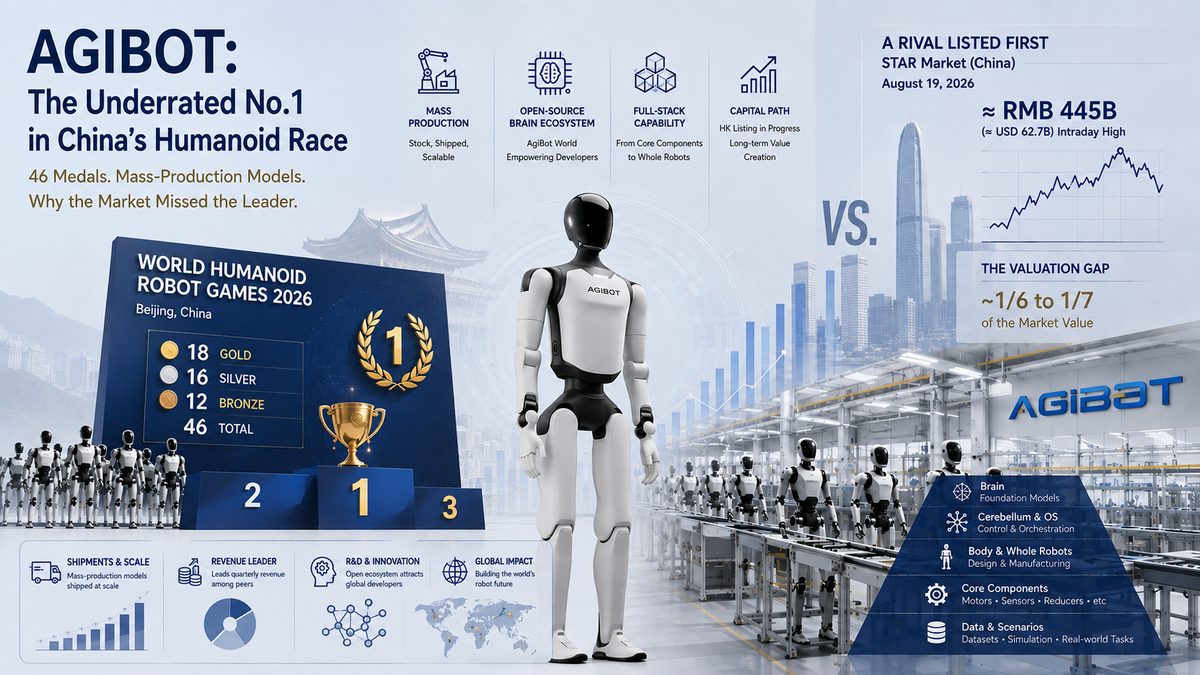
In August 2026, the Second World Humanoid Robot Games closed in Beijing, and the team sitting first on both the gold-medal table and the overall medal table was a first-time entrant: 18 golds, 16 silvers, 12 bronzes, 46 medals in all, all won with stock, mass-production models. A month earlier, the company announced it had started the process of listing in Hong Kong (July 24), with media reporting a target valuation of HK$40 billion to HK$50 billion (about RMB 34.6 billion to 43.3 billion), a range it has never confirmed. And three days before the games opened, a rival with the same shipment tier and a smaller quarterly revenue listed on China's STAR Market, its Nasdaq-style tech board (August 19), its market value touching roughly RMB 445 billion (about $62.7 billion) intraday before the pop faded. Forty-six medals bought no headline. The company that leads the quarterly revenue comparison has not drawn an equivalent market price. This article puts the two mismatches on the same page, walks through AGIBOT's production line, its open-source "brain" ecosystem and its capital path, then makes the case against the company that a careful reader should also make. Why did the biggest medal winner stay out of the spotlight? And why did the side with the stronger scorecard get a price only about one-sixth to one-seventh as high?
Article structure
- 1. A Company That Is No.1 and Out of the Spotlight
- 2. On the Field: The Technical Map Behind 46 Medals
- 3. Production: From RMB 300K to 15,000 Robots
- 4. The Brain: An "Android Moment" in Open Source
- 5. Capital: Between RMB 15B and RMB 240B
- 6. The Other Side: Five Clouds of Doubt
- 7. Conclusion: Will the Market Re-price AGIBOT?
1. A Company That Is No.1 and Out of the Spotlight
The Second World Humanoid Robot Games ran from August 22 to 26, 2026, at the National Speed Skating Oval, the "Ice Ribbon," in Beijing: 16 countries, 666 teams, 2,056 humanoid robots, 51 events and 1,301 matches. When the dust settled, first place on both medal tables belonged to a first-time entrant. AGIBOT took 18 golds, 16 silvers and 12 bronzes for 46 medals. Every machine it fielded was a stock production model, an unmodified off-the-shelf unit: the Elf G2 wheeled dual-arm robot, the Yuanzheng A3 full-size humanoid, the Lingxi X2 mid-size humanoid and the OmniHand dexterous hand. Not one was customized for the event.
The public narrative, however, belonged to two other companies. TianGong Ultra won the large-class 100-meter final in 8.64 seconds, faster than the human men's world record of 9.58 seconds, and took the 400 meters in 38.15 seconds. TianGong Omni won the small-class 400 meters with a now-viral "face-covering" running style. Unitree ran 12.41 seconds in the 100-meter heats, last in its group, a jarring contrast with the double titles it took at the first games, and the letdown came the same week its shares slumped for four straight days after listing. The company with the most medals became a footnote to headlines that said "double first" and moved on.
The same mismatch shows up in the capital market. AGIBOT's latest public private-market valuation is RMB 15 billion (about $2.1 billion), set in March 2025 when Tencent led its Series B round. On July 24, 2026, AGIBOT announced that it had started the process of listing in Hong Kong. Media, citing an unidentified investor, reported a target valuation of HK$40 billion to HK$50 billion (about RMB 34.6 billion to 43.3 billion); the company has confirmed neither the range nor a timetable. Unitree, by contrast, listed on the STAR Market, China's Nasdaq-style board for tech firms, on August 19, 2026 (ticker 688836.SH), with an issue market value of about RMB 61 billion (about $8.6 billion). It closed day one at RMB 845, up 460.34%, worth around RMB 342 billion (about $48 billion), after touching roughly RMB 445 billion (about $62.7 billion) intraday. Around August 25, four losing sessions later, it still stood near RMB 240 billion (about $34 billion).
One clarification first. "Underrated" does not mean cheap. On Guancha's estimate, AGIBOT's reported IPO target would equal a price-to-sales (P/S) ratio of about 32 to 41 times its 2025 revenue of RMB 1.05 billion, above Unitree's roughly 24 times and UBTECH's roughly 22 times. (The P/S ratio compares a company's market value with its annual revenue.) The market has not offered AGIBOT a bargain price.
The mismatch sits one layer deeper. In 2025, AGIBOT shipped 5,168 units, about 39% of the world total, first place on Omdia's basis of "general humanoid robots, including wheeled." In the first half of 2026 it shipped 8,400 to 9,700 units, a 43.1% to 44% share depending on whether the number comes from SAG or Counterpoint, first either way. In Q1 2026 its revenue exceeded RMB 1 billion against Unitree's RMB 423 million. A company whose shipments and revenue match or beat its rival's is carrying roughly one-sixth to one-seventh of that rival's market value.
That is the mismatch this article dissects: brand narrative heat and market pricing run well below AGIBOT's records in mass production, shipments, competition results and ecosystem. Is the market wrong, or are the records padded? The next six chapters check item by item.
2. On the Field: The Technical Map Behind 46 Medals
2.1 A Debut That Topped Both Tables
AGIBOT did not compete in the first games, so these games were its debut. The 46 medals deserve a breakdown. In the eight dexterous-hand events, AGIBOT took seven golds with the stock production version of the Agilink OmniHand, and 14 medals in all (7 golds, 4 silvers, 3 bronzes). In the 12 scenario-track events it took six golds, mostly on the wheeled dual-arm Elf G2, covering scenarios such as fire and emergency response and library shelving. In the athletic track it took five golds, including Lingxi X2's gold in the 100-meter hurdles and Yuanzheng A3's double gold in Tai Chi and ballroom dance.
The reference numbers are just as clear. TianGong took 15 golds, 12 silvers and 18 bronzes for 45 medals, second place, and Unitree was third. What matters most is the equipment: AGIBOT ran stock production models with no race modifications. Results scored by production machines measure the product directly. Results scored by one-off prototypes would say far less.
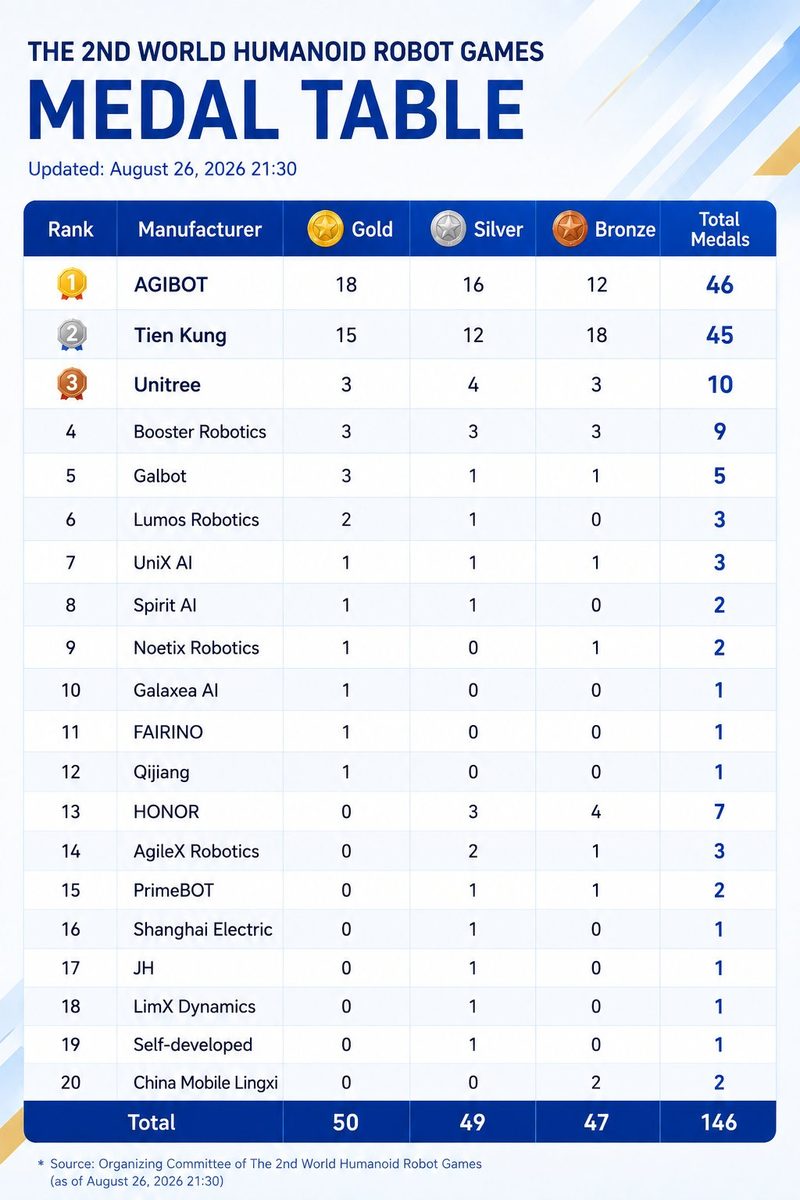
Fig 1 Official medal table of the Second World Humanoid Robot Games (as of August 26, 2026)
2.2 One Brain, Four Bodies
What is worth noticing about the 46 medals is not the count but the way they were produced. One base model, GO-1, appeared on four form factors at the same time. The wheeled dual-arm Elf G2 anchored the scenario track. The mid-size bipedal Lingxi X2 won the 100-meter hurdles. The full-size bipedal Yuanzheng A3 executed high-dynamic whole-body routines in Tai Chi and ballroom dance. The OmniHand dexterous hand won fine-manipulation events such as block building fully autonomously.
That is "one brain, many bodies" shown in open competition: a single model architecture reused across form factors, with the body serving as the brain's vehicle. Four forms winning together means AGIBOT has built manipulation intelligence, locomotion intelligence and interaction intelligence into one system base and then adapted it laterally to different bodies. It also explains how the company positions itself. Deng Taihua, AGIBOT's chairman and CEO, says AGIBOT is an embodied intelligence (AI that learns and acts through a physical body) foundation-model company; AI needs a body, so the company built the bodies to go with it, letting the AI define the body. About three-quarters of its R&D headcount and more than three-quarters of its R&D spending go to the "big brain" and "small brain" AI systems, the reasoning and planning stack and the motor-control layer. The industry contrast is clear: Unitree is the hardware company, with more than 95% of core components developed in-house; AGIBOT is the brain company. Both routes are legitimate, but "one brain, many bodies" is the first time the brain route has been validated at scale on a competition field.
2.3 Why the Biggest Medal Winner Was Not the Headline Story
Put the communications playbooks of the four companies side by side and the mechanism appears. TianGong owns the "limits" story. A machine breaking human records is inherently dramatic, and the face-covering run was a ready-made meme. Galbot owns the "autonomy" story: in the family-service, restaurant and supermarket scenario events, the three longest and hardest of the scenario track, it competed fully autonomously and took gold in every one, a 100% rate, and was called the biggest winner of the scenario events. Unitree owns the "contrast" story: last place in 12.41 seconds plus a share price that halved, tailor-made for clickbait.
AGIBOT owns the "breadth" story: multiple teams (the Shanghai AGIBOT team, the Chengdu AGIBOT team, the Shenzhen AGIBOT team), multiple form factors, multiple scenarios and the most medals. Third-party commentary summed it up as "many teams competing on one shared hardware platform adapted across scenarios, with the most scenario-event medals, while Agilink broke through in fine manipulation with its hand alone." In the language of communications: TianGong has the drama of breaking records, Galbot has the value label of full autonomy, and AGIBOT has 46 medals with no single image a newsroom can replay.
One telling detail deserves mention here. Part of AGIBOT's breadth came from competition strategy: after day one it held only 2 golds, 3 silvers and 2 bronzes, and the late surge did the rest. TianGong's side, meanwhile, published "34 record-breaking performances" and some of its communications claimed first place in total medals, while the public scoreboard shows 45, one fewer than AGIBOT's 46. The detail underlines the point: 46 medals is "most in quantity," while viral moments almost always reward a single extreme.
3. Production: From RMB 300K to 15,000 Robots
3.1 The Revenue Curve
AGIBOT was founded in Shanghai's Lingang area in February 2023, with AGIBOT Innovation (Shanghai) Technology Co., Ltd. as the operating entity. Revenue went from roughly RMB 300,000 in 2023 to more than RMB 60 million in 2024 and past RMB 1.05 billion in 2025, up more than 16 times from 2024; Leaderobot, a Chinese robotics media platform, ranked it as the fastest Chinese robot company to cross RMB 1 billion in annual revenue. In Q1 2026, single-quarter revenue exceeded RMB 1 billion, as quoted by media (the company has disclosed no breakdown), against Unitree's RMB 423 million.