Beyond Human: How Robot Games Are Redefining China's Humanoid Industry
Why it matters: the games are becoming the yardstick for China's humanoid robot industry.
AlphaTypeE Lab
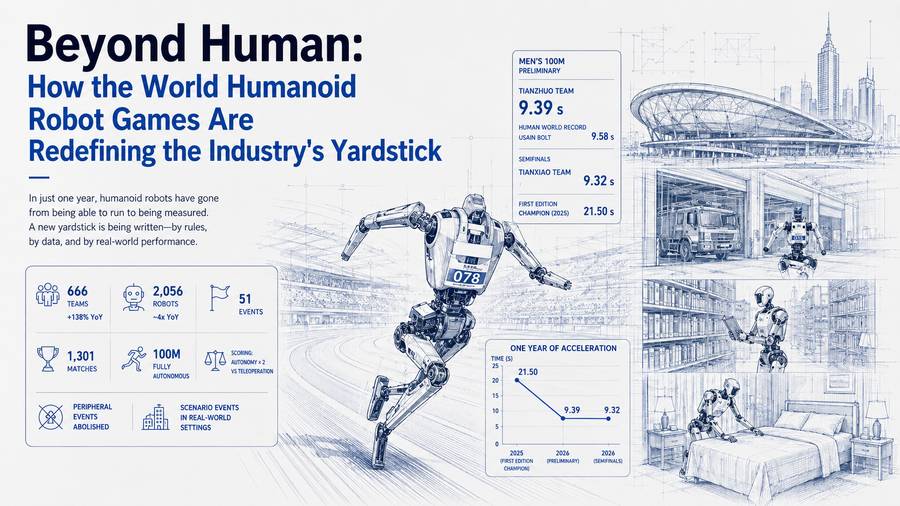
On the evening of August 22, 2026, at Beijing's National Speed Skating Oval, the "Ice Ribbon," a robot from the Tianzhuo team ran the 100-meter preliminary in 9.39 seconds, 0.19 seconds faster than Usain Bolt's human world record. Minutes later, in the semifinals, the Tianxiao team ran 9.32 seconds. One year earlier, on the same track, the first-edition champion needed 21.50 seconds. That is the story that traveled around the world, and it may not be the most important story of these games. Consider everything else that changed: 666 teams, 2,056 robots, 51 events and 1,301 matches, with the number of teams up 138 percent and robots roughly quadrupled in a single year; the 100 meters converted to a fully autonomous event; a scoring system that prices autonomy at twice teleoperation; peripheral events abolished; and scenario events moving out of the arena and into working fire stations, libraries and hotel rooms. In twelve months, humanoid robots have gone from being able to run to being measured. So what, exactly, is this competition measuring? When a scoreboard becomes a shared yardstick across companies and years, who gets to set the yardstick? The answer is written into the rules.
Article structure
- 1. Why Watch: Setting a Yardstick for Progress
- 2. The Full Picture: A Field Recalibrated by Rules
- 3. One Year: From Running to Being Measured
- 4. Beyond Human: Trends and Cold Realities
1. Why Watch: Setting a Yardstick for Progress
1.1 “9.39 Seconds”: The Most Viral News, Maybe Not the Most Important One
The scene is easy to picture. On the evening of August 22, on the 100-meter track of the "Ice Ribbon," the robot belonging to the Tianzhuo team crossed the line, and the clock froze at 9.39 seconds. In the semifinals that followed, the Tianxiao team ran 9.32 seconds. Usain Bolt's human world record is 9.58 seconds. Within two days, news organizations around the world lined up to verify the same fact: a humanoid robot had beaten the human 100-meter record in open competition, for the first time. It is the most viral story of these games, and it deserves to be.
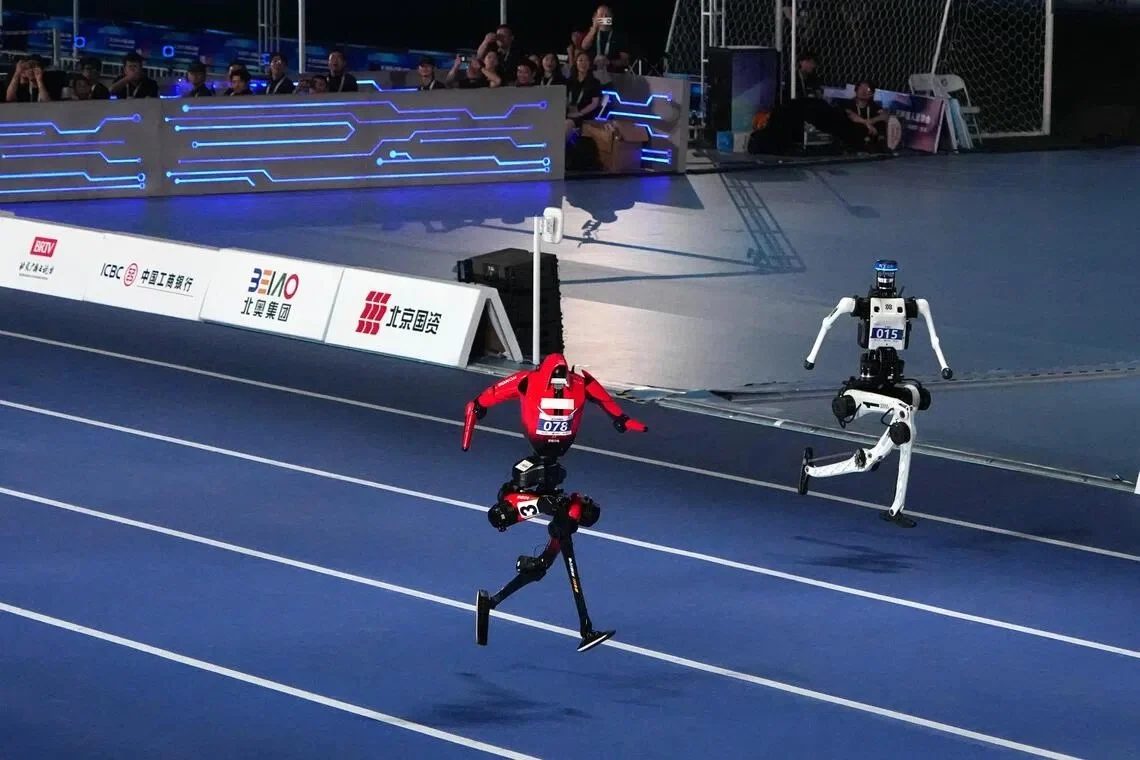
Fig 1 Two humanoid robots sprint side by side in the 100-meter event at the second World Humanoid Robot Games
This article will argue that it may also be the least important story.
That is not a dismissal of 9.39 seconds. A year ago, at this same venue, the inaugural 100-meter champion ran 21.50 seconds. Before that, the question of whether a humanoid robot could finish 100 meters at all was itself the news. Going from 21.50 to 9.39 seconds means that joint motors, reducers, servo control, data collection and capital all closed in on the same problem within twelve months. That result commands respect.
The problem is that results are only outcomes; rules are the method. What an industry should chew on is not the time on a scoreboard on any given day, but the clauses written into the rulebook: which events got created, which behaviors earn bonus points, which capability gets pulled out and tested in isolation. These clauses never defined who wins one match. They define what kind of progress counts as progress. The most consequential changes of this second edition were all on the rules side, and that is where the industry should be reading.
1.2 Two Languages: The Showroom and the Scoreboard
Over the past year, humanoid robot launch events came one after another. Specifications doubled on presentation slides. Demo videos swept social media feeds. Every parameter update carried its own promotional energy. This is showroom language. Its grammar is "I can." Its subject is the vendor. Its footnotes are written by the video editor.
The games speak a different language. Same track, same rules, same field of rivals, robots starting one after another, and results produced by instruments rather than edits. Liu Xingliang, a research fellow at the Digital China Research Institute of the University of Chinese Academy of Social Sciences, drew the boundary between the two with one sentence: the showroom tests whether a robot can do something, and the competition field tests whether it can actually deliver. Understood a step further, that sentence separates two kinds of tests: the showroom is an existence test, and the arena is a repeatability test.
Out of that separation comes an object that did not exist before: a measurement series that spans years. August 2025: 21.50 seconds in the 100 meters. August 2026: 9.39 seconds in the preliminary, 9.32 in the semifinal. Two years, a handful of numbers, one venue, one event specification. It constitutes the first reproducible, comparable, year-over-year 100-meter measurement series in the history of humanoid robotics. Reproducible numbers are the industry's real language, because research budgets and capital pricing both need a single yardstick to measure against. Think about what a venture investor is actually buying: a claim about future capability, priced today. Without a comparable series, that claim can only be judged on the vendor's own slides. With one, it can be judged against a baseline that every company's machine has faced, in the same event, under the same rules. That is why a measurement series, however sparse, is worth more to outsiders than any single demonstration.
1.3 Rules as a Price List: Competition Rules Are Pricing the Industry
Three changes in this edition's rulebook deserve to be remembered.
First, the 100 meters became a fully autonomous event. Autonomy moved from a bonus item to an entry ticket. Second, the scoring rules set the weight of fully autonomous operation at 1.0 and teleoperation at 0.5, a factor of two apart, with organizers explaining that they hope robots become truly autonomous. Third, the peripheral events were abolished, and the competition categories contracted from four to two: competitive events and scenario events.
Read together, those three clauses form a complete industry specification sheet. When organizers price autonomy at twice teleoperation, that is not a technical preference. It is a quantified statement: autonomy is the future, and teleoperation is the transition. When the 100 meters no longer permits teleoperation at all, that is not a threshold being set. It is an announcement to every vendor that the next competitive cycle starts from autonomy.
Note also what the rules did not do. Teleoperation was not banned everywhere: it remains legal in scoring events, at half weight. That is the sharper move. Banning a practice removes it from view; pricing it at 0.5 keeps it in the data while declaring it worth half as much. An industry that is still years from reliable autonomy gets a measured path instead of a cliff, and the measurement itself tells companies where value is moving.
Competition rules, therefore, are no longer just competition rules. They are a standard document, a price list, and a public version of the industry's roadmap. Sport has always been a metaphor for industry. In these games, the rules themselves have become part of industrial policy.
1.4 Robot Home, and the Bases That Turn "Compete to Build" Into Concrete
If rules are the language, infrastructure is the grammar book.
For this edition, the organizers built an athletes' village for machines: Robot Home. One code per robot, one code per battery, check-in and retrieval in 30 seconds, and 200 charging cabinets that can power at least 1,200 batteries at the same time, with the logistics run on JD Logistics' digital systems. When the robot population climbs from over 500 machines to 2,056, digitizing replenishment, dispatch and management is itself a course the industry has to take.
The bigger changes sit outside the arena. The Beijing humanoid robot training base, inaugurated during the first edition, has now operated for a year, and Booster Robotics (加速进化), Linkerbot and AGIBOT have moved in one after another. Alongside it sits the global humanoid robot industry ecosystem training and evaluation base, jointly built by CCID (the China Center for Information Industry Development), Chaoyang District and Beijing Beiao Group. Its first phase opened in May in Hall 5 west of the Ice Ribbon and the "Panda's Eye" pavilion, serving competing teams by appointment before the games and opening to the whole industry afterward.
"Compete to build" (以赛促产, Beijing's policy of using competitions to drive industry) used to be a slogan. It is now architecture. The games have been converted from a once-every-few-years festival into an industrial facility that runs 365 days a year. In support, Beijing issued the Action Plan for Embodied Intelligence Technology Innovation and Industry Cultivation (2025 to 2027), targeting breakthroughs in no fewer than 100 key technologies by 2027, and the X-Humanoid center's database now collects over 500 hours of demonstration data from robots per day. Capital and policy have both broken ground on the same blueprint. In plain terms: in Beijing, embodied intelligence, the branch of AI that learns and acts through a physical body, has been given a city-scale testbed.
1.5 Why Beijing
Beijing has connected two things: building robots, and measuring robots.
The Tiangong family is one of the biggest winners of this edition. The 9.39-second preliminary belongs to the Tianzhuo team in a Tiangong Ultra. The 400-meter large-class champion ran 38.15 seconds, and the 1500-meter champion ran 2:21. The records all carry the Tiangong name. Behind that name stands the country's first national-local co-built embodied AI innovation center (an institution jointly funded by national and Beijing municipal authorities), founded in November 2023 and branded X-Humanoid, also known as the Beijing Humanoid Robot Innovation Center. In February 2026 it completed its first market funding round of more than RMB 700 million (about $100 million).
One level up is the industrial belt. Data from the Beijing Municipal Bureau of Economy and Information Technology: embodied intelligence funding in Beijing reached RMB 19.24 billion (about $2.7 billion) in 2025, 41 percent of the national total. E-Town, Beijing's economic-technological development area and a national-level industrial zone, has gathered more than 300 robot-related companies. Put the events, the bases, the capital and the companies on a single map, and the reason the measurement happened in Beijing becomes visible: density has to be built before being measured has any meaning. Before a yardstick can be erected, there has to be a city.
2. The Full Picture: A Field Recalibrated by Rules
2.1 Scale and Composition: Almost Every Number Doubled in a Year
The basics first. This edition ran from August 22 to 26 at the National Speed Skating Oval, the "Ice Ribbon," with the program extended from three days and six competition sessions to five days and nine sessions. The field: 16 countries, 666 teams and 2,056 robots. Compared with the first edition, the number of teams grew 138 percent, the number of robots roughly quadrupled, events rose from 26 to 51, and matches went from 487 to 1,301, up 167 percent. The games ran into the same week as the World Robot Conference in Beijing's E-Town district, the city's other flagship robotics event, so the city's robot calendar was effectively full.
The composition deserves a look too. From China: 157 companies plus 200 universities and research institutions fielded 641 teams and 1,975 robots, including 27 of the country's elite universities (the 985 project designates China's top institutions), while the country's leading humanoid firms, including Unitree, UBTECH, Xiaomi and Fourier Intelligence, all took part. From abroad: 25 teams, with the traditional robotics powers, the United States, Germany and Japan, all present, and Brazil assembling a national squad from five teams that had won robot soccer World Cup titles. The organizer lineup also expanded, from the Beijing municipal government and China Media Group (CMG) alone, to a four-party cast adding the World Robot Cooperation Organization and the Asia-Pacific Robot Cup International Council. Even ticketing went public: RMB 98 (about $14) for competition days and RMB 128 (about $18) for the opening and closing ceremonies.
A doubled field is not news by itself. When event grade, participant base and organizing structure all upgrade at the same time, the signal is clear: this measuring instrument is being recalibrated for a larger scale.
2.2 A Change in Kind: From Performance to Assessment
The 51 events of this edition split into two blocks: 30 competitive events and 21 scenario events.
The competitive block covers 11 disciplines: athletics, soccer, gymnastics, weightlifting, table tennis, martial arts, street dance, sports dance, free combat, tug-of-war and pitch-pot (an ancient Chinese game of tossing arrows into a pot). Compared with the first edition, the organizers added head-to-head events such as table tennis and free combat, promoted martial arts and cheerleading from performance categories into the official competitive sequence, and abolished the peripheral events entirely, collapsing four categories into two. Rules were sharpened in detail as well: the 100-meter and 400-meter hurdle races now run two robots on two lanes at once, and martial arts and dance events require uniform costumes.