The Silent Supermarket: A German AI Fellow at WRC 2026, Full Transcript
Why it matters: one of Europe's most decorated robotics scholars gives the soberest assessment yet of the home-robot timeline, with the full keynote transcript attached.
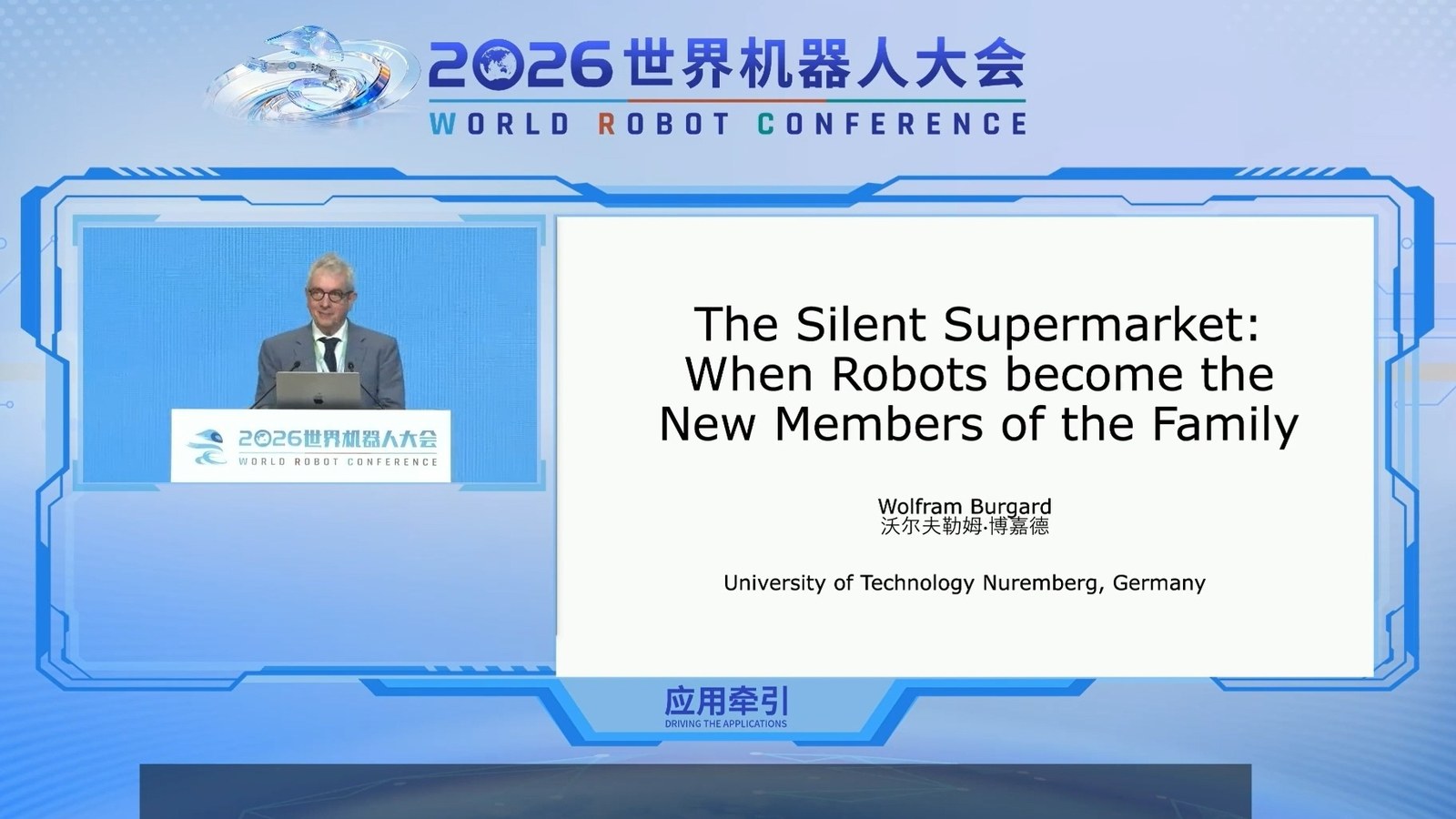
Embodied AI Frontier | August 2026
At this year's World Robot Conference, Wolfram Burgard, a member of the German National Academy of Science and Engineering (acatech), used a roughly twenty-minute talk to answer one question: what would give robots the right to enter our homes. His answer differs from the typical industry roadshow pitch. It is not about faster hardware iteration, but about world models, the sense of touch, and a data ecosystem that spans companies. Three demonstrations from the talk are worth remembering: a robotic arm that refuses to grasp a dirty cup, a vacuum cleaner that learns to avoid jewelry, and a supermarket robot that packs groceries the human way, zero shot. While industry posts optimistic timelines for home robots, this scholar's verdict is that it will take several more years. The same question, two answers so far apart. Is this industry hype, or a genuine divergence in judgment?
Article structure
- 1. From the Factory Floor to the Living Room: A Talk About the Hardest Task
- 2. World Models: A Robot Needs to Know What a Clean Kitchen Means
- 3. Touch: The Underrated Fourth Modality
- 4. From Vacuuming to Bin Packing: Learning Loops on Edge Devices
- 5. The Internet of Robots: The Next Battle Over Data
- 6. Our Take: Three Signals
1. From the Factory Floor to the Living Room: A Talk About the Hardest Task
1.1 Why Burgard's Talk Matters
The 11th World Robot Conference brought more than 300 exhibitors and over 2,000 exhibits to Beijing. Among the main-forum speakers, Wolfram Burgard's credentials carry unusual weight. He is a member of the German National Academy of Science and Engineering (acatech), the founding chair of the Department of Computer Science and AI at the University of Technology Nuremberg (UTN), and a professor of robotics and AI there. He is an IEEE Fellow and an AAAI Fellow, and a co-author, with Sebastian Thrun and Dieter Fox, of *Probabilistic Robotics*, one of the field's classic texts. He received the 2022 IEEE Robotics and Automation Award and served as president of the IEEE Robotics and Automation Society (RAS) in 2019.
This was Burgard's fifth time at the World Robot Conference. According to a China News Network report, he said that every year he witnesses a huge leap in robot technology at the event. The arc of his keynotes shows the same research thread. In 2024, he spoke at the main forum on robot foundation models. In 2025, his topic was "From Museum Tours to Urban Mobility: The Autonomous Evolution of Mobile Robots." In 2026, he returned with "The Silent Supermarket: When Robots Become New Family Members." Foundation models, autonomous mobility, entering the home: the three threads run through all three talks. This year's lecture is not a standalone statement. It extends a single, continuous research line.
1.2 The Silent Supermarket
The title's implied meaning is worth unpacking. The talk's official Chinese title renders supermarket as 超级市场 (chaoji shichang), a phrase that literally means "super big market." That is exactly the point. Home robots are the largest potential market in the robotics industry, and that market has stayed silent: no mature product has truly broken the silence. Burgard himself said at the opening of his talk that the title points to the challenge of getting robots into our everyday lives. His closing judgment follows the same thread: real success for home robots is still several years away. A market this large, with so few voices in it, is the premise for understanding the whole lecture.
The main line runs from there. The industry's path goes from the factory floor to the home, and Burgard names the vehicles: humanoid robot platforms, advanced dexterous hands with additional perception capabilities, and the often-underestimated computing infrastructure.
2. World Models: A Robot Needs to Know What a Clean Kitchen Means
2.1 Why Home Is the Hardest Setting
"Tidy up the kitchen" is the first concrete example in Burgard's talk, and he chose it because it best shows why the home is hard. The instruction can be simple, he said, or enormously complex. A robot must understand every object in the kitchen, and it must also know what "a clean kitchen" actually means. In industry, task definitions are closed: workpieces, workstations, and process parameters are all known in advance. The home is an open world. Object types are unlimited, arrangements are arbitrary, and task boundaries are fuzzy. That is his first argument for why household tasks are harder than industrial ones.
2.2 From Internet Models to Multimodal World Models
ChatGPT-style systems trained on internet-scale data mostly rely on vision, language, and text, Burgard noted in his talk. The internet provides enough data for such systems. Robots need more. They need tactile sensation, the sense of touch, and reasoning about forces: how much force to apply to manipulate the world properly. He defined the world model in one sentence: a model that lets a robot understand the world and predict what will happen based on its actions. One consequence follows. The input modality list of a robot model is naturally longer than that of a language model.
2.3 Chained Tasks and Overnight Retraining
Even a simple instruction like "open the drawer" is not simple, Burgard argued. The robot must understand what a drawer is, where the handle is, and how the handle is used to open it. His team's approach: train individual actions separately, label them in natural language, then use a foundation model to generate the code that chains these actions together. In the demo task "tidy up and turn on the green light," the robot grasped cubes, opened a drawer, placed the cubes inside, closed the drawer, and pressed the green button in sequence.
Burgard also raised a more fundamental engineering question. The industry currently produces a new model every couple of months, he said, while home robots need to learn quickly from everyday operation. The ideal cadence would be overnight retraining. Given the energy consumption and size of today's models, that goal remains unresolved.