From Exhibits to Products: Unitree's CEO at WRC 2026, Full Transcript
Why it matters: the 80% x 80% threshold is the first quantifiable acceptance criterion for the embodied AI moment, proposed by the founder of China's first humanoid robot stock, with a full transcript of the keynote included.
Embodied AI Frontier | August 2026
On August 20, the morning after Unitree Robotics' stock market debut, founder Wang Xingxing took the main stage of the 2026 World Robot Conference. A day earlier, the company had listed on China's STAR Market, the NASDAQ-style board for tech firms, at RMB 150.80 per share and soared 629% on day one. In his speech, Wang was working on a different timescale: a BeiDou-synchronized swarm of 49 G1 robots at the Temple of Heaven, a preview robot with a top speed of about 12.6 m/s, and a threshold waiting to be tested: 80% × 80%. Take a robot into 80% of unfamiliar scenes, and it completes 80% of tasks, in as little as 2-3 years or as long as 5-10. This deep dive unpacks the technical judgments and industrial implications of that roughly 20-minute keynote section by section, and closes with our own independent take. When exhibits begin to answer for valuations, where will the humanoid robot industry's next decade crack first?
Article structure
- 1. The Day After the IPO: A Speech That Set the Tone
- 2. A Decade of Exhibits: From G1 to the Manned Mech
- 3. Data and Technical Routes
- 4. The 80% Threshold: A Quantifiable Definition of the Embodied AI Moment
- 5. Centimeter-Level Error: Why Input-Output Alignment Is the Biggest Bottleneck
- 6. Physical AI Self-Evolution: Letting Robots Write Their Own Code
- 7. Our Take: Three Signals
1. The Day After the IPO: A Speech That Set the Tone
August 19, 2026, two things happened on the same day. The 2026 World Robot Conference (WRC 2026), the event's 11th edition, opened at the Beiren Etrong International Exhibition & Convention Center in Yizhuang, Beijing's E-Town, under the theme "Human-Machine Symbiosis, Industry-Demand Integration," with more than 300 exhibitors, over 2,000 exhibits, and 150-plus debut products. On the same day, Unitree Robotics (688836.SH) listed on the STAR Market. The offer price was RMB 150.80 per share (~$21), pricing the company at RMB 60.99 billion (~$8.6B). The stock opened at RMB 1,100 (~$155) on its first day, up 629% from the offer price, and its intraday market value briefly broke through RMB 440 billion (~$62B). Media dubbed it "the first humanoid robot stock" on China's A-share market (mainland-listed shares). Caixin reported that the offering corresponded to a price-to-earnings ratio of roughly 219 times 2025 earnings, adjusted for non-recurring items on a diluted basis. BBC Chinese reported that Unitree's 2025 net profit came to about RMB 278 million (~$39M), making it one of the few profitable companies in the humanoid robot sector, and that the company shipped more than 5,500 humanoid units that year. The tension between valuation and profitability became the capital market's most direct question: what supports a market value on the order of RMB 60 billion?
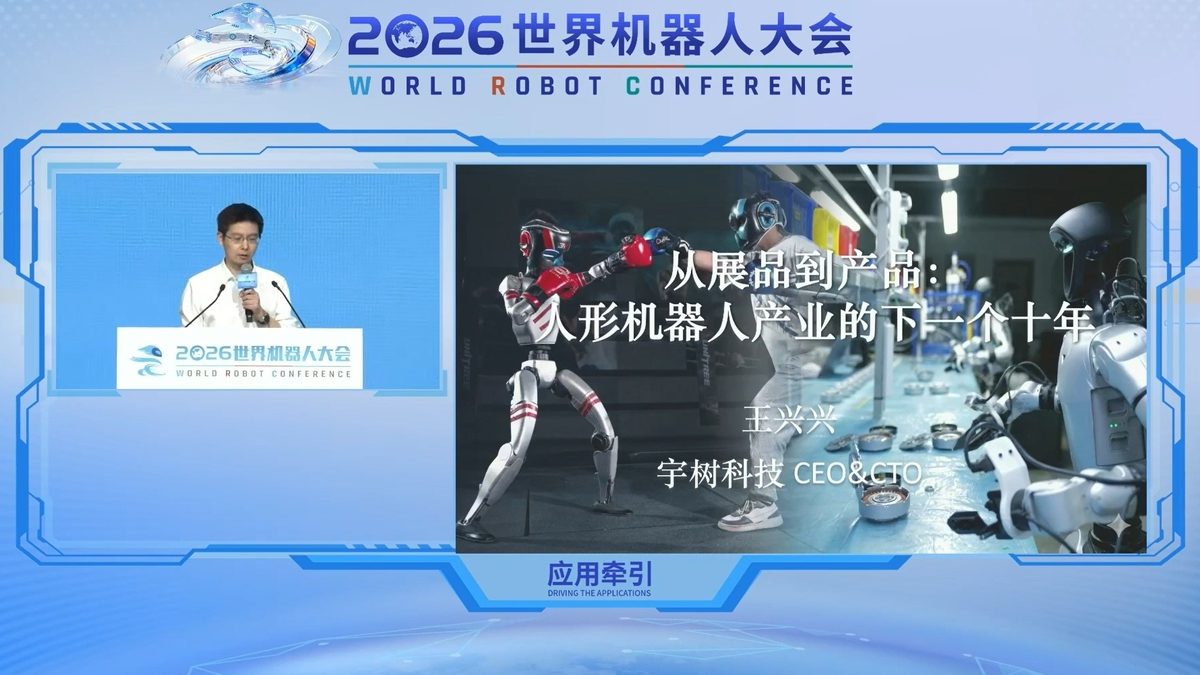
The next morning, Wang Xingxing stepped onto the main forum stage and delivered the keynote "From Exhibits to Products: The Next Decade of the Humanoid Robot Industry," a talk of 20 minutes and 49 seconds. It was Unitree's first public speech after listing. The title was itself a response. The market asked: what justifies the RMB 60 billion valuation? Wang's answer: watch the next decade.
The narrative order of the speech was itself an argument. Wang first traced how a decade of product lines marched step by step toward the market, then laid out his views on data and technical routes, then offered a quantifiable definition of the embodied AI moment and his attribution of the bottleneck, and finally introduced a new direction in physical AI self-evolution. The sections below unpack it paragraph by paragraph.
2. A Decade of Exhibits: From G1 to the Manned Mech
2.1 From Quadrupeds to Humanoids: G1 and H1
Unitree was founded in August 2016 and started with quadruped robots. In August 2023, it released the H1, its first full-size general-purpose humanoid robot. On May 13, 2024, it launched the G1 humanoid robot at a starting price of RMB 99,000 (~$14K). Wang Xingxing said in his speech that the G1 has basically become a global benchmark product since its launch, and that most similar robots in use worldwide today are either derived from it or look very similar to it. On April 11, 2026, Unitree announced that a modified H1 recorded a peak speed of 10 m/s in a 100-meter test, setting a new record for humanoid running speed. For reference, Usain Bolt's average speed over his 100-meter world record run was about 10.44 m/s. The two figures now sit on the same order of magnitude.
2.2 Performance and Swarms: From the Gala to the Temple of Heaven
At the 2026 CCTV Spring Festival Gala, China's Lunar New Year TV gala, Unitree used G1 and H2 humanoid robots in the "Wu BOT" segment, a martial-arts routine that the speaker referred to as "wubo," or martial-arts combat. Twenty-four units performed under fully automatic swarm control, marking the world's first fully autonomous humanoid robot swarm performance, with motions trained by AI from dozens of classic Chinese kung fu moves. Wang Xingxing said in his speech that the segment attracted on the order of tens of billions of overseas views. That figure cannot be independently verified, and it is cited here as the speaker's own claim. On February 23, 2026, 49 G1 robots performed in front of the Hall of Prayer for Good Harvests at the Temple of Heaven in Beijing, synchronized through the BeiDou satellite navigation system, achieving micron-level motion precision and millisecond-level response.
2.3 Mainstream Products: The Manned Mech, S2W, and Go2
On May 12, 2026, Unitree released the GD01 manned transformable mech, priced from RMB 3.9 million (~$550K), which the company calls the world's first mass-production-grade manned mech. Wang Xingxing said in his speech that the mech stands about 3 meters tall and weighs about 500 kilograms with a pilot aboard. It can transform into a four-legged mode with better stability and obstacle-crossing ability, putting it in the same role as an off-road vehicle: outdoor trekking and transport in complex environments. Precisely because stability is better in four-legged mode, he said, Unitree decided to open genuine pre-sales.
The same speech mentioned two quadruped-line products. Of the new-generation wheeled-legged robot S2W, Wang said it weighs about 20 kilograms, offers strong payload and endurance, is largely rain-resistant, and works both indoors and outdoors. He added that Unitree has ported part of its humanoid technology back onto the quadruped platform. Of the Go2, which received a flexibility upgrade, he said the robot offers strong value for money and is already available for pre-order or retail at JD.com and Taobao, China's two leading e-commerce platforms. Neither the S2W nor the Go2 upgrade has public reporting support yet, so those parameters are treated as the speaker's own statements.
2.4 A Frontier Preview: "Superman"
On August 17, 2026, Unitree previewed the "Superman" humanoid robot: legs of 0.85 meters, a standing jump of 2 meters, and a top running speed of about 12.6 m/s (the official release states 12.66 m/s, while Wang said 12.65 m/s in his speech). Both metrics exceed public human records. Wang Xingxing said in his speech that the product took only about three months to develop and remains a preview, not an official release.
2.5 A Product Line with Clear Sequencing
String the product line together and a clear sense of order emerges. The swarm performances at the Gala and the Temple of Heaven solved the problem of being seen by the world. The GD01 and the Go2 solved the problem of keeping cash flowing. The S2W and "Superman" are tasked with pushing the technical frontier outward. When it comes to factory and home scenarios, Wang's stance was cautious. He said in his speech that Unitree has deployed robots on production lines with an automobile factory since 2024 and has been running tests at its own factory, but has not scaled up, because "efficiency and generalization are not yet good enough" and every new task requires retraining. Show and consumer scenarios go first; industrial and home scenarios are deferred. The path from exhibits to products is not rolled out evenly, but in layers.
3. Data and Technical Routes
This section answers the question: what do you feed the AI? Wang Xingxing gave a clear ranking in his speech. The real training data for AI robots consists mainly of large volumes of human data and internet data as the primary pretraining data, with real-robot data as an essential but much smaller supplement. By volume, human data is more plentiful and more important. On collection, Unitree gathers data itself and works with third parties in parallel, using the data internally and opening it to the industry. The industrial implication of this ranking: the data supply for embodied intelligence will, in the near term, keep betting on real human behavior rather than on synthetic simulation data or pure real-robot collection.
On model routes, Wang named the two mainstream approaches, VLA models and world models, and said world models are the direction the industry has discussed most this year. He disclosed that AI models are the company's largest area of capital and talent investment. Unitree began working on video-generation-based world models in early 2020, shelved the effort at the end of 2020 because results were unsatisfactory, and restarted and scaled it up in 2025.
Put the data view and the model route side by side, and Unitree's overall strategy becomes visible: on data, bet on real-world collection; on models, run VLA and world models in parallel; and rank AI investment above hardware iteration. That mirrors the exhibit-side strategy of building cash-generating products first. Cash flow funds AI investment, and AI investment sets the next product frontier.
4. The 80% Threshold: A Quantifiable Definition of the Embodied AI Moment
Over the past two years, "the ChatGPT moment of embodied intelligence" has been the industry's most quoted slogan, but nobody had defined an acceptance criterion. Wang Xingxing offered one in his speech. Take a robot into any unfamiliar environment, and through voice or text commands it completes about 80% of tasks. That is the true moment of embodied intelligence, he said, arriving in as little as 2-3 years or within 5-10 years at the latest.
The first value of this definition is that it is testable. It turns "generalization" from an adjective into two measurable numbers: scene coverage, 80% of unfamiliar scenes, and task completion, 80% of tasks. Wang also described the current baseline: with enough collection and training in a fixed scene, success rates can approach 100%; once objects or environments change, success rates collapse sharply. The 80% × 80% bar is a quantifiable anchor for that decline curve.
The second value is the time constraint. The span between 2-3 years and 5-10 years is, at bottom, the industry's disagreement about the nature of the bottleneck. If the bottleneck is an engineering problem, in data scale, compute, or closed-loop efficiency, 2-3 years is reachable. If it is a problem of principle, in physical-world modeling or generalization mechanisms, 5-10 years is more realistic. Setting the threshold at "task completion rate" rather than "full reliability" is itself a realistic calibration. It concedes that robots will make mistakes and only requires that most tasks be completable.