Roundup: Gold-Winning Robots at the Second World Humanoid Robot Games
Why it matters: a roundup of the gold-winning robots and the technology behind them.
By Embodied AI Frontier
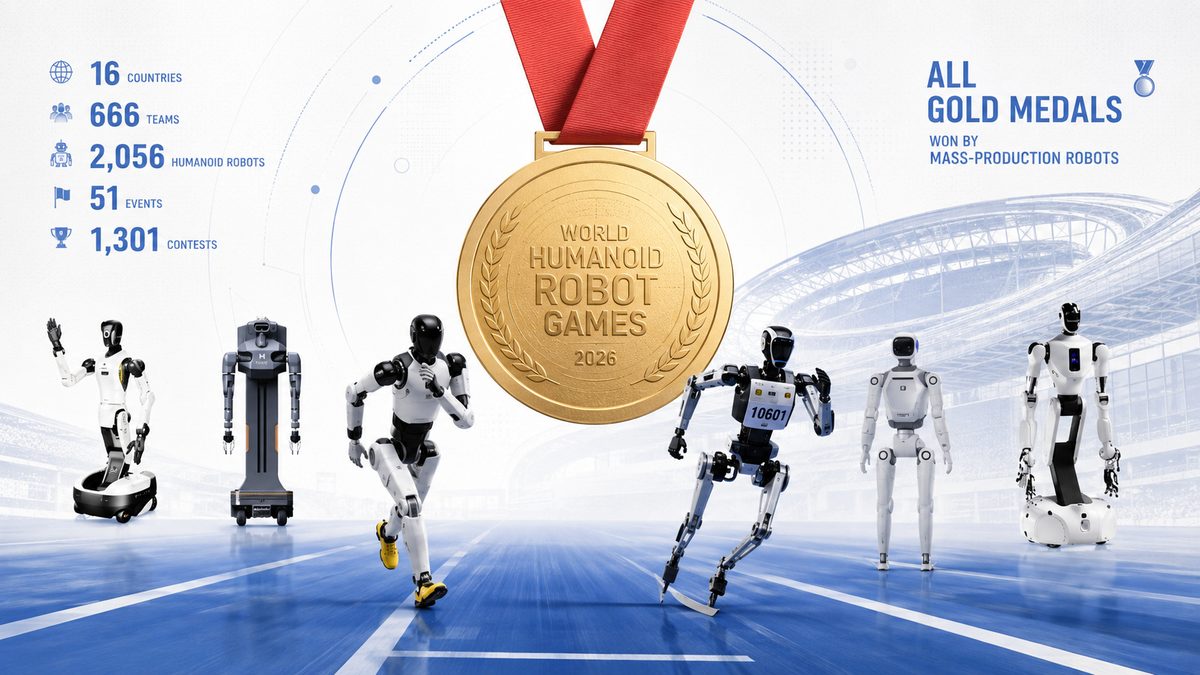
From August 22 to 26, 2026, the second World Humanoid Robot Games were held at the National Speed Skating Oval ("Ice Ribbon") in Beijing. Sixteen countries fielded 666 teams and 2,056 humanoid robots across 51 events and 1,301 contests. Many treat the Games as a who-runs-fastest spectacle, but the detail worth revisiting is different: every gold medal went to a mass-produced model, with not a single machine custom-built for the competition. When production-line robots pass both the arena test and the market test at the same time, the medal table becomes, in effect, a health check for the industry's technical maturity. This article reviews the core technology behind this edition's main gold-medal machines across three tracks, and returns to a single question: why did production robots sweep the golds, and what does that say about embodied intelligence?
Article structure
- 1. Why the Golds Matter: A Collective Test of Mass Production
- 2. The Athletic Track: Pushing the Limits of Human Records
- 3. The Scenario Track: Sending Robots to Work
- 4. Dexterous Hands: The Underrated Last Centimeter
- 5. Industry Coordinates Behind the Medal Table
1. Why the Golds Matter: A Collective Test of Mass Production
1.1 The Signal Behind the Numbers
Start with the basics. The Games ran from August 22 to 26 at Beijing's National Speed Skating Oval. Five days of competition drew 666 teams and 2,056 humanoid robots from 16 countries across five continents. The 51 standard events split into an athletic track and a scenario track, with 1,301 official contests. Against the first edition, teams grew 138 percent, the robot count quadrupled, events rose from 26 to 51, and contests from 487 to 1,301.
A doubled scale is not news in itself. The more telling signal is a tightening of the rules: most events sharply cut or banned teleoperation outright, requiring robots to complete tasks purely through their own perception, decision-making and execution. Full autonomy became a condition of entry, not a scoring bonus.
1.2 Why Gold-Medal Machines Are Worth a Closer Look
What distinguishes the Games from a trade fair or product launch is that they produce a quantified, comparable, repeatable scorecard. A booth tests whether a robot can do something; the arena tests whether it can do it reliably. When that scorecard lands under the label "mass-produced model," its meaning shifts from a single product's spec sheet to a public yardstick for the whole industry's technical maturity.
The most consequential fact of the Games is this: every gold-medal robot was a production model from a mainstream maker, and not one was custom-modified for the event. That concentration is the signal. A production model's advantage lies in facing both the arena test and the market test at once. It must post a result on the track while also completing long, multi-step workflows in factories, hotels and restaurants. Only a production model that clears both tests carries reference value for real deployment.
2. The Athletic Track: Pushing the Limits of Human Records
The athletic track tests explosive locomotion, dynamic balance, whole-body coordination and the fidelity of high-difficulty movement replication, covering classic disciplines from track and field, gymnastics, martial arts and dance to strength contests. The gold machines here sit at the frontier of fully autonomous locomotion, joint torque density and autonomous navigation.
2.1 Tiangong Ultra: Writing Human Records Into Robot History
Tiangong Ultra is the flagship full-size humanoid from the Beijing Humanoid Robot Innovation Center, and the biggest winner of the athletic track's large-class events.
In the large-class 100-meter final it won in 8.64 seconds, nearly a second inside Usain Bolt's human world record; in the large-class 400 meters it ran 38.15 seconds; in the 1,500 meters it finished in 2 minutes 21.63 seconds; in the standing long jump it leapt 4.83 meters, more than a meter beyond the human standing-long-jump record; and in the long jump it cleared 7.97 meters, about a meter short of the human long-jump record of 8.95 meters but well past the women's record. Several events not only broke the first edition's marks but, in some cases, exceeded the physical limits of human athletes.
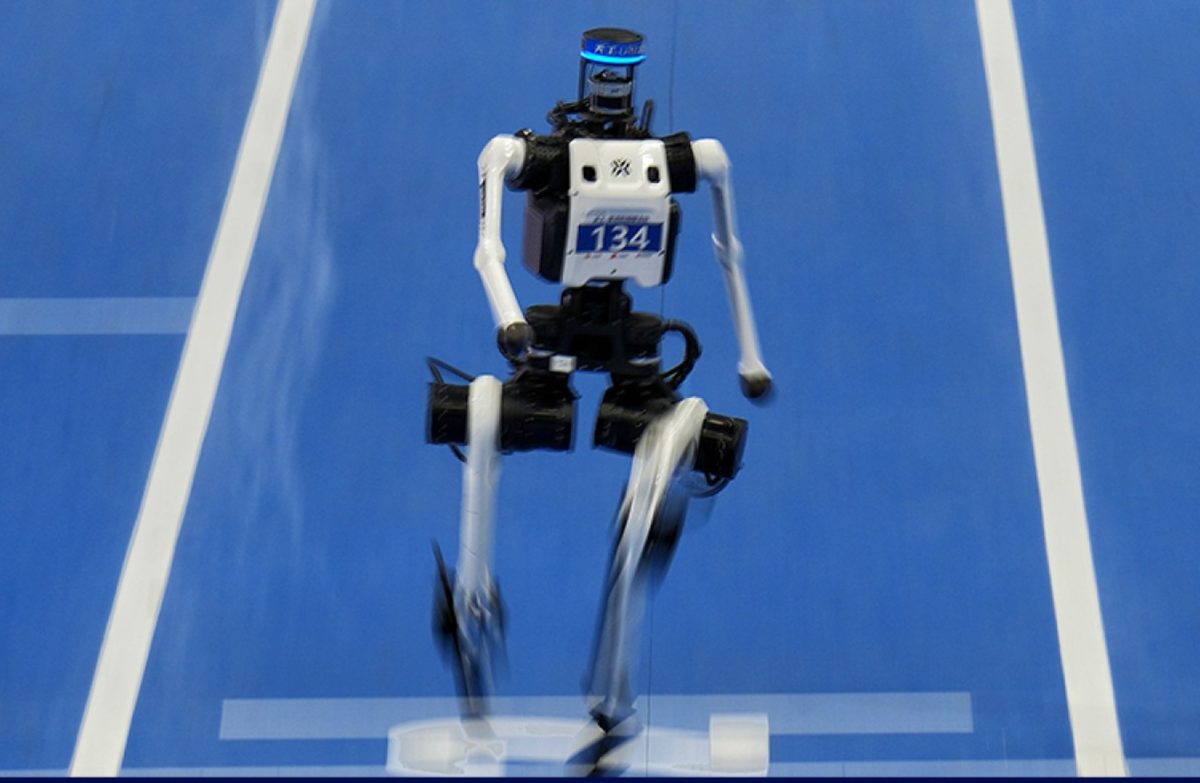
Fig 1 Tiangong Ultra, Beijing Humanoid Robot Innovation Center
Tiangong Ultra's performance rests on three stacked layers. First, a lightweight but high-strength chassis paired with self-developed high-output integrated joint actuators whose torque and speed improved by an order of magnitude over the prior generation. Second, an industry-leading dual-battery hot-swap system that allows power switching without powering down, paired with smart energy management to close the endurance gap in longer races. Third, and most consequential this edition, it runs a fully autonomous navigation mode: a two-layer software architecture plus reinforcement-learning-driven motion strategies that let it sense the track, adjust its posture and hold an optimal running state in real time, with no human intervention.
2.2 Tiangong Omni: Same Algorithm, Different Size
Tiangong Omni is the compact, balanced member of the Tiangong family. Unlike the flagship, competition-tuned Ultra, Omni's positioning leans toward real-world deployment, using balanced performance to cover the scenarios a smaller machine can reach.
Its winning posture in the final went viral. Cocked far forward with both arms pressed against its face, it drew the nickname "face-hugging run." This was not a glitch. It is the optimal aerodynamic layout iterated by the autonomous motion-control algorithm through repeated trial and error: it maximizes drag reduction at speed while holding the center of mass forward to avoid tipping from torque. Nor was the posture pre-programmed by the engineers; the robot arrived at it autonomously by reading live track data, its own center-of-mass feedback and aerodynamic parameters in the moment. It shows the motion-control algorithm has moved from executing a designed motion to optimizing a motion for the scene.
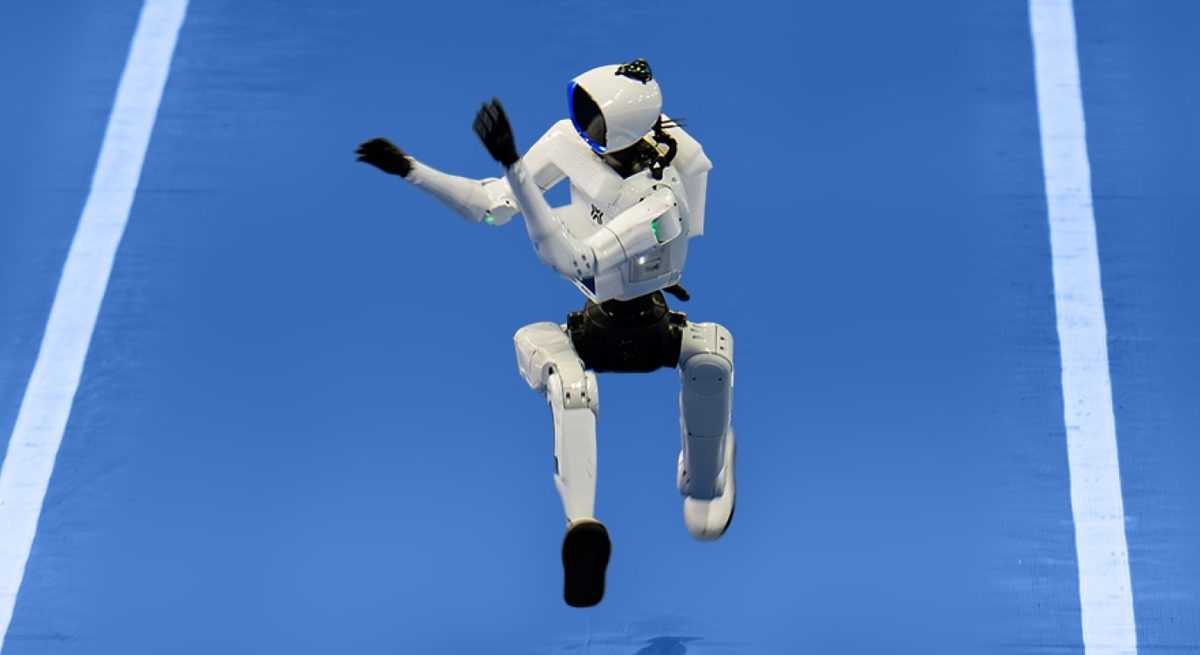
Fig 2 Tiangong Omni in its “face-hugging run” winning posture, Beijing Humanoid Robot Innovation Center
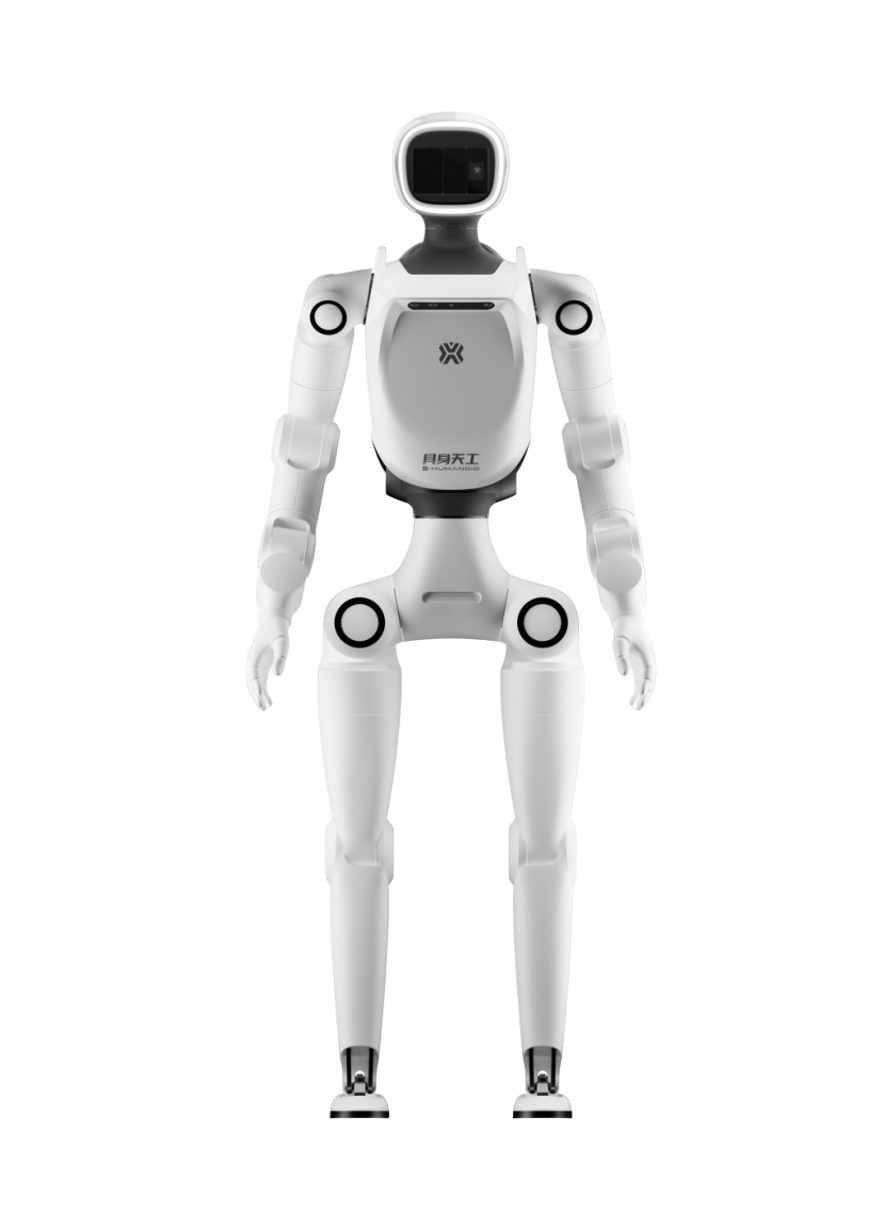
Fig 3 Tiangong Omni, Beijing Humanoid Robot Innovation Center
In the small-class 400 meters it won in 45.66 seconds, only about two seconds outside the human 400-meter world record. On hardware, it drops the industry-standard lidar and runs a purely vision-based sensing stack, cutting mass and pushing toward the cost constraints of a real deployment. It shares the same motion-control algorithm as the Ultra, and under the same racing constraint it converged on nearly identical pose optimization. That points to a Tiangong architecture with cross-size, cross-scenario generality rather than a single-model point solution.
2.3 AGIBOT Lingxi X2: A Production Machine's All-Round Test
AGIBOT Lingxi X2 is a production-grade full-size humanoid from AGIBOT that took gold in the 100-meter hurdles. It carried no event-specific hardware conversion, winning on the stock version's all-round performance.
The 100-meter hurdle track set up 10 obstacles of different types, including a continuous slope, a narrow passage, uneven paving and a low crawl tunnel. The requirement is to recognize, re-plan and adjust posture in real time at speed, where any single lapse can lose the race. Lingxi X2 ran the full course without a mistake. Its blend of high-speed agility, dynamic balance, real-time sensing navigation, complex-terrain crossing and whole-body posture adaptation is exactly the hurdle event's test.