Are Chinese Robots Taking Over Europe? What IFA 2026 Shows
Why read: China makes almost all of the world's humanoid robots, yet very few reach European factories. The gap between the show floor and the production line is where the real story sits.
By Embodied AI Frontier
IFA 2026 closed in Berlin on September 8. The 102nd edition drew more than 1,900 brands from 49 countries and an expected 220,000 visitors, including 932 exhibitors from China.
For the first time in the show's 102-year history, robots walked a runway.
Between the show floor and the production line, however, sit several numbers that rarely make the press release.
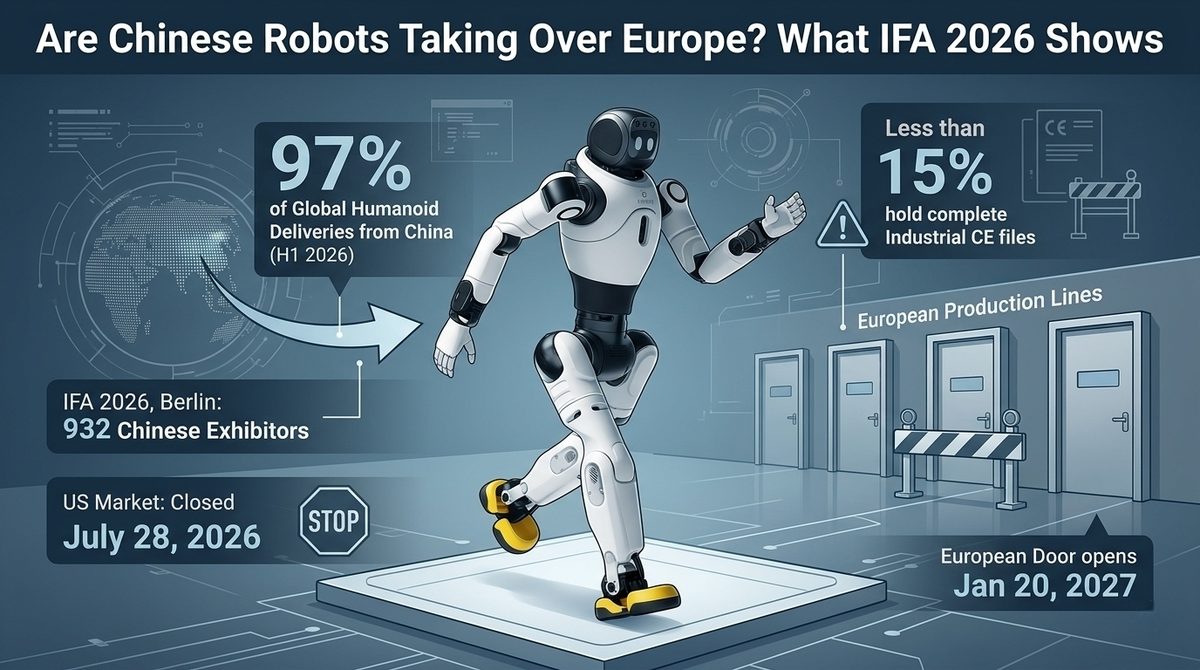
Smart Analytics Global puts Chinese makers at more than 97% of global humanoid deliveries in the first half of 2026; the same dataset shows China absorbing more than 85% of global demand.
Unitree began selling humanoid robots in Europe on July 22, 2026. Six days later, the United States closed its door.
Europe has no equivalent ban, but it has a door that opens on January 20, 2027, and a ratio few mention: fewer than 15% of commercial humanoid robots hold complete industrial CE files.
So why do robots that fill a trade show still struggle to reach a European production line?
Article structure
- 1. IFA 2026: A Show Redefined by Robots
- 2. The Other Side of 97%
- 3. Why Europe: The Pivot After America Closed Its Door
- 4. Four Modes of Going Abroad
- 5. Three Non-Technical Barriers
- 6. Europe's Response: Redefining the Scoreboard
- 7. Conclusion: From Showcase to Production Line
On September 5, 2026, eleven companies walked their robots across the Creator Stage at Messe Berlin. It was the first robot runway in the 102-year history of IFA, and most of the participants had Chinese roots: Unitree, AGIBOT, ENGINEAI, DEEP Robotics and Dobot among them.
The runway was a footnote. What made this edition memorable was the shape of the exhibitor list. According to figures reported by Korean media, 932 Chinese exhibitors came to Berlin, roughly half of the total and up about 35% year on year.
The question follows naturally: are Chinese robots taking over Europe?
Start with a set of numbers. In the first half of 2026, Chinese manufacturers shipped about 18,500 humanoid robots, more than 97% of global deliveries according to Smart Analytics Global (SAG), a market research firm. In the same dataset, China itself absorbed more than 85% of global demand. That leaves roughly 2,300 units for overseas markets, or 12.4% of Chinese output, a figure calculated by Axis Intelligence Research from SAG data.
The distance between the show floor and the production line sits inside that gap.
1. IFA 2026: A Show Redefined by Robots
1.1 The Base Numbers: 102nd Edition, 1,900 Exhibitors, 932 from China
The 102nd IFA ran from September 4 to 8, 2026 in Berlin under the theme "The Future Is Now". Official figures put the show at more than 1,900 brands from 49 countries, with an expected 220,000 visitors from 140 countries across 27 halls.
The Chinese presence has two sets of figures. Figures reported by the Korean outlets Herald Economy and EBN put Chinese exhibitors at 932, roughly half the total and up about 35% year on year. A separate tally by 36Kr reporter Huang Nan, writing from the floor, recorded 928 from mainland China and 84 from Hong Kong, which together put the figure past a thousand. The two counts use different scopes and cut-off dates, so the safer approach is to cite both rather than merge them.
Robots became the organising theme of this edition. IFA Next gathered around 300 exhibitors, which the organisers described as the largest humanoid robot showcase in the show's history. The September 5 "Robots on the Runway" event took place at the Creator Stage with eleven participating companies, most of them with Chinese roots. Official sources give two timings for the event: the IFA programme page lists 12:45, while the official press release says 13:00.
Leif Lindner, CEO of IFA Management GmbH, framed the shift plainly: "This year we are seeing more humanoid robots at IFA than ever before. This is more than a showcase. It shows that robotics, AI and new interfaces are becoming an increasingly inseparable part of everyday life."
1.2 Samsung's Exit: A Main Hall Changes Hands
The more telling change was not the number of Chinese exhibitors but what happened to the main hall.
For the first time since 1991, Samsung did not rent a large stand at Messe Berlin. Instead it held "Samsung CONNECT" at Humboldt Carré in central Berlin, about eight kilometres from the fairgrounds, opening two days before the show (September 2 to 6). Benjamin Braun, Chief Marketing Officer of Samsung Europe, gave the official reason: AI should deliver tangible benefits that people can see and experience in their everyday lives. Samsung described the new format as a focused, hands-on demonstration environment.
Two details are easy to miss.
Samsung still set up a Creator Hub inside Messe Berlin and remained its main sponsor.
The same move had already appeared at CES 2026, where Samsung shifted its presence from the Las Vegas Convention Center to the Wynn Hotel. That pattern looks like a sustained strategic pullback rather than a decision aimed at IFA alone.
The impression on the floor was real. Korean reporters described halls that felt emptier than in previous years, with much of the space given over to business meeting rooms. One industry official told Newsis: "Samsung and LG used to take large stands in the IFA main hall to strengthen global marketing. Now Chinese companies have taken that position."
Xiaomi stepped into that space. Making its IFA debut, the company took more than 3,300 square metres, brought around 380 products along with three electric vehicles and its XRING chip, and said it plans to enter the German market in 2027.
This section sticks to the facts: who left, who filled the space, and how the floor changed. Motives are left to the reader.
1.3 The Other Side of the Floor: "What Problem Does It Solve?"
A high Chinese exhibitor count invites the conclusion that Chinese robots are taking over Europe. What reporters saw on the floor was more complicated.
Huang Nan's notebook from 36Kr records two scenes. A French visitor crouched in front of a robot vacuum, comparing the weave of its mop to judge how well the arm would actually work. Dealers from the Netherlands and Australia knelt beside lawn mowers to inspect the blades underneath. Her summary: "This is not a stage for flexing technical muscle. It is a place to do business and find customers."
The question heard over and over was the same: "What problem does your product solve right now?"
The "embodied AI" boom that has dominated Chinese headlines for two years had almost no echo in Berlin. Robot booths did not talk about world models or spatial intelligence. Their screens did not show backflips. They showed a lawn mower working a wet slope, a vacuum arm reaching under a chair, and a window-cleaning robot crawling across curved glass. One exhibitor put it this way: "In Shenzhen, if your pitch deck does not have two pages on embodied AI, investors will not even look at you. In Berlin, if your mower cannot handle the lawn, they walk away on the spot."
Meng Jia, president of the robot vacuum division at Dreame, was blunter: "Nobody here asks which lidar supplier we use or what AI model runs in the back end. European media and dealers go straight to the point: how far can the arm reach? What bacteria does the steam kill? Can it avoid pet vomit?"
Willand, the Segway-Ninebot brand behind the Navimow mowers, took a different route, folding local concerns into its product story. Instead of emphasising "no-boundary navigation" or "triple navigation", it talked about hedgehog avoidance, a feature that stops the mower from injuring hedgehogs. Ryan Kong, the company's European general manager, said European users have shifted from watching the technology to demanding results.
Lindner's own caution is worth recording: "Consumers will not pay more simply because the box says AI." He added: "Europe is attractive but it is not an easy market. A good product is the starting point, not the complete strategy."
The heat on the floor and the numbers at the start of this article are two sides of the same story. The next section unpacks them.
2. The Other Side of 97%
2.1 Four Numbers, Four Definitions
In the first half of 2026, at least four different figures circulated for the same product category in the same period:
| Source | Definition | H1 2026 figure | Notes |
|---|---|---|---|
| Smart Analytics Global (SAG) | Global humanoid deliveries | About 19,100 units (up 272% year on year) | Chinese makers above 97%, Chinese demand above 85% |
| Counterpoint Research | Global humanoid shipments | More than 22,000 units (up nearly 300%) | AGIBOT 9,700 units, Unitree more than 7,000 |
| China Humanoid Robotics Application Alliance (HRAA) | China shipments | More than 30,000 units | May include wheeled platforms |
| MIIT (Ministry of Industry and Information Technology) | China production | More than 40,000 units | Production, not shipments |
The first rule when these four numbers appear together is not to use them as evidence in the same sentence.
The widely cited "China accounts for 97%" comes from a single source: SAG. Counterpoint Research puts global shipments in the same period at more than 22,000 units, roughly 3,000 higher. HRAA's figure of more than 30,000 units for China alone exceeds what the two Western firms estimate for the entire world. The MIIT figure of more than 40,000 units refers to production, which includes inventory, research and education channels, and is a different concept from shipments.
There is no single authoritative definition for this category. Every "humanoid robot shipment" number traces back to one research firm's own methodology. For readers, the practical step is to find the institution and its definition before accepting any market share claim.
2.2 The Net Export Wedge: 12.4%
Putting SAG's two shares together produces a result that rarely appears in coverage.
If Chinese manufacturers account for about 97% of global shipments, that translates to roughly 18,527 of the 19,100 units. If China absorbs more than 85% of global demand, that is roughly 16,235 units. The difference, about 2,292 units, is what reaches overseas markets. That amounts to 12.4% of Chinese output, according to a calculation by Axis Intelligence Research based on SAG data.
In other words, the number of humanoid robots actually sold abroad in the first half of 2026 was in the low thousands.
The gap between that figure and the "Chinese robots are taking over Europe" narrative needs no commentary. China's humanoid robot industry is currently driven by domestic demand: capacity, supply chains and orders circulate mainly inside the country. Going abroad has only just begun; it is not a conquest already completed. For European buyers, that leads to a more practical conclusion: most of the Chinese robots in the headlines are not outside China at all.
2.3 A 25.9% Absorption Rate: Factories Ahead of Customers
If 12.4% answers "how much is sold abroad", 25.9% answers "what happens after it is bought".
Axis Intelligence Research built an indicator called the China Humanoid Absorption Ratio. The numerator is the volume of Chinese shipments actually absorbed by commercial and industrial settings; the denominator is half of MIIT's full-year production forecast. Using SAG's figure that commercial and industrial buyers account for 70% of the market, 18,527 multiplied by 0.70 gives about 12,969 units, which divided by 50,000 yields 25.9% as of August 21, 2026. The firm's own conclusion: the factories are ahead of the customers.
Another data point points the same way. Unitree's prospectus for its STAR Market listing in Shanghai (China's NASDAQ-style board for technology companies) discloses that of the more than 5,500 humanoid robots it shipped in 2025, 74% went to universities, research institutions and individual developers rather than to production floors.
Feedback from factories is consistent. A phrase that recurs in industry reporting is "soaring metrics and idle machines": industrial settings require robots to run continuously and reliably for long stretches, while cross-task generalisation remains a weakness.
Efficiency data comes from inside the industry as well. In January 2026, the Financial Times ran a headline: "Robots only half as efficient as humans, says leading Chinese producer." The admission points to the same engineering gap. Completing an action in a controlled demonstration and completing it continuously, stably and predictably on a production line are two different capabilities.