The Anchor Still Holds: What Unitree's RMB 230 Billion Crash Wiped Out
Why read: Unitree's halving is the first stress test of the embodied AI valuation anchor. It recalibrates how every IPO candidate, private round and A/H price gap will be judged.
By Embodied AI Frontier
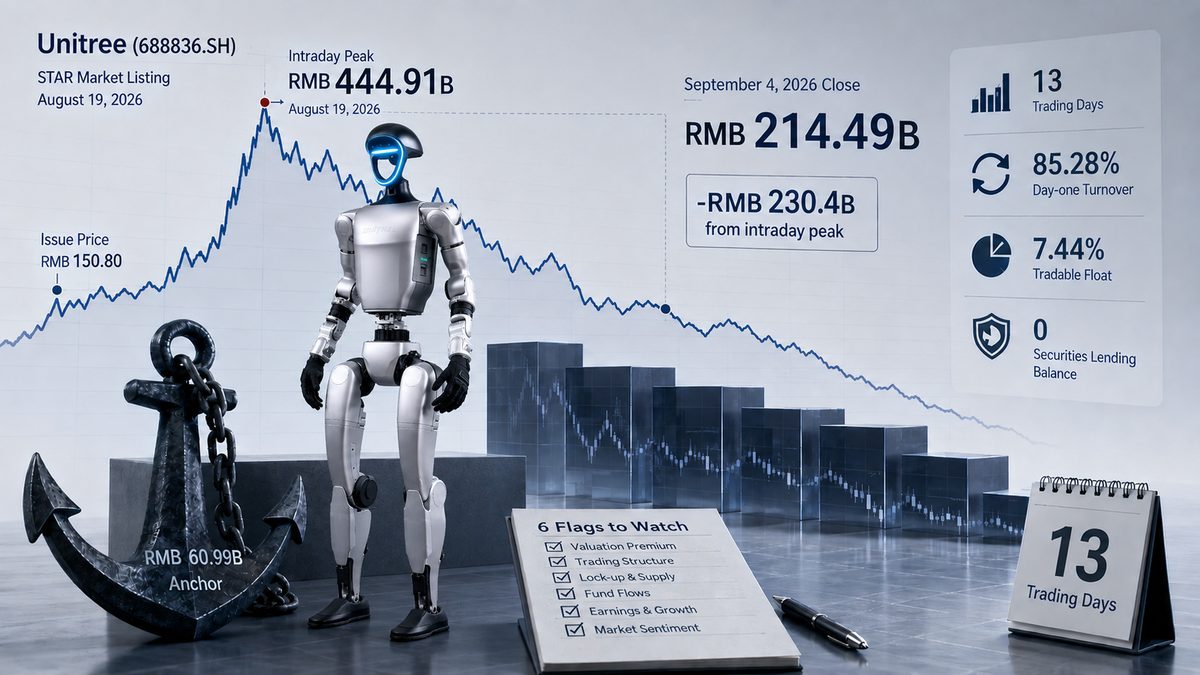
On August 19, 2026, Unitree (688836.SH) listed on the STAR Market, China's NASDAQ-style board for tech firms, at an issue price of RMB 150.80. The stock opened at RMB 1,100, pushed the company's market capitalization to RMB 444.91 billion intraday, and closed at RMB 845.
Thirteen trading days later, on September 4, it closed at RMB 530.30, a market cap of RMB 214.49 billion: roughly RMB 230.4 billion below the intraday peak, but still 251.7% above the issue price.
Day-one turnover ran to 85.28% on RMB 23.16 billion of trading, while the entire tradable float amounted to just 7.44% of total shares; the securities lending balance stayed at zero throughout.
Did the market overturn the RMB 60.99 billion issue price, or did it hand back only the premium that the first-day frenzy itself had created? Why was the clearing this fast, this deep, and why did it happen to more than one company?
This article keeps the coordinate system of "The $8.5 Billion Anchor," takes the 13 trading days after the listing apart, and closes with six flags that can be checked later.
Article structure
- 1. Thirteen Days: From RMB 444.9 Billion to RMB 214.5 Billion
- 2. Three Knives: Valuation, Float Structure, and a Founder's Words
- 3. Outlier or Signal: The Parallel Selloffs in New Listings and the Sector
- 4. Still Not Cheap After a 51.8% Drop
- 5. August 2027: The Master Switch Hanging Over the Stock
- 6. Private Markets and the IPO Queue: A Lower Anchor Begins
- 7. One Industry, Two Prices: The A/H Gap and the Pricier Brain
- 8. The First Share on a Forked Road: Six Flags Worth Checking
1. Thirteen Days: From RMB 444.9 Billion to RMB 214.5 Billion
This article is the post-listing sequel to "The $8.5 Billion Anchor." The previous one was written after Unitree's IPO subscription closed. We treated the RMB 150.80 issue price and the RMB 60.99 billion issue market cap as the first public-market pricing benchmark for the embodied intelligence industry, and left one question open: was the yardstick anchoring a course, or anchoring an illusion? Thirteen trading days after the listing, the market has delivered a first answer.
The first layer of that answer: the fall was fast, without being total. On August 19, Unitree opened at RMB 1,100, up 629.44% from the issue price. Market capitalization peaked at RMB 444.91 billion intraday. The stock closed at RMB 845, up 460.34%. Turnover on day one was 85.28% on volume of RMB 23.16 billion, the highest first-day turnover among STAR Market newcomers since the start of 2026 (Wind data; CIQTEK followed at 83.74%, Pinzhun Laser at 81.22%, CXMT at 66.40%). Across the next 12 trading days there was almost no rebound worth the name: the best single day was August 27, up 3.97%. On Friday, September 4, Unitree closed at RMB 530.30.
| Date | Close (RMB) | Daily change | Market cap | Key event |
|---|---|---|---|---|
| Aug 19 | 845.00 | +460.34% | RMB 341.77 billion | Opened at RMB 1,100; intraday peak of RMB 444.91 billion |
| Aug 20 | 687.00 | -18.70% | RMB 277.87 billion | About RMB 63.9 billion gone in one day |
| Aug 24 | 603.08 | -10.31% | RMB 243.92 billion | Media version: "RMB 100 billion in three days" |
| Sep 2 | 546.02 | -4.39% | RMB 220.85 billion | First intraday break below RMB 550; "halving" headlines erupt |
| Sep 4 | 530.30 | -3.66% | RMB 214.49 billion | -51.8% from peak; +251.7% from issue price |
Let us be precise about the calibers. The "halving" in this article means the 51.8% drawdown from the intraday peak of RMB 444.91 billion, roughly RMB 230.4 billion of market value gone. From the first-day close of RMB 845, the stock is down 37.2%. From the issue price, it is still up 251.66%. The range across every trading day since the listing runs from RMB 528.85 to RMB 1,100.00. In other words, everything the market killed in those 13 days was price formed after the opening on August 19.
The second layer hides in the share structure. After issuance, total share capital stood at 404.46 million shares, and the offering itself accounted for 40.45 million shares, exactly 10% of the total. Only 30.09 million shares, 7.44% of the capital, could trade on day one, made up of the online (retail) tranche of 9.71 million and the unhedged 90% of the institutional (offline) tranche of 20.38 million. Those offline shares cost exactly the issue price, RMB 150.80, and they made up 67.7% of the first-day float, close to seven in ten shares.
| Layer | Shares (million) | % of total shares | Tradable on day one | Lock-up |
|---|---|---|---|---|
| Online (retail) tranche | 9.71 | 2.40% | Yes | None |
| Institutional (offline) tranche, unhedged 90% | 20.38 | 5.04% | Yes | None |
| Institutional (offline) tranche, locked 10% | 2.27 | 0.56% | No | 6 months (Feb 19, 2027) |
| Strategic placement (except DeepSeek) | 7.16 | 1.77% | No | 12 months (Aug 19, 2027) |
| Strategic placement (DeepSeek) | 0.93 | 0.23% | No | 36 months (Aug 19, 2029) |
| Pre-IPO shareholders | about 220.6 | 54.54% | No | 12 months (Aug 19, 2027) |
| Wang Xingxing and concert parties | 121.43 | 30.02% | No | 36 months (Aug 19, 2029) |
A further roughly 21.99 million shares (5.44%) belong to pre-IPO shareholders under different lock-up arrangements and are not listed separately above.
The 85.28% turnover means about 25.66 million shares changed hands on day one, the entire tradable float sold in a single session. Divide the RMB 23.16 billion of trading by that volume and the day-one average price comes to roughly RMB 903 (our calculation from public quote data). The standard script for new-stock speculation runs on consecutive limit-ups, with chips changing hands day by day. Unitree compressed the entire process into four hours on day one. Turnover then fell steadily: 41.98% on August 20, 27.02% on August 24, 12.69% on September 4, while daily volume collapsed from RMB 23.16 billion to RMB 2.075 billion.
An often-missed footnote: from August 19 to September 3, Unitree's securities lending balance was zero. That is not because no one held a bearish view. New STAR Market listings become eligible for margin trading and securities lending from day one, but rules introduced in October 2023 bar restricted shares and strategic placement shares from being lent out, so there was nothing to borrow. The margin financing balance stood at about RMB 1.382 billion on September 3, after a peak of about RMB 1.419 billion on August 25. The accurate description of those 13 days: no shorts pressed the market. What happened instead was distribution of low-cost chips and leveraged money absorbing the selling.
That answers the first "why" of this clearing: why so fast. Because the plate being priced was too small. A 7.44% float set the price of 404.46 million shares. Unitree's share price was never the outcome of all shareholders trading; it was a pricing game played with 30.09 million shares. The previous article anticipated a dual effect of the issue anchor, a ceiling on upside and a higher acceptance threshold. It did not anticipate the violence. The anchor applied to the whole company. Only 7.44% of it traded.
2. Three Knives: Valuation, Float Structure, and a Founder's Words
The most circulated explanation after the halving was "one sentence from Wang Xingxing cut RMB 200 billion." The attribution works as a headline; it does not work as logic. Taken apart across 13 days, three knives did the work. The founder's remark was the last to fall, and it was a trigger, not the root cause.
Knife one: valuation overstretch. The issue P/E was 219.23 times (2025 net profit attributable to shareholders excluding non-recurring items, diluted), already 5.7 times the robot industry average of 38.56 times. The first-day open at RMB 1,100 added 629.44% on top of the issue price. Against the intraday peak market cap of RMB 444.91 billion and 2025 non-recurring-adjusted net profit of RMB 591 million, the static P/E peaked at roughly 750 times, which media including ifeng Finance generally described as "around 800 times." Money that went in on day one was not pricing a company with RMB 1.699 billion of annual revenue. It was pricing years of future earnings. Valuation overstretch was not the trigger of the fall, but it set the depth of it: a price anchored to RMB 591 million of profit has, by construction, far more air beneath it than a price anchored to the current income statement.
Knife two: the float structure. The previous chapter already dissected it: a 7.44% float, an offline segment with 67.7% of day-one tradable shares at a cost of RMB 150.80, an 85.28% one-day turnover, a day-one average price near RMB 903. Hithink's day-one money-flow data points the same way: net inflow of RMB 4.415 billion in super-large orders and net outflow of RMB 2.22 billion in large orders. Holders of cheap chips finished handing them to the high-side buyers on day one. What followed was a stock market game with a fixed pool of players: each sale had no fresh money to absorb it. MiaoTou, a paid research arm of Huxiu, called this the "float illusion" on August 25: a peak market cap of RMB 444.91 billion built on the marginal pricing of just 30.09 million tradable shares.
Pi Haizhou, a Chinese financial commentator, added a mechanical layer. Under the registration-based IPO regime, with no daily price limit on the first day, speculation that used to take a dozen limit-up days got compressed into a single session. The peak arrived on day one, and with no chain of consecutive limit-ups to extend the story, a pullback became inevitable.
Knife three: the founder's words. Lay out the timeline. At the World Robot Conference (WRC) in August 2025, Wang Xingxing, Unitree's founder and chief executive, said the "ChatGPT moment" for humanoid robots "could come in one to two years, or two to three years; at the slowest, three to five years." On August 20, 2026, the day after listing, speaking at the WRC main forum in a talk titled "From Exhibition to Product: The Next Decade of the Humanoid Robot Industry," he revised it: "From the perspective of the development cycle, the industry may see a key breakthrough in as little as two to three years, or as long as five to ten years." Unitree fell 18.70% that day, about RMB 63.9 billion of market value gone.
Two facts need to be added. First, the whole speech was about the bottleneck of generalization and acceptance criteria, including the standard he put forward: in 80% of unfamiliar scenarios, given voice or text commands, a robot can complete about 80% of the tasks. The listing, the share price and the market cap were never mentioned. Second, at the August 7 roadshow he had said "there is pressure, and all the more motivation." We found no public comment by him on the share price after the listing.
Measured from August 2025, the revision did stretch the window. But the idea that one sentence cut RMB 200 billion is one the media spreading it do not believe themselves. ZAKER, the Chinese news aggregator, ran the piece under the headline "The key knife was Wang Xingxing's own," and the article's own conclusion was that "Wang Xingxing simply did not alter the real timetable of technological development for the sake of the share price." ifeng Finance's "RMB 216.4 billion of market value gone in nine days, all because of one sentence from the founder?" closed by conceding that the founder's remark "did poke the hornet's nest," but that treating it as the sole cause of the crash "completely misreads the nature of this capital accident": the bubble "was already blown up before the listing," and he was "just the one who pressed the countdown button."
Our conclusion is the same: valuation and float structure are the main causes; the remark was the trigger. Wang Xingxing did not adjust the timetable of technology development to suit the share price, and that refusal is precisely where the market's recalibration begins. At the first-day close of RMB 845, his stake was worth about RMB 102.6 billion (about RMB 18.3 billion at the issue price).
3. Outlier or Signal: The Parallel Selloffs in New Listings and the Sector
Two clearing processes ran in parallel on the STAR Market in August. One happened in new listings, the other in concept stocks. Unitree was simply the most extreme case in either.
| Stock | Listing date | Issue price (RMB) | First-day close | Close on Sep 4 | vs first-day close | vs first-day high |
|---|---|---|---|---|---|---|
| CXMT (688825) | Jul 27 | 8.66 | 49.00 | 54.80 | +11.84% | -0.42% |
| CIQTEK (688828) | Aug 11 | 21.22 | 110.23 | 91.00 | -17.45% | -22.88% |
| Pinzhun Laser (688826) | Aug 18 | 186.88 | 1,152.00 | 771.90 | -32.99% | -40.62% |
| Unitree (688836) | Aug 19 | 150.80 | 845.00 | 530.30 | -37.24% | -51.79% |
"Surging on day one, then giving it back fast" was not rare in August's new listings: Pinzhun Laser is down 40.62% from its first-day high, CIQTEK 22.88%. But halving-grade damage happened to Unitree alone. The one exception is CXMT, China's leading DRAM maker, still up 11.84% from its first-day close with its memory-cycle story intact, the sample The New York Times (Chinese edition) described as "benefiting from China's AI boom." ifeng Finance has also cited two earlier cases: Zhenbao, up 1,221% on day one and down more than 60% at its 30-day trough, and Xi'an Yicai, which fell from RMB 66.83 to RMB 24. Both figures come from earlier ifeng Finance reporting, we have not independently verified them, and they are cited for reference only.
| Stock | Close Aug 18 | Close Sep 4 | Change |
|---|---|---|---|
| Leaderdrive (688017) | 380.80 | 279.80 | -26.52% |
| Swancor (688585) | 188.97 | 139.37 | -26.24% |
| Estun (002747) | 40.04 | 29.88 | -25.37% |
| Shuanghuan (002472) | 39.91 | 38.05 | -4.66% |
| Inovance (300124) | 62.18 | 59.31 | -4.61% |
Two patterns read off the concept-stock table.
First, the biggest piece of the sector's decline landed on the day Unitree listed. Yicai reported that on August 19 the humanoid-robot index (8841699.WI) fell more than 6%, with over 100 concept stocks down; Qin'an Auto Parts, Zhongda Lide and Julun hit their daily limits. After that, most names drifted lower or stabilized: Shuanghuan and Beite have already turned positive since August 19.
Second, the split followed fundamentals. Inovance and Shuanghuan, with revenue, profit and real customers, fell 4.61% and 4.66% over the window; Leaderdrive, the A-share champion in harmonic reducers, Estun and Swancor, all high-beta, pure-narrative names, fell more than 25%. One more figure needs honest labeling: media reported a main-capital net outflow of RMB 27.57 billion from the robot sector on August 19. That number comes from relays by Stockstar and Sohu, a single-source figure, unconfirmed by exchange data, listed for background only.
Two sets of facts, one diagnosis, two layers. The mechanical layer is common to all new listings: enormous turnover, a scarce float, the peak arriving on day one. Pi Haizhou's "the speculation model has changed" argument holds here. The supply side amplified it: A-share IPOs since the start of 2026 number 100, raising about RMB 188.47 billion (Wind data via Securities Times), and more supply means more volatility. The pricing layer is the new variable. Wallstreetcn, the Chinese financial outlet, wrote on August 24 that the sector is moving from "theme-and-sentiment pricing" to "earnings- and volume-verification pricing." An ifeng Finance column, Qiangdiao Next, put it more precisely: what this selloff confiscated is the qualification for scarcity-based pricing, and going forward "first," "only" and "fastest" may no longer be enough.
Our judgment: the mechanism is common to new listings; the falling pricing ceiling is the new variable. Unitree is the most extreme outlier of this clearing, and also the first signal of the new pricing paradigm.
4. Still Not Cheap After a 51.8% Drop
Start with the least intuitive result: a stock down 51.8% has not become cheap. Put the institutional targets on the table.
| Institution | Target price / valuation | Basis and timing |
|---|---|---|
| CITIC Securities (lead underwriter) | RMB 50.6-55.9 billion (about RMB 125-138 per share) | Reasonable value range 6-12 months after listing (August) |
| CCB International | RMB 269 (about RMB 109 billion) | 32x 2026E price-to-sales (given in March) |
| Nomura (Japanese investment bank) | RMB 370 (about RMB 150 billion) | Initiation with Buy; 25x 2027E price-to-sales (August 19) |
| Sep 4 market price | RMB 530.30 (RMB 214.49 billion) | Above every institutional target |
All three institutions sit below the current price. The lead underwriter's reasonable range is about a quarter of today's market cap. Nomura's Buy rating is a footnote of a different kind: it concedes the quality of the company while conceding nothing about the price. The target is about 56% below the first-day close and 145% above the issue price; a Buy and a discount, side by side.
Now re-run the arithmetic framework from the previous article. It computed that at the issue market cap of RMB 60.99 billion, a reversion to a 50x P/E would require about RMB 1.22 billion of annual net profit, which at a sustainable margin implies revenue of RMB 6 billion to 10 billion and unit sales of 100,000 to 170,000 robots. Apply the same formula to today's RMB 214.49 billion: at 50x P/E the company needs about RMB 4.3 billion of net profit; even at 30x, about RMB 7.15 billion. Consensus estimates for 2026 net profit stand at RMB 690 million (Hithink's F10 data, two institutions, up 148.02%). RMB 4.3 billion is more than six times RMB 690 million.