Why China's Robot IPOs Are Slowing Down: What Changed in H2 2026
Why it matters: a systematic read on what China's securities regulator actually screens for in robot listings, and which of the roughly 50 companies in the queue can clear it.
By Embodied AI Frontier
On 3 September 2026, a Chinese robot joint maker's parent company voted to end its spin-off listing. Five days later, The Information reported that China's securities regulator had given informal guidance raising the bar for humanoid robot listings. Chinese media have since telescoped the two into one story: tightening, then a casualty. The sequence does not support that reading, and the arithmetic behind the bar is more specific than "tightening." This article reconstructs what changed in H2 2026 from public filings, exchange decisions, official statements and media accounts, and asks the question the market has not yet answered: if the constraint is not revenue size but who pays the revenue, how many of the companies now queuing can pass?
- According to media accounts, the guidance was conveyed informally and no rule has been published; the China Securities Regulatory Commission (CSRC) did not respond to requests for comment, and as of publication no new regulation has been publicly issued.
- This article treats all such accounts as reported, not established.
- All figures are sourced to the documents listed at the end, except where a figure is labeled as media-reported; exchange-rate conversions are noted inline.
Article structure
- Introduction: A Five-Day Gap
- 1. Two Things Stitched Into One Story
- 2. The Question Behind the Question: Who Pays the Revenue?
- 3. How Enforcement Works Without a Document
- 4. Who Can Actually List
- 5. An Asset Cycle Invalidated by a Technology Shift
- 6. The Industry Disagreeing With Itself
- 7. The International Frame
- 8. What Comes Next
- Sources and Data Notes
- Date: 23 September 2026
Introduction: A Five-Day Gap
On 3 September 2026, the board of Shuanghuan Driveline 2Announcement on terminating the spin-off listing of its subsidiary on the STAR MarketView the entry below → passed a resolution: terminate the spin-off of its subsidiary Zhejiang Fine Motion Robot Joint Technology (环动科技) and withdraw its application to list on Shanghai's STAR Market (科创板). The spin-off had been in planning since September 2023; the listing application was accepted on 25 November 2024. Its revenue grew 28.32 percent in 2025 and its net profit grew 54.31 percent. Nothing in its disclosed financials suggested it could not pass.
Five days later, on 8 September, The Information reported that the CSRC had given some investment banks and institutional investors informal guidance raising the bar for humanoid robot listings. The report cited unnamed people familiar with the matter. Reuters relayed it the next day 17China slows humanoid robot IPO rush as hype outruns reality (2026-09-21, authorized mirror)View the entry below →, and The Paper confirmed on 11 September that the CSRC had not replied to requests for comment 19CSRC has not yet responded to requests for commentView the entry below →. Chinese financial media followed in volume.
By the end of September, the two events had been merged in most coverage into a single causal chain, with the withdrawal read as the first casualty of a new and stricter regime. On 21 September, the Shanghai Stock Exchange formally confirmed the termination of the Fine Motion review 1Decision to terminate the STAR Market IPO review of Zhejiang Fine Motion Robot Joint TechnologyView the entry below →, and the account appeared to close.
That chain is intuitive. It is also wrong on the dates, and the error matters, because it changes what the story is about.
Fine Motion's decision on 3 September came before the guidance was reported on 8 September. A company cannot withdraw because of guidance it has not received. The two events are connected, but not in the direction most coverage implies, and not through the mechanism most coverage assumes.
What follows separates them, then asks what the separation reveals. The answer is not a simpler story. It is a more specific one. The constraint taking shape is not about how large a robot company's revenue is. It is about who pays it.
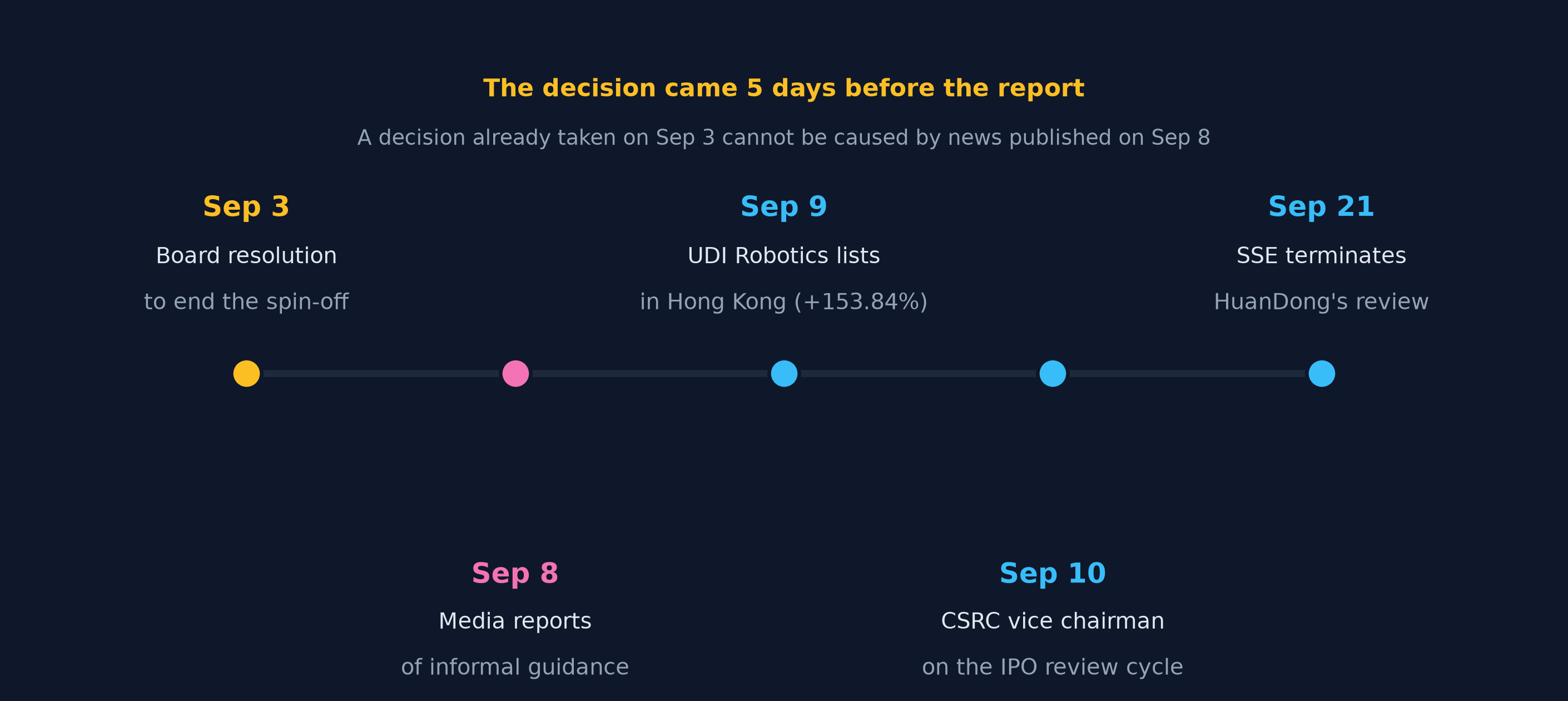
Figure 1 The timeline of two events
Source: Shanghai Stock Exchange filings, Shuanghuan Driveline announcements, public reporting; compiled by Embodied AI Frontier
1. Two Things Stitched Into One Story
1.1 The Withdrawal That Had Nothing Missing
Fine Motion Robot Joint Technology makes RV reducers, a core component for robot joints. It is the kind of company China's industrial policy has spent a decade trying to build: a domestic supplier of a precision part long dominated by Japanese manufacturers. Its parent, Shuanghuan Driveline, is listed on the Shenzhen Stock Exchange and qualifies as an "A-share spin-off to A-share listing" (A 拆 A), a structure that carries its own set of hard tests under the 2022 trial rules on spin-offs 2Announcement on terminating the spin-off listing of its subsidiary on the STAR MarketView the entry below →.
On the numbers alone, the application looked solid. Fine Motion's revenue was RMB 309 million in 2023, RMB 341 million in 2024 and RMB 438 million in 2025, roughly USD 46 million, USD 51 million and USD 65 million at about 6.72 yuan to the dollar. Net profit was RMB 76.26 million, RMB 60.76 million and RMB 93.77 million, about USD 11 million, USD 9 million and USD 14 million 1Decision to terminate the STAR Market IPO review of Zhejiang Fine Motion Robot Joint TechnologyView the entry below →. That is a real business with real customers, not a pre-revenue story asking the market for patience.
| Year | Revenue (RMB m) | Net profit (RMB m) | Top-5 customer share | Largest customer (Estun) |
|---|---|---|---|---|
| 2023 | 309 | 76 | 92.12% | 51.61% |
| 2024 | 341 | 61 | 82.87% | 58.14% |
| 2025 | 438 | 94 | 78.34% | 48.56% |
Table 1: Fine Motion Robot Joint Technology, key financials (2023–2025)
Source: prospectus and inquiry responses, as cited in media reporting
The company cleared the numeric gates. Under the 2022 trial rules on spin-offs, the parent's cumulative net profit over the three most recent fiscal years, after deducting its equity share of the subsidiary's net profit, must reach RMB 600 million. Shuanghuan's came to RMB 821.23 million. The subsidiary's share of the parent's net profit must stay below 50 percent; in 2022 it was 4.90 percent. Its share of the parent's net assets must stay below 30 percent; it was 2.24 percent. The proportion of shares held by the listed company's directors, senior managers and their related parties also met the requirement.
It also cleared every disclosure test the exchange applied, at least on the record available to the public. The application was accepted on 25 November 2024. The review entered the inquiry stage on 18 December 2024. The first round of responses, covering 15 questions, was published on 14 March 2025, and the second round was filed and published on 6 May 2025. Then the file stopped moving. It sat without a third round of questions, without an approval, and without a rejection for roughly sixteen and a half months 1Decision to terminate the STAR Market IPO review of Zhejiang Fine Motion Robot Joint TechnologyView the entry below →.
That silence is the first fact worth holding onto. An application that meets the tests and then stops moving is not a rejection. It is a queue that has stopped advancing.
1.2 What the Exchange Said, What the Media Said
When the Shanghai Stock Exchange finally terminated the review on 21 September, its decision gave a reason: Fine Motion and its sponsor had voluntarily withdrawn the application 1Decision to terminate the STAR Market IPO review of Zhejiang Fine Motion Robot Joint TechnologyView the entry below →. That is the standard language for a voluntary withdrawal, and it is accurate as far as it goes. It does not say why.
The company's own announcement on 3 September 2Announcement on terminating the spin-off listing of its subsidiary on the STAR MarketView the entry below → gave a different frame. It cited adjustments to the spin-off plan in light of its overall business strategy. It did not mention regulatory pressure, informal guidance, or humanoid robots.
Media accounts added a third layer. A 21st Century Business Herald report on 22 September described the withdrawal as a consequence of tightening review standards, connecting it to the guidance reported by The Information 20Capital disenchantment: embodied AI IPOs may shift toward selective entry and strict managementView the entry below →2121st Century Business HeraldView the entry below →. The framing was tightening, then casualty.
Three accounts, three different causal stories, all about the same event. The official record describes a voluntary act. The corporate record describes a strategic choice. The media record describes a regulatory squeeze. None is fabricated. They are answering different questions.
1.3 Why the Sequence Matters
The sequence is what settles the question of which account is doing the explanatory work.
Fine Motion's board resolved to end the listing on 3 September. The Information's report appeared on 8 September. The CSRC vice chairman's public remarks on the IPO process came on 10 September 8Vice Chairman Li Chao on IPO review cycles, State Council Information Office briefingView the entry below →. The exchange's formal termination decision came on 21 September 1Decision to terminate the STAR Market IPO review of Zhejiang Fine Motion Robot Joint TechnologyView the entry below →.
If the withdrawal were a consequence of the reported guidance, the order would run the other way. It does not. The decision precedes the report by five days.
That leaves three possibilities, and the article will test all three rather than assume one:
1. The withdrawal was unrelated to any new bar, and the media framing is a coincidence of timing.
2. The withdrawal reflected pressure that had been building for months, of which the September report was a later public echo.
3. Both were symptoms of something larger that was already changing the economics of robot listings, and neither caused the other.
The third is the most defensible, and Section 5.5 sets out why. The evidence points not to a new rule imposed in September, but to a standard that had already been shifting underneath the market, and to an industry whose revenue structure was about to be asked about in a way it had not been before.
The gap between 3 September and 8 September is small. What it contains is the entire difference between "regulators tightened and a company fell" and "a standard moved, and a company's owners decided the timing was wrong."
2. The Question Behind the Question: Who Pays the Revenue?
Fine Motion's case shows where an individual review can stall. A second development that surfaced in September 2026 concerns the entry standard for the entire sector.
2.1 A New Kind of Buyer
As of the end of April 2026, China had at least 90 humanoid robot data collection and training centers either in operation or under construction, of which at least 64 were already running. The count comes from a 22 May 2026 survey by the market research firm Interact Analysis. Its scope covers national, provincial, municipal and district-level centers plus some large corporate ones, excluding university laboratory facilities 29A survey of 90-plus humanoid robot data collection centers in ChinaView the entry below →.
Jiang Lei (江磊), chief scientist at the state-backed National and Local Joint Humanoid Robot Innovation Center, describes the training grounds this way: a training field is a factory for producing data. The physical scale matches the metaphor. The Beijing Shijingshan Humanoid Robot Data Training Center (北京石景山人形机器人数据训练中心) covers 3,000 square meters, houses 108 robots of multiple form factors, and claims an annual output of more than a million multimodal data records 13Beijing Shijingshan Humanoid Robot Data Training CenterView the entry below →. A parallel facility opened in Shanghai's Zhangjiang district in January 2025 14Shanghai Zhangjiang heterogeneous humanoid robot training ground opensView the entry below →.
The center's operator is a company called Zhongguancun Tongli. Its largest customer is a robot maker. That relationship, traced through public filings, is where the revenue question starts.
Table 2: A funding loop that can be verified
| Step | What happens |
|---|---|
| 1 | The robot company bids for a publicly funded procurement project at a state-backed data collection center |
| 2 | The center signs a data services contract with the robot company and pays for hardware or services |
| 3 | The robot company buys training data back from the same center |
| 4 | The purchase is booked as a data cost; the center's payment is booked as the company's revenue |
Source: media interviews with the parties involved; mechanism illustration only, not independently verified by this publication
2.2 A Loop That Walks All the Way Around
According to a May 2026 report by the Chinese tech outlet TMTPost (single source, not corroborated by a second independent outlet), AGIBOT quoted RMB 31.02 million, about USD 4.6 million, for a robot procurement project at the Hubei Humanoid Robot Innovation Center in September 2025, and was named the preferred bidder (预中标, a preliminary award pending contract signature). The buyer was Optics Valley Dongzhi (光谷东智), a state-owned enterprise. Four months later, in January 2026, AGIBOT signed an agreement with the same center to purchase several thousand hours of training data. The center's director told the outlet: AGIBOT has always been our customer. Every link in that chain comes from the same outlet's interviews; this article could not independently verify it, and presents it as a mechanism example rather than an established fact 31Inside robot data collection centers: the malformed prosperity of passing money from one hand to the otherView the entry below →.
The people drawing the line most clearly are inside the industry. Jiang Zheyuan, founder of Noetix Robotics (松延动力), offered a usable test in a September 2026 talk:
If a company only buys robots to collect data, that is real demand. If it also asks the seller to buy the data back, it is not.
Subsidies discount that last link further. According to media reports, Guangzhou's Nansha district subsidizes 30 percent of the cost for companies buying training-ground services, capped at RMB 2 million, and 30 percent for buying corpus data, capped at RMB 1 million. Heilongjiang offers data vouchers worth 10 percent of transaction value, capped at RMB 1 million. Both are reported by media without the underlying local policy documents, so the percentages should be read as directional 30Embodied AI's fig leaf lifted: how much longer can the data center internal circulation business last (2026-09-12, via Eastmoney)View the entry below →.
The composition of actual demand is visible in another dataset. In the first half of 2026, publicly disclosed winning bids for humanoid and embodied AI robot projects in China totaled 218 contracts worth RMB 1.723 billion, about USD 256 million. Broken down by the nature of the buyer, education and research accounted for 55.5 percent, government and state capital for 20.6 percent, for a combined 76.1 percent. Industrial customers accounted for 21.1 percent, and the remaining 2.8 percent were projects where the buyer type was not disclosed. Most of the industrial orders were prototype testing, showroom displays and training pilots rather than volume production orders. The data comes from a tally by the Humanoid Robot Scenario Application Alliance, cited in media reports; the underlying report is not public, so the figures should be read as directional 30Embodied AI's fig leaf lifted: how much longer can the data center internal circulation business last (2026-09-12, via Eastmoney)View the entry below →.
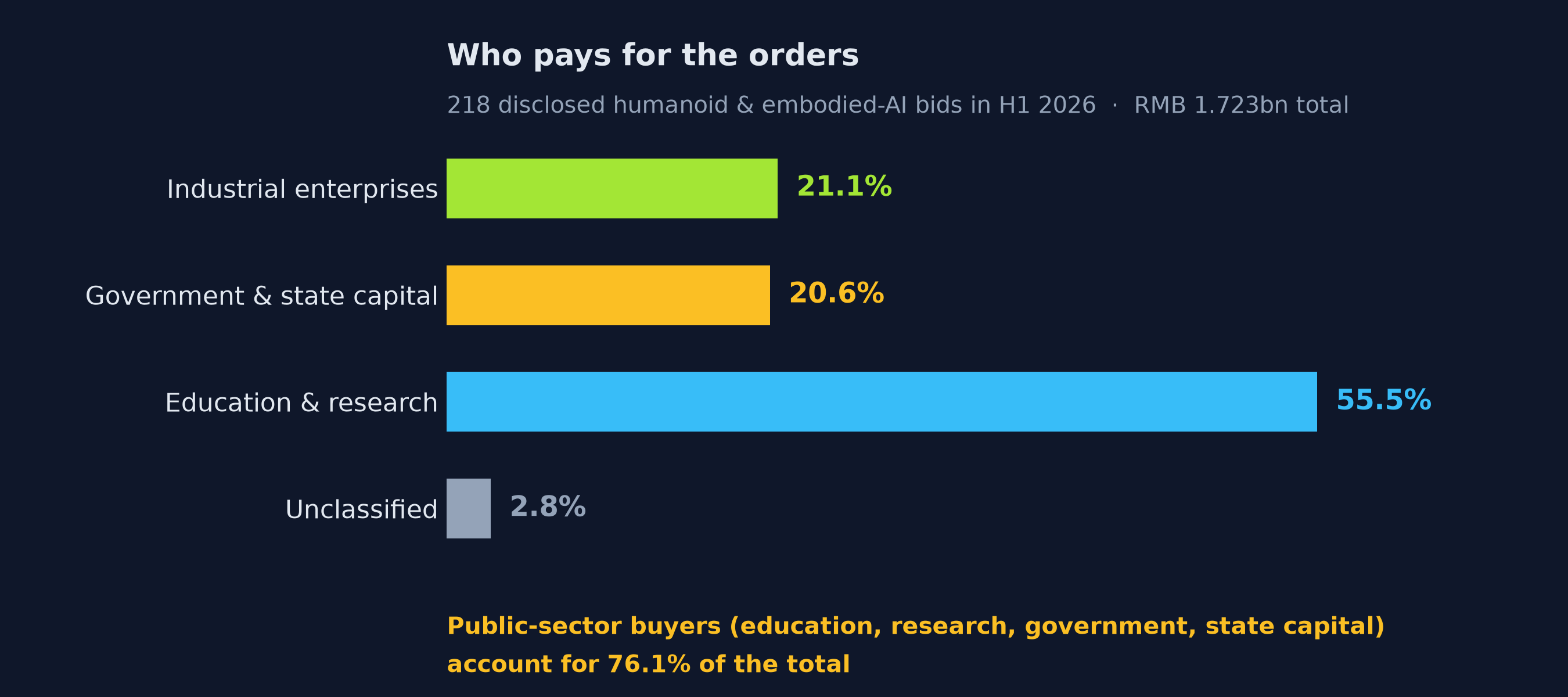
Figure 2 Structure of winning bids in H1 2026
Source: Humanoid Robot Scenario Application Alliance tally, cited in media reporting
2.3 The Cost Side, in Published Numbers
The other problem with data collection centers is the ratio between cost and revenue. Public information used to be scarce. In 2026, several verifiable unit prices appeared.
Table 3: Published unit prices and cost structure in data collection
| Item | Figure |
|---|---|
| Domestic real-robot data quotation | about RMB 500 to 1,000 per hour (USD 74 to 149 per hour) |
| Effective output from one teleoperator in 8 hours | only 2 to 3 hours of usable data |
| Monthly salary of a data collection worker | RMB 8,000 to 15,000 |
| Crowdsourced pay for data collected without a robot body | about RMB 20 per hour |
| Price of one turnkey data center solution | RMB 400,000 to 500,000 (USD 60,000 to 74,000), including robots, hardware, software, cloud processing, after-sales service and a model training platform |
Source: TMTPost, 21st Century Business Herald, as cited
Ding Yan (丁琰), co-CTO of Luming Robotics (鹿明机器人), said at an industry conference in December 2025 that 70 to 80 percent of the cost of building a data collection plant goes to buying robot hardware, and that at plants built at scale, data management often falls short and the data is essentially wasted 32Data unit prices, three tiers of effective standards, and cost structureView the entry below →. Procurement awards in Guangxi and elsewhere illustrate the flow of public money into these facilities 35Guangxi data center equipment procurement awardView the entry below →36Huizhou humanoid robot project award (2025-12)View the entry below →37Beijing Shijingshan training center phase two ordersView the entry below →.
The scale gap inside the industry makes the same point. By industry estimate, cumulative high-quality training data across the whole sector is about 500,000 hours. The consensus view is that reaching emergent intelligence could require 100 million hours or more 32Data unit prices, three tiers of effective standards, and cost structureView the entry below →.
2.4 Two Hands of Policy
On 10 June 2026, the Ministry of Industry and Information Technology and the State-owned Assets Supervision and Administration Commission launched a special program for real-world training of humanoid robots and embodied AI, covering ten provinces and municipalities including Beijing, Tianjin, Shanghai, Jiangsu, Zhejiang, Shandong, Hubei, Hunan and Guangdong. Each is to select at least 20 priority scenarios, with the goal of forming more than 100 high-value application scenarios by year end and supporting deployment at the scale of tens of thousands of units 92026 special program for real-world training of humanoid robots and embodied AI (Xinhua, 2026-06-10)View the entry below →. The scenarios cover manufacturing, warehousing and logistics, and healthcare and elderly care.
The same policy apparatus is pushing demand into existence and raising the disclosure bar for the companies that supply it. That is not a contradiction; it is the arithmetic working itself out. Support for buyers produces orders. Orders produce revenue. If a large share of that revenue comes from entities the state also funds, then the review question shifts from whether the revenue exists to whether it would exist without state funding.
2.5 Two Numbers to Handle With Care
The first is the claim that local governments can provide 80 to 90 percent of initial investment in certain joint ventures. The figure comes from a Reuters report on 21 September 2026, attributed to a person familiar with humanoid robot investors. The original wording is "could provide." As of writing, no Chinese official document, corporate filing, business registration record or financial statement corroborates the ratio, and the Reuters report does not name a single company as an example 17China slows humanoid robot IPO rush as hype outruns reality (2026-09-21, authorized mirror)View the entry below →.
The second is the claim that excluding data-center-related revenue, some robot companies' valuations could fall 60 to 70 percent. The original English text limits this clearly: it is the source's personal estimate, not a regulatory calculation 17China slows humanoid robot IPO rush as hype outruns reality (2026-09-21, authorized mirror)View the entry below →.
Both numbers travel widely with their qualifiers stripped, becoming "local governments typically fund 80 to 90 percent" and "data revenue is 60 to 70 percent of valuations."
One directly verifiable figure creates tension with the second. Leju Robotics' prospectus discloses that its largest customer, Beijing Shijingshan Industrial Development Co. (北京石景山产业发展有限公司), accounted for RMB 33.41 million in 2025 sales, or 12.94 percent of revenue. That customer is the operator of the Beijing Shijingshan Humanoid Robot Data Training Center 28Leju Robotics prospectus and its largest customerView the entry below →.
A single customer at roughly 13 percent of one company's revenue sits a long way from an estimate that stripping data revenue would cut valuations by 60 to 70 percent. This does not refute the Reuters source. "Some companies" can mean an extreme case, and one company, one year and one customer cannot represent a sector. But it is a verifiable reference point and belongs next to the estimate.
A firmer set of facts comes from UBTECH. Over three months from October to December 2025, the company signed six large data center contracts: RMB 264 million in Fangchenggang, RMB 159 million in Zigong, RMB 143 million in Jiujiang, RMB 126 million for another Guangxi project, RMB 59.62 million in Huizhou, and RMB 77.80 million in Hohhot. Together they total about RMB 829 million, roughly USD 123 million, or about 59 percent of the company's nearly RMB 1.4 billion in signed contracts for 2025 34UBTECH's consolidation and revenue structureView the entry below →. Of the 11 contracts worth over RMB 10 million that UBTECH announced in 2025, three went clearly to factories, seven went to data collection centers, and one did not disclose the buyer.
A caveat matters here. The 59 percent is a share of orders signed, not of revenue recognized. UBTECH recognized RMB 2.001 billion in revenue in 2025, and there is a lag between signing and recognition 34UBTECH's consolidation and revenue structureView the entry below →.
2.6 What an Examiner Would Ask
If the revenue question is the core of the standard, then a listing examiner has three lines of questioning available, and each one is answerable only with disclosures most applicants have not made.
First: who is the counterparty, and what is its funding source? A procurement contract with a data collection center is not the same as a purchase order from a factory, even when the cash is equally real.
Second: is the product a capital purchase or a consumable? A center that buys 108 robots once does not buy 108 more next year unless the data they generate has a buyer.
Third: how much of the revenue survives when the service is sold as a turnkey package rather than as hardware? A solution priced at RMB 400,000 to 500,000 bundles hardware, software, cloud processing and a model training platform, so per-unit robot revenue is folded into a single figure and is no longer separately visible 33Data center solution pricing and the economic threshold for a single centerView the entry below →.
None of these questions is new in kind. What is new is that they now apply to a sector whose most visible demand is publicly funded, at a moment when the exchange is asking applicants to prove that the demand is durable.
3. How Enforcement Works Without a Document
One fact about the September 2026 shift is repeated constantly and rarely taken seriously: there is no document.
China Business Journal wrote on September 19 that no formal document had been issued. A source quoted in Reuters' own reporting on September 21 said there is no formal ban. As of September 23, the CSRC, the Shanghai Stock Exchange and the Shenzhen Stock Exchange had made no public response to the reports 19CSRC has not yet responded to requests for commentView the entry below →. Reuters' text states that the CSRC did not respond to requests for comment.
How does a change with no text, no named authority and no public confirmation manage to affect actual listing timelines? The answer is in the structure of the sourcing.
3.1 Who Is Saying This
Lay the September reports out in order and a two-layer structure appears.
On 8 September 2026, the US tech outlet The Information published the first report, saying the CSRC had given some investment banks and institutional investors informal guidance raising the listing bar for humanoid robot companies. The sourcing was people familiar with the matter.
On 9 September, Reuters relayed the report and labeled it as originating with The Information. Over the following days Chinese and multilingual media followed in volume, but the great majority were relays. 36Kr labeled its item as relayed from The Information. Radio France Internationale, Lianhe Zaobao and World Journal all repeated the sourcing to unnamed people. The Paper, on 11 September, verified one thing alongside: the CSRC had not yet replied to requests for comment 19CSRC has not yet responded to requests for commentView the entry below →.
On 21 September, two independent pieces of reporting appeared. A Cailianshe reporter, Zhao Xinrui, interviewed investment banking sources at multiple firms, and Reuters published its own in-depth report 18Has the robot IPO bar tightened? Checking with investment banksView the entry below →17China slows humanoid robot IPO rush as hype outruns reality (2026-09-21, authorized mirror)View the entry below →. As of that date, these two were the only outlets that had done original reporting, one domestic and one foreign, and they are the only two on which the sourcing chain in this article rests.
What matters most about those two pieces is how differently they handle the same word.
3.2 Who Is Warning Whom
The Cailianshe report surfaced a layer nobody had made clear:
"Some investment banking staff have received reminders from their own firms about hard-tech IPOs, including in the robotics sector: if a company's industry position is not prominent enough, its listing process may be affected."
The subject of that sentence is the bankers' own employers. In other words, the reminder came from the compliance desk at the bankers' own securities firms, not from a notice issued directly by a regulator. Cailianshe also stressed that the reminder's scope extends beyond robotics to hard-tech IPOs generally, and that companies without a prominent industry position may see their timelines affected.
The same report contains a more telling passage:
"A leading brokerage told this reporter that its bankers were not notified through window guidance, and that the matter is aimed more at reinforcing the sponsor's front-end gatekeeping responsibility. In China's system the sponsor (保荐机构) is the licensed underwriter that acts as the exchange's front-line gatekeeper for an issuer's disclosure."
That is an unnamed major brokerage explicitly denying the window-guidance framing. But the wording of the denial reveals the mechanism: it acknowledges that something exists, and defines its nature as reinforcing the sponsor's responsibility for screening at the front end.
The denial carries more information than an admission would. It points to a form of constraint that works without an administrative order.
Reuters' own September 21 piece shows the same divergence internally. Among the people it quotes, one says humanoid robot IPOs are effectively frozen, while another says there is no formal ban, only an industry-wide slowdown. Two quotes in one report, pointing in different directions.
3.3 A Rule Set That Has Existed Since 2024
To see why a reminder can work without a document, go back to an earlier timeline.