A Unitree G1 in the Operating Room: What the First Live Surgery by a Humanoid Robot Actually Shows
Why read it: the first time the question of whether a humanoid robot can operate has been turned into a set of comparable numbers.
By Embodied AI Frontier
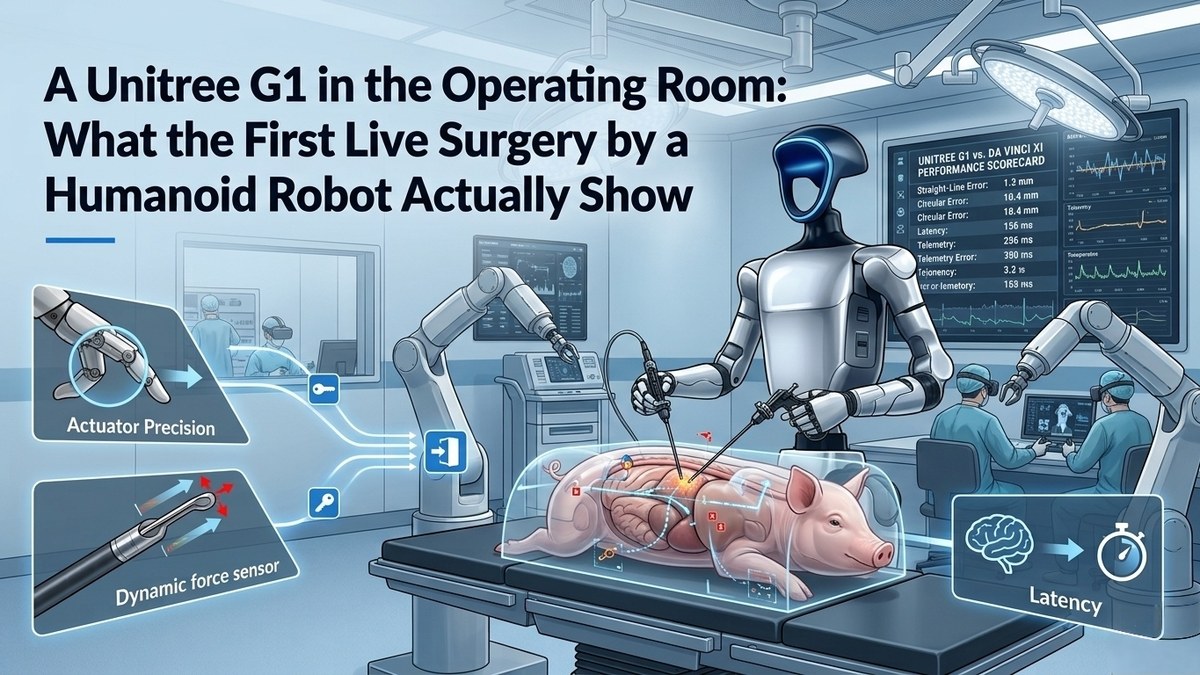
On July 8, 2026, engineers and surgeons at the University of California San Diego published a paper in Nature reporting that two teleoperated humanoid robots had performed laparoscopic gallbladder removals on live pigs. The platform was an off-the-shelf Unitree G1, nicknamed Surgie, standing five feet tall and weighing 60 pounds. The dedicated surgical system it was measured against weighs about 1,800 pounds. The paper also supplies the numbers that matter: straight-line tracking error of about 1.3 millimeters, circular tracking error of about 10.4 millimeters, and 156 milliseconds of latency. Across two dry-lab tasks the humanoid already beat unassisted human hands, while remaining clearly behind the da Vinci Xi. This article unpacks that scorecard, and the four gates still standing between the robot and a clinical operating room.
Article structure
- 1. The Surgical Record: Two Live Porcine Cholecystectomies
- 2. Why a General-Purpose Humanoid: Footprint, Reach and Cost
- 3. Measuring Precision: Straight Lines, Curves and 156 Milliseconds
- 4. Four Gates Before Clinical Use: Sterility, Ports, Recalibration and Remote Operation
- 5. Conclusion: What the First Time Proves, and What It Does Not
1. The Surgical Record: Two Live Porcine Cholecystectomies
On July 8, 2026, the University of California San Diego announced that its engineers and surgeons had completed two operations on live animals using two teleoperated humanoid robots, with the paper appearing the same day in Nature, volume 657, pages 236 to 2442In vivo feasibility study of humanoid robots in surgeryView the entry below →. The university's release called it a world first for live surgery1Surgeons Use Teleoperated Humanoid Robots to Perform Live Surgery, a World FirstView the entry below →.
The paper states the claim more narrowly: this was the first in vivo use of a humanoid robotic surgical system to perform a standard laparoscopic cholecystectomy, a gallbladder removal, in a porcine model3In vivo feasibility study of humanoid robots in surgeryView the entry below →. Cholecystectomy is one of the most common operations in surgery. A few small incisions are made in the abdomen, and the gallbladder is separated from the liver bed.
The two cases were organized differently. In the first, one humanoid robot worked with a human surgeon acting as the assistant. In the second, two humanoid robots worked side by side1Surgeons Use Teleoperated Humanoid Robots to Perform Live Surgery, a World FirstView the entry below →. Both operations were performed on large non-primate mammals, and neither was converted to conventional laparoscopy or to open surgery1Surgeons Use Teleoperated Humanoid Robots to Perform Live Surgery, a World FirstView the entry below →3In vivo feasibility study of humanoid robots in surgeryView the entry below →.
The robots were not built for surgery. The paper names the platform as the Unitree G1 and describes it as "an economical and commercially available" general-purpose humanoid3In vivo feasibility study of humanoid robots in surgeryView the entry below →. Unitree is a humanoid robot company based in Hangzhou, China, which sells complete robots and developer kits. In this study its role was to supply the hardware, and the surgery was performed by the UCSD team, a division of labor that the paper and the university release keep consistent1Surgeons Use Teleoperated Humanoid Robots to Perform Live Surgery, a World FirstView the entry below →3In vivo feasibility study of humanoid robots in surgeryView the entry below →.
The robot was nicknamed Surgie. The name came from an earlier paper by the same group in 2025, which validated dexterous manipulation under controlled conditions and performed no surgery at all3In vivo feasibility study of humanoid robots in surgeryView the entry below →4In vivo feasibility study of humanoid robots in surgery, publication pageView the entry below →.
The two cases left behind a quantitative record. Active console time, meaning the minutes a surgeon actually drove the robot, fell from 56 minutes 15 seconds in the first case to 31 minutes 59 seconds in the second3In vivo feasibility study of humanoid robots in surgeryView the entry below →. The difference between the two cases cannot be attributed to a single variable. The university's account is that this kind of overhead was also common with early-stage dedicated systems and is likely to improve over time1Surgeons Use Teleoperated Humanoid Robots to Perform Live Surgery, a World FirstView the entry below →, and with only two cases there is not yet enough evidence to draw a learning curve.
The interruptions are more telling. What the paper calls a deployment is a full recalibration or physical repositioning of the robot relative to the ports, and that happened 8 times in the first case and 4 in the second. Instrument exchanges are a separate category of event. Each of these took at least 3 minutes, and the paper groups both into "major pauses" of longer than 3 minutes: 2 in the first case and 3 in the second. Short pauses of under 1 minute, mostly a bedside assistant cleaning a lens or adjusting an instrument, fell from 7 to 43In vivo feasibility study of humanoid robots in surgeryView the entry below →. The paper states both sides of this ledger. The interruptions did disrupt the flow of the operation, and they did not affect performance while the surgeon was actively on the console, where the critical steps in both cases were completed "excellently"3In vivo feasibility study of humanoid robots in surgeryView the entry below →.
The cases were not risk-free. The second involved minor bile spillage and some bleeding from the liver bed, both managed with suction and electrocautery. Neither case required conversion to open surgery3In vivo feasibility study of humanoid robots in surgeryView the entry below →.
2. Why a General-Purpose Humanoid: Footprint, Reach and Cost
The first obstacle a surgical robot meets is often the room itself. The UCSD release draws the contrast: a dedicated surgical system typically carries three or four robotic arms, proprietary instruments and proprietary software. It weighs about 1,800 pounds, needs a team to set it up, and takes up a large share of an operating room, which usually has to be retrofitted to hold it1Surgeons Use Teleoperated Humanoid Robots to Perform Live Surgery, a World FirstView the entry below →.
The robots in this study belong to a different order of magnitude: five feet tall, 60 pounds. By weight alone, the dedicated system is 30 times heavier1Surgeons Use Teleoperated Humanoid Robots to Perform Live Surgery, a World FirstView the entry below →.
The paper adds a smaller scale. The G1's arm span measures about 450 millimeters, against an adult arm span of 1.6 to 1.8 meters that the paper places alongside it3In vivo feasibility study of humanoid robots in surgeryView the entry below →. On that comparison, its arm span is roughly a quarter of an adult's. Arm span decides whether a robot can stand at the table at all. Laparoscopic instruments pass through ports at fixed positions, so whether the arms can get where they need to go, and whether they block one another, is a hard constraint rather than a matter of preference.
On cost, only qualitative language and press figures can be verified. The UCSD release says a platform like this costs a fraction of a dedicated system and gives no number, and the paper discloses no price1Surgeons Use Teleoperated Humanoid Robots to Perform Live Surgery, a World FirstView the entry below →3In vivo feasibility study of humanoid robots in surgeryView the entry below →. Forbes offers two orders of magnitude: general-purpose humanoid robots sell for under $20,000, while the dedicated surgical systems in clinical use run into the millions5Humanoid Robots Just Performed Live Surgery For The First Time EverView the entry below →. Both figures come from a news outlet rather than from a manufacturer or the research team, which makes them useful as scale references only.
Two media framings point at the same fact. Forbes, writing on July 10, described the machine as an off-the-shelf Unitree G1 and stressed how general and how available it is5Humanoid Robots Just Performed Live Surgery For The First Time EverView the entry below →. The South China Morning Post led with the angle of American scientists operating with a Chinese robot6US scientists use Chinese humanoid robot to carry out keyhole surgery and remove organsView the entry below →. The same machine reads as a variable in the cost structure in English coverage, and as a position in China's supply chain in Chinese coverage. What makes its presence in an operating room possible is the assumption the embodied AI industry runs on: one general-purpose body, adapted to many tasks.
3. Measuring Precision: Straight Lines, Curves and 156 Milliseconds
The paper breaks the question of surgical capability into measurable parts. The first is bench-top tracking accuracy. The instrument tip is commanded along set geometric paths, an optical motion capture system records what actually happens, and the deviation is computed. Straight-line motion deviates by about 1.3 millimeters. Circular motion deviates radially by about 10.4 millimeters, roughly 8 times as much3In vivo feasibility study of humanoid robots in surgeryView the entry below →. The paper's own reading is that straight-line tracking has reached millimeter scale, while curved motion remains limited by in-plane accuracy3In vivo feasibility study of humanoid robots in surgeryView the entry below →.
The comparison comes from the literature. In the same passage, the paper cites earlier work reporting that clinically deployed teleoperated surgical robots achieve positional accuracy of about 1 millimeter under calibrated conditions3In vivo feasibility study of humanoid robots in surgeryView the entry below →. That figure does not come from the same experiment. The paper cites it to make the same point: curved trajectories are the platform's current weakness.
The second part is latency. The delay between the operator's hand movement and the robot's end-effector movement averaged about 156 milliseconds, measured with a camera running at 120 frames per second3In vivo feasibility study of humanoid robots in surgeryView the entry below →. The paper cites literature stating that conventional surgical robotic systems are generally expected to keep latency below 150 milliseconds3In vivo feasibility study of humanoid robots in surgeryView the entry below →. Six milliseconds is a narrow gap, and distance adds latency, which is why the paper and the university both list remote operation as work still to be done1Surgeons Use Teleoperated Humanoid Robots to Perform Live Surgery, a World FirstView the entry below →3In vivo feasibility study of humanoid robots in surgeryView the entry below →.
The third part is scored by users. Two dry-lab tasks drew different participants. A ring transfer task enrolled 18 people, six of them surgeons and 12 with no medical training. A peg transfer task from the Fundamentals of Laparoscopic Surgery curriculum, which tests the basic skills of keyhole surgery, enrolled 13 surgically trained participants3In vivo feasibility study of humanoid robots in surgeryView the entry below →.
Each participant worked through all three conditions in randomized order, moving among the humanoid platform, a surgical robot and manual operation, with randomization intended to cancel out fatigue effects3In vivo feasibility study of humanoid robots in surgeryView the entry below →. Put the three sets of results side by side and the position becomes clear.
Table 1. Two dry-lab tasks across three operating conditions
| Task and metric | Humanoid | Dedicated surgical system | Manual |
|---|---|---|---|
| Peg transfer: score (out of 100) | 85.4 | 97.7 | 70.5 |
| Peg transfer: completion time | 560 seconds | 118 seconds | 878 seconds |
| Ring transfer: weighted error (lower is better) | 4.5 | 4.6 | 7.0 |
| Ring transfer: completion time | 75 seconds | 43 seconds | 64 seconds |
Source: Nature 657, 236 to 244 (2026), Tables 1 and 2. The dedicated system is the da Vinci Xi in the peg transfer task and the da Vinci Research Kit in the ring transfer task.
The table supports a single judgement: the humanoid beats manual operation and trails the dedicated system. It scored about 15 points above manual hands and about 12 below the da Vinci Xi, and it took roughly 5 times as long, with about 5 times as many errors. The ring transfer task looks different. Its weighted error matched the dedicated system almost exactly, while its completion time was the longest of the three conditions, most visibly among novices3In vivo feasibility study of humanoid robots in surgeryView the entry below →.
Splitting participants by experience changes the size of the gap without changing its direction. On the same humanoid platform, senior surgeons scored close to 94, within 5 points of the da Vinci Xi's 98.7, while junior surgeons scored just above 793In vivo feasibility study of humanoid robots in surgeryView the entry below →. The same machine, in more practiced hands, performs visibly better.
The university release contains one more line that deserves its own paragraph. Shanglei Liu, an assistant professor of surgery at the UC San Diego School of Medicine who teleoperated the robot during the study, said a procedure performed by a teleoperated humanoid robot is "just as precise" as one performed with a teleoperated surgical robotic system1Surgeons Use Teleoperated Humanoid Robots to Perform Live Surgery, a World FirstView the entry below →. That statement describes intraoperative feel in a clinical setting. The figures in the table come from repeated measurement in a dry lab. The two can hold at once: at the table, both platforms completed the critical steps, and under controlled repetition the humanoid trails by a wider margin.
4. Four Gates Before Clinical Use: Sterility, Ports, Recalibration and Remote Operation
The paper lists the conditions for clinical use in four categories.
The first is sterility. Sterility during the study was maintained by fitting sterile gloves over the robotic arms, an approach that cannot fully reproduce the sterile workflow of human surgery. Commercial robotic arms have no components that can withstand autoclaving, and the paper names the combination of sterility, sensor function and motion calibration as a critical barrier3In vivo feasibility study of humanoid robots in surgeryView the entry below →.
The second is workspace. Laparoscopic surgery requires instruments to pass through ports while pivoting around a fixed point, a constraint shared by dedicated systems and by manual surgery. The paper's assessment is that under standard port placement the humanoid reaches a comparable workspace at only a subset of pivot positions, and that standard layouts need to be adapted for the humanoid before surgical deployment3In vivo feasibility study of humanoid robots in surgeryView the entry below →.
The third is recalibration. An animal's breathing and drift in the robot's base keep the effective pivot point moving, and the team applied a temporal filter to prevent unsafe disturbances. When drift grows too large, visualization degrades, or an instrument behaves unexpectedly, the procedure halts for recalibration, at least three minutes at a time3In vivo feasibility study of humanoid robots in surgeryView the entry below →. This is what the eight and four interruptions in the first section amount to: downtime that is currently a routine cost of using the platform.
The fourth is remote operation. Latency, reach and force feedback are all on the improvement list, and the paper and the university both frame deployment in remote or under-resourced settings as a long-term goal1Surgeons Use Teleoperated Humanoid Robots to Perform Live Surgery, a World FirstView the entry below →3In vivo feasibility study of humanoid robots in surgeryView the entry below →.
One further point sits outside the technical list and still needs to be stated. The subjects were pigs and the study is preclinical animal work. The paper describes its aim as establishing feasibility and quantifying current abilities and limits. Use in humans remains behind regulation, ethics review and further rounds of validation3In vivo feasibility study of humanoid robots in surgeryView the entry below →.
5. Conclusion: What the First Time Proves, and What It Does Not
Back to the opening question: what does it mean that an off-the-shelf humanoid robot completed two operations.
It establishes feasibility, and it turns feasibility into numbers that can be compared. Until now, the question of whether a humanoid robot could operate was mostly answered with task demonstrations. This study supplies a continuous scale: console time per case, number of redeployments, bench-top tracking accuracy, latency, and a comparison with humans and dedicated systems across two tasks3In vivo feasibility study of humanoid robots in surgeryView the entry below →.
Its scorecard is layered. On motions that are simple and single-pass, including straight-line tracking, instrument transfer, clipping of the cystic duct and mobilization of the gallbladder, it already holds a conversation with dedicated systems and with human surgeons. On motions that demand continuous curves and a stable pivot, it trails the dedicated system by a visible margin3In vivo feasibility study of humanoid robots in surgeryView the entry below →. The yardsticks are worth repeating. The clinical teleoperated systems cited in the paper are accurate to about 1 millimeter, and this platform's circular error is larger than 10 millimeters. In the peg transfer task, the da Vinci Xi recorded fewer than a quarter of its errors, while manual operation recorded far more3In vivo feasibility study of humanoid robots in surgeryView the entry below →.
This site ran into the same class of problem in "Is China Actually Using Humanoid Robots in Its Factories?": between a technology that has entered a setting and one that has been validated there sits a layer that can be measured. On this question, the paper has supplied that layer.
Three things are now worth watching.
First, the two kinds of overhead in further live studies. Console time fell from 56 minutes 15 seconds to 31 minutes 59 seconds, and redeployments fell from eight to four. Two cases are not enough to establish a trend. If a third and fourth case keep improving, the framework is closing its gaps. If the numbers stall, the constraint sits in the hardware rather than in the operator3In vivo feasibility study of humanoid robots in surgeryView the entry below →.
Second, whether curve accuracy and latency can approach the dedicated systems. A circular error above 10 millimeters and 156 milliseconds of latency are the two hardest numbers in the study, and they decide whether the platform moves from capable of finishing a procedure to dependable in one3In vivo feasibility study of humanoid robots in surgeryView the entry below →.
Third, sterility and instrument adaptation. Gloves over robotic arms are a stopgap, and port layouts need to be redesigned. Both problems sit on the engineering side. Once sterilizable components and a dedicated port strategy are validated in public, a humanoid platform will actually be eligible to enter an operating room3In vivo feasibility study of humanoid robots in surgeryView the entry below →.
The data and code behind the study are archived on Zenodo, with the dry-lab performance dataset and the analysis code stored under separate records, so the work can be checked independently7User Performance Data SheetsView the entry below →. The weight of this first time lies in moving humanoid surgery from demonstration to a baseline that has been peer-reviewed and can be reproduced. For embodied AI as a whole, the operating room now joins the factory and the warehouse as a setting whose progress is being measured.
Sources
The study
Media and data
Note on sources: the university release and the peer-reviewed paper describe the same study. Where their wording differs, this article follows the published paper.