How China's Car Industry Became a Humanoid Robot Supply Chain
Why read: a car-by-car record of who is actually building humanoid robots in China, what the supply chain inherits from EVs, and what still stands between the line and a real business.
By Embodied AI Frontier
On September 8, 2026, a humanoid robot completed final assembly and walked off an automated line in Guangzhou. The line belongs to XPeng, and it marks how far Chinese carmakers' robot programs have come: to the production line itself.
Counterpoint Research, cited by CNBC, counts nearly 20 carmakers worldwide entering humanoid robotics. In China, 16 to 17 can be verified, split across three routes: in-house development, spun-off subsidiaries and strategic investment.
They are drawing on the base the EV industry already built: China accounts for about 90% of global capacity for processing and refining the permanent magnets used in motors, more than 75% of robot components are now sourced domestically, and humanoid unit prices fell 72% in three years.
Building the machines, however, is only the first step. Most carmakers' products remain at the unveiling or development stage, and three questions are still open: efficiency, orders and general-purpose capability.
Can the car industry's manufacturing scale become a scaled robotics business? And how far away is it?
Article structure
- 1. Starting Point: Thinner Margins, a Supply Chain Already in Place
- 2. The Entrants: Who Is Building, and How Far
- 3. The Product: How Good, and What Is Still Missing
- 4. The Business: Who Buys the Robots
- 5. The Price: How Markets Read the Shift
- 6. The Global Picture: China Is Not Alone
- 7. The Verdict: From Roll-Off to Real Work
On September 8, 2026, in Guangzhou, a humanoid robot about 1.7 meters tall completed final assembly and walked off the line on its own. XPeng, the Guangzhou-based electric-vehicle maker, designated the day as the commissioning of its robot production line. The company says core process automation exceeds 80%, and describes the line as the world's first automated production line for "advanced general-purpose humanoid robots": 76 degrees of freedom, with a physical-AI model running on board1XPeng's robot production line officially commissioned: the world's first advanced general-purpose humanoid robot completes automated final assembly and walks off the lineView the entry below →. He Xiaopeng, XPeng's chairman and CEO, acknowledges the line has "no precedent to follow"1XPeng's robot production line officially commissioned: the world's first advanced general-purpose humanoid robot completes automated final assembly and walks off the lineView the entry below →2IRON, the World's First Advanced General-Purpose Humanoid Robot, Walks off the Production Lines as XPeng's Humanoid Robot Manufacturing Facility Is Officially Commissioned (press release)View the entry below →.
Shift the camera to other Chinese car factories on the same day and a different scene appears: the humanoids showing up on those lines mostly come from dedicated robotics companies such as UBTECH and AGIBOT. In that story, carmakers are customers, not manufacturers.
The XPeng line belongs to a different story: carmakers building robots for themselves. Its outline has taken shape in just two years. In 2024, it was concepts and equity stakes; in 2025, company entities and shop-floor testing; by 2026, production lines, mass-production schedules and delivery figures began to appear. And its questions are harder ones: can the manufacturing capacity the car industry has accumulated be used to make robots, and can those robots become a real business?
1. Starting Point: Thinner Margins, a Supply Chain Already in Place
The first reason carmakers are looking at robotics is written in the profit statement.
According to the National Bureau of Statistics of China, revenue for the country's auto manufacturing sector in the first half of 2026 was RMB 5.19 trillion (about $726 billion), up 1.8% year on year, while total profit fell 19.5% to RMB 195.35 billion (about $27 billion). The operating margin dropped to 3.8%, against 6.5% for downstream industrial enterprises54industrial enterprise profit data, January-June 2026 (relayed by Xinhua's Economic Information Daily)View the entry below →55Auto industry profits fall nearly 20% in the first halfView the entry below →. Vehicle assembly is thinner still: 1.5%, per the China Association of Automobile Manufacturers56H1 2026 vehicle-assembly margin data (via CNBC, citing Counterpoint)View the entry below →.
Rising revenue with shrinking profit is the classic moment for a traditional manufacturing industry to reinvent itself. Beijing Daily, in a September report, described the carmakers' moves as opening a "second battlefield"12From making cars to making robots: carmakers open up a second battlefieldView the entry below →. But motive alone does not explain capability. Why is it carmakers, and not some other industry, that can actually do this?
The answer lies buried in their own supply chain.
In April 2026, McKinsey listed the shares in an article titled "Turning humanoid supply chain constraints into billion-dollar wins": China controls roughly 69% of global rare-earth mining and 90% of the capacity to process and refine the permanent magnets used in motors, along with 40% of precision bearings and 35% of motors. A June chart added driver boards and power electronics at 30%, and encoders and position sensors at 40% (Japan holds 30% and Germany 15%)44Turning humanoid supply chain constraints into billion-dollar winsView the entry below →45China's humanoid robot edgeView the entry below →. That month, The New York Times offered numbers from the production side: more than 90% of the components in a UBTECH robot come from Chinese companies, and the main imports that remain are chips46Why It's Nearly Impossible to Build a Robot Without ChinaView the entry below →.
What that supply chain produces is a steep cost curve. Unitree's IPO prospectus shows the average price of a humanoid robot falling from RMB 593,400 (about $83,000) in 2023 to RMB 166,400 (about $23,000) in 2025, a drop of 72%48UnitreeView the entry below →. Domestic sourcing for core components passed 75% by the end of 202547core component localization data (relayed by China Economic Net and Securities Daily)View the entry below →, six-axis force sensors fell from the tens of thousands of yuan into under RMB 5,000 (about $700), and planetary roller screws dropped by more than 80%.
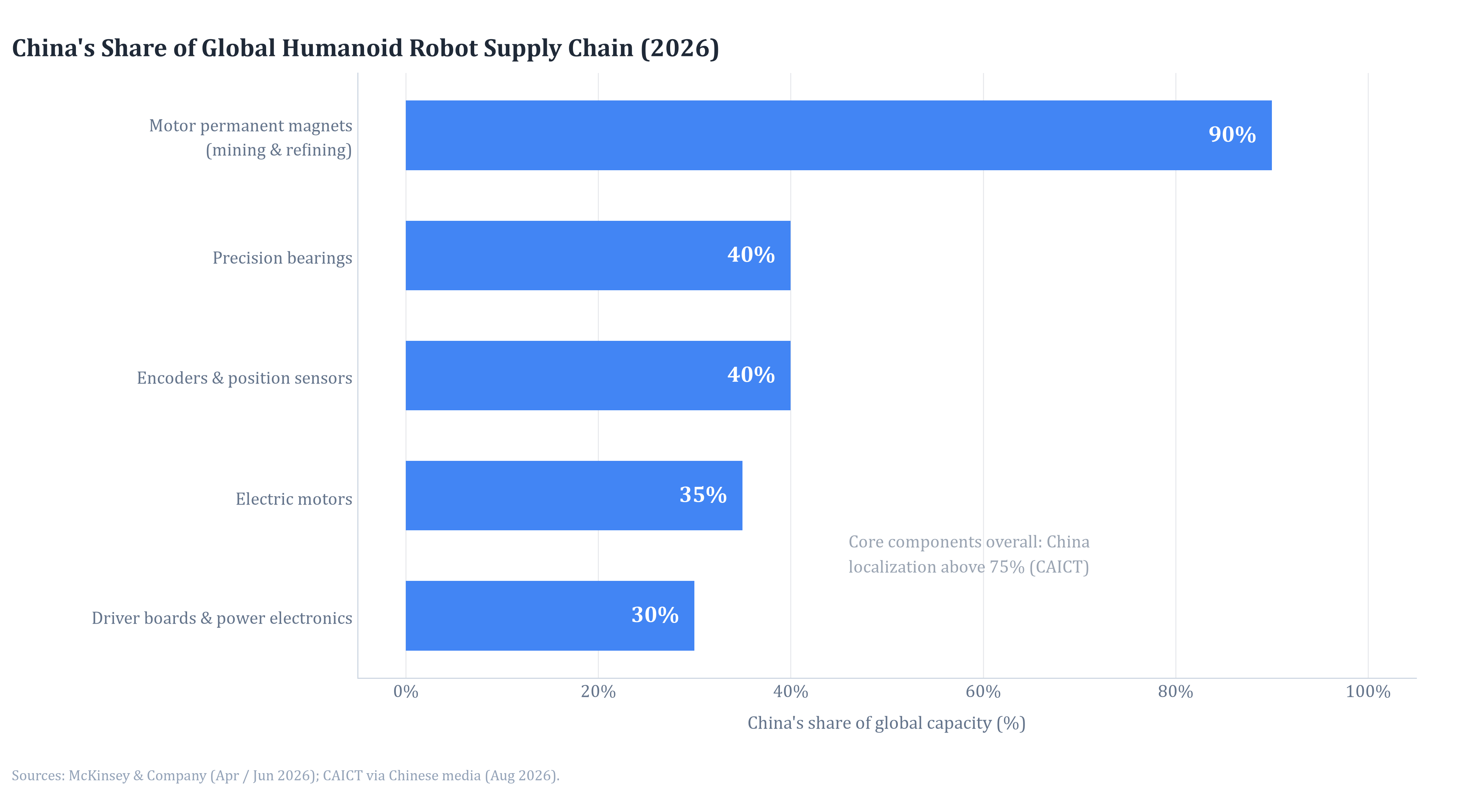
Fig 1 China's share of the global humanoid robot supply chain (2026)
For carmakers, the more pointed question is how much of that base they can inherit directly. Three numbers circulate, and they do not measure the same thing.
XPeng said on its second-quarter earnings call that more than 85% of its robot supply-chain partners overlap with its auto business. A BYD executive was reported as saying the commonality rate for core robot components exceeds 60%. And Jin Bing, a former first-level inspector at the State Post Bureau, told the Aggregated Intelligence Industry Development Conference in September 2026 that the technology-stack overlap is more than 70%52After $900 million, how does XPeng turn its auto supply chain into a humanoid robot mass-production system?View the entry below →60Orders booked into 2027: who is underpinning the humanoid "year of mass production"?View the entry below →53Technology-stack overlap above 70%: nearly 20 carmakers enter embodied intelligenceView the entry below →. The three numbers describe supplier lists, component commonality and technology-stack overlap, respectively. Reading 85% as "eight in ten parts can be swapped in" is the most common misunderstanding in circulation.
Component makers are the most sensitive observation point for this migration. RoboSense, an automotive lidar maker, sold 282,600 lidar units for robotics in the first half of 2026, up 510.4% year on year, with robotics becoming the main source of its product gross profit38RoboSense optimizes its robotics business layout, focusing on core componentsView the entry below →. Joyson Electronics says its controllers and other products are in volume supply to leading robot companies37Joyson Electronics unveils dexterous hands, semi-solid-state batteries and other robot core components at WAICView the entry below →. Progress is uneven: robot-component revenue at Tuopu Group and Zhejiang XCC Group was still only about RMB 20 million (roughly $2.8 million) each in the first half, and Zhejiang XCC Group describes itself as still "investing for growth"392026 semi-annual reportView the entry below →40Earnings call: Zhejiang XCC Group says robot components remain in a "investing for growth" phaseView the entry below →.
Supply chain, cost curve, component makers: the three point to one conclusion. The hardware prerequisites for building a robot in China are already in place, and the ones who laid them down are the carmakers themselves.
2. The Entrants: Who Is Building, and How Far
The field of entrants is larger than it first appears. According to Counterpoint Research, a technology market research firm, as cited by CNBC on September 9, 2026, nearly 20 carmakers worldwide have entered humanoid robotics through in-house development, investment or incubation as of August 2026, with Chinese companies accounting for more than half62China's EV makers shift gears to focus on humanoids as car market slowsView the entry below →49Humanoid Robotics Leans on Automotive Industry for Future GrowthView the entry below →. Based on company-by-company public disclosures, China's entrants can be verified at 16 to 17: XPeng, Li Auto, NIO, BYD, Xiaomi, GAC, Chery, Changan, Dongfeng, FAW, SAIC, Geely, SERES, Leapmotor, BAIC and JAC12From making cars to making robots: carmakers open up a second battlefieldView the entry below →.
They have chosen three routes.
The first is building the whole robot in-house. XPeng's robot has walked off a production line. Xiaomi has put its own humanoids to work at stations inside its own auto plant. BYD has confirmed it is developing a humanoid and says its brand "Xiaodi" will debut in August11BYD formally enters the embodied intelligence race; its humanoid robot "Xiaodi" will debut in AugustView the entry below →. Dongfeng is developing its own models, including one called "Xiao Dong"36Dongfeng Motor's humanoid robots to go on duty next yearView the entry below →.
The second route puts the robot business into a separate company. GAC incubated Huilun Technology; Chery's AiMOGA robotics business runs independently; Changan and BAIC have set up robotics subsidiaries.
The third route is capital. NIO participates through strategic investment and says robotics is not its main business. Public reports say Geely Capital led a funding round in Robot Era and also invested in Unitree12From making cars to making robots: carmakers open up a second battlefieldView the entry below →.
Huawei plays a different role: no public record shows its own robots entering carmakers' production lines, and it positions itself as a platform and enabler70National and local joint centers and Huawei release an embodied intelligence training-ground showcaseView the entry below →.
Line the 16 companies up and a clear gradient emerges: many have announced; few have products. Five words are routinely mixed together in their statements, "unveiled," "production line," "mass production," "delivered" and "deployed," and each one measures something different. Most carmakers are still in the first two stages.
Table 1 China's carmakers and their humanoid robot progress (based on publicly verifiable information)
| Company | Route | Latest verifiable milestone | Stage |
|---|---|---|---|
| XPeng | In-house | Automated line commissioned September 8, 2026, core-process automation above 80% (company claim); mass production by end-2026, deliveries in 2027 | Production line |
| Xiaomi | In-house | Nut-fastening station at its auto plant: 98% success rate on both sides (human rate about 99%), 76-second takt | Production-line application (station level)14Xiaomi discloses new progress of humanoid robots in factories: success rate in some scenarios rises to 98%View the entry below → |
| GAC (Huilun Technology) | Spun off | 7 flagship projects, close to 50 units deployed, longest continuous run 12 months (company claims) | Deployed6GAC's humanoid robot company Huilun Technology completes a 100-million-yuan funding roundView the entry below → |
| Chery (AiMOGA) | Spun off | Cumulative deliveries above 2,000 units (overseas, all product types; delivery definition not disclosed) | Delivered8Chery's AiMOGA robot exports pass 2,000 unitsView the entry below → |
| SAIC | In-house + investment | "Nengzai No. 1" (co-developed with AGIBOT) began work on a Buick battery line on March 27, 2026 | Deployed16SAIC takes the lead in deploying a humanoid robot on a mass-production lineView the entry below → |
| Dongfeng | In-house + ecosystem | Developing "Xiao Dong" and other models; 2026 rollout planned36Dongfeng Motor's humanoid robots to go on duty next yearView the entry below → | In development |
| FAW | In-house | Showed full-size bipedal, wheeled-arm and service models at the World Robot Conference on August 21, 2026 | Unveiled19FAW's self-developed embodied intelligence robot debuts at the 2026 World Robot ConferenceView the entry below → |
| Changan | Subsidiary | Filing: humanoid auto robot mass production expected by 2028 | In development13Changan Automobile board resolution on the establishment of a robotics companyView the entry below → |
| SERES | In-house + partner | "Xiaosai" shown publicly for the first time on June 15, 2026 at its Chongqing plant | Unveiled34report on the debut of SERES' humanoid robot "Xiaosai"View the entry below → |
| BYD | In-house + investment | Confirmed in development; "Xiaodi" debut set for August | Announced11BYD formally enters the embodied intelligence race; its humanoid robot "Xiaodi" will debut in AugustView the entry below → |
| Li Auto | In-house | Confirmed humanoid R&D started in May 2026 | In development |
| NIO | Investment | Won't build robots; participates through strategic investment | Investment |
| Geely | Investment | Geely Capital led Robot Era's round and invested in Unitree12From making cars to making robots: carmakers open up a second battlefieldView the entry below → | Investment |
| BAIC | Subsidiary + investment | Set up Beijing Yuanqi Physical Intelligence in August 2026 with RMB 800 million (about $112 million) in registered capital | Company formed |
| Leapmotor | Subsidiary | Set up Huzhou Lingsheng Precision Manufacturing in July 2026 | Company formed |
| JAC | Official outlook | Its website lists humanoid robotics among new tracks, alongside a 2025 laboratory cluster | Early watch |
Source: company websites and filings, and authoritative media reports; compiled as of early September 2026.
The rhythm on the timeline says more than the roster. In 2024, moves clustered around concepts and equity stakes. In 2025, they turned into company entities and shop-floor tests: AiMOGA began operating independently; Changan and FAW set up robotics subsidiaries. In the first nine months of 2026, production lines, deployments and delivery figures started arriving in batches: XPeng moved its line to center stage, Xiaomi published station success rates, Huilun disclosed operating mileage. One blank also remains: none of the 16 has published data showing its own, self-developed robots running around the clock at its own plant.
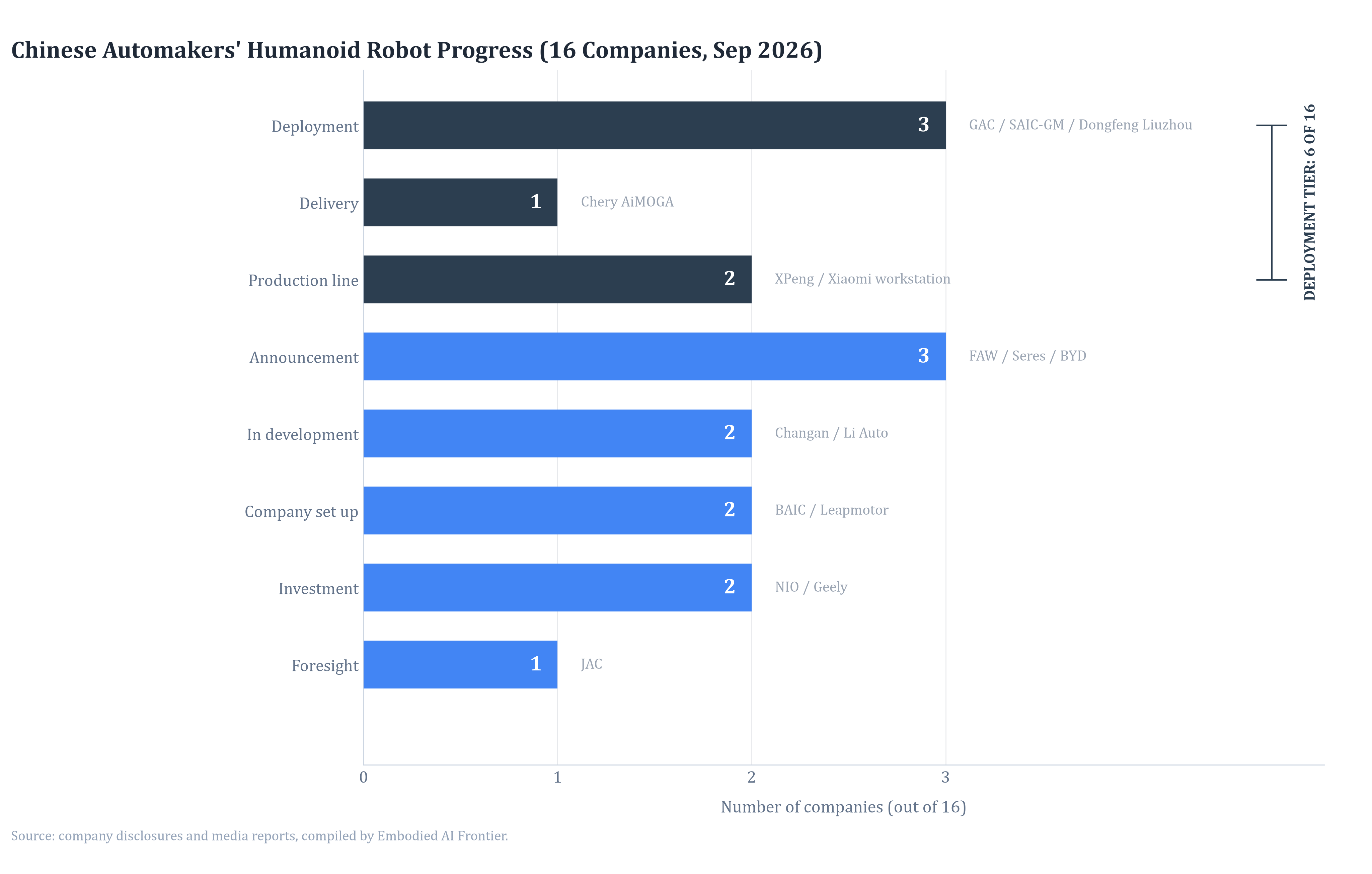
Fig 2 Where China's 16 carmakers stand in humanoid robots (as of September 2026)
One claim needs its own paragraph. XPeng's line is described as a "world's first"1XPeng's robot production line officially commissioned: the world's first advanced general-purpose humanoid robot completes automated final assembly and walks off the lineView the entry below →; an earlier precedent is Figure's BotQ facility, announced in March 2025 with a first-generation line designed for 12,000 units a year, which media reports said reached one robot per hour in April 202623Figure opens BotQ, its humanoid robot manufacturing facilityView the entry below →. Tesla's reconfigured line in Fremont was still being installed as of its July 22 second-quarter update, with the capacity figure left blank25Q2 2026 Update (SEC Exhibit 99.1)View the entry below →. Electrek, a US industry outlet, put the two facts into one sentence on September 7: Tesla is still converting a car line, and XPeng has just opened one27XPeng starts IRON humanoid robot production as Tesla Optimus stallsView the entry below →. "First" holds within the combination XPeng defines: the "advanced general-purpose" category, on an automated line.
One final point of reference: none of this is uniquely Chinese. Hyundai, BMW, Mercedes-Benz, Ford and Mitsubishi have all made their own moves, differing in style and speed. That part comes in Section 6.
3. The Product: How Good, and What Is Still Missing
The production line answers the first question: can it be built? The product has to answer a second: can it be used?