China's Dexterous Hand Industry: A $3.5B Quest for a "Standard Hand"
Why it matters: the fullest public accounting of China's dexterous hand race, from the $3.5B capital wave to WRC2026 field sightings and the question of who survives the cycle.
By Embodied AI Frontier
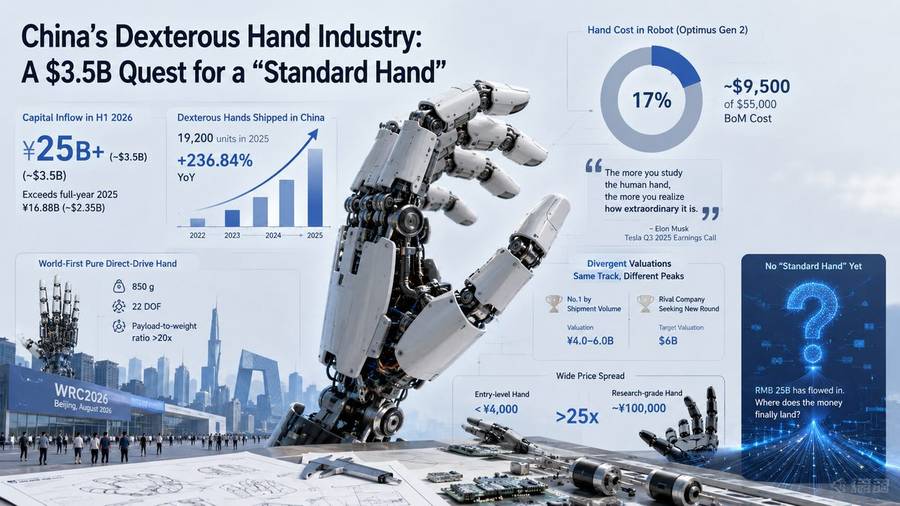
China's dexterous hand sector, the multi-fingered robot hands that give humanoid machines fine manipulation, raised more than RMB 25 billion (~$3.5B) in the first half of 2026, already surpassing the RMB 16.88 billion (~$2.35B) raised in all of 2025, according to ITJuzi's incomplete statistics. GGII counted about 19,200 dexterous hands shipped in China in 2025, up 236.84% year on year. On the cost side, Morgan Stanley's teardown estimate of the Tesla Optimus Gen 2 puts the hand at about 17% of the total bill of materials (roughly $9,500 of a $55,000 robot). Elon Musk said at Tesla's Q3 2025 earnings call: "The more you study the human hand, the more you realize how extraordinary it is." At the World Robot Conference (WRC2026) in Beijing in August 2026, a world-first pure direct-drive hand drew the biggest crowds with 850 g, 22 degrees of freedom and a payload-to-weight ratio above 20x. Around the same time, the No. 1 shipper by volume carried a third-party valuation of just RMB 4.0 to 6.0 billion, while a rival was seeking a new round at a $6B target valuation. One company ships an entry-level hand at under RMB 4,000; another lifts its valuation with research-grade hands near RMB 100,000, a spread of more than 25x. If the shipment leader is not the valuation leader, and RMB 25 billion has already entered the sector without a "standard hand" emerging, where does the money finally land?
Article structure
- 1. The Last Bottleneck: Why Dexterous Hands Are Hardest
- 2. $3.5B and No "Standard Hand": Capital Heat vs Industry Chaos
- 3. Three Routes, Three Businesses
- 4. The Battle of Metrics: Shipments, DOF, and Price
- 5. WRC2026 Field Report: The Hand's Revival
- 6. The Next Battle: From Specs to Deployment
- 7. Who Survives the Cycle
1. The Last Bottleneck: Why Dexterous Hands Are Hardest
1.1 One Hand, About 17% of the Bill of Materials
Morgan Stanley's teardown estimate of the Tesla Optimus Gen 2 puts the total bill of materials at about $55,000 (roughly RMB 376,000) and the dexterous hand at about $9,500 (roughly RMB 65,000). That is about 17% of the entire robot, a figure Chinese media commonly cite as 17.3%. Two caveats: no original Morgan Stanley report is public, so every citation is secondhand; and practitioners' own rule of thumb is close, with hand hardware typically running 10% to 20% of the whole-body cost, and above 20% on some high-end builds.
This is an anomalous concentration. Two legs and dozens of joints make up the body, yet two hands with only a few dozen joints soak up about 17% of material cost. The explanation is that the hand is one of the densest degrees-of-freedom packages and one of the most demanding to manufacture. Motors, reducers, ball screws, encoders and sensors have to fit inside a palm-sized space, and every joint carries its own share of independent motion.
1.2 Musk: The Human Hand Is Extraordinary
At Tesla's Q3 2025 earnings call, Musk admitted that Optimus 2 is hard to build because the forearm and the hand are harder to manufacture than every other part of the robot combined: "The more you study the human hand, the more you realize how extraordinary it is." The remark comes from a founder whose entire engineering team is grinding on that exact component, so it carries more weight than an observer's take. The Optimus Gen 3 hand integrates 22 degrees of freedom, with every joint driven by its own motor: a fully actuated design.
1.3 The Body Is Maturing. Fine Manipulation Is the Bottleneck.
The WRC2026 show floor offered a yardstick. At booths where robots did backflips, visitors took a photo and moved on. The crowds that stayed were in front of robots sorting parcels on a conveyor belt and tightening screws at a workstation. A Reuters line, "robots that can do kung fu are old news," has been widely shared, as quoted in industry field notes from the show. Bipedal walking, jumping and backflips are now table stakes for the leading players. Stunts no longer set anyone apart.
Turning a screw, peeling an orange, picking a phone off a desk: these test fingertip force control, tactile sensing and freedom-of-motion coordination. Whether a robot can do real work is decided at the fingertips. That is exactly why the hand is the last bottleneck: as the body matures, the hand sets the distance between "can walk" and "can work."
2. $3.5B and No "Standard Hand": Capital Heat vs Industry Chaos
2.1 RMB 25 Billion in Six Months, Three Counting Methods
ITJuzi's incomplete statistics show about RMB 16.877 billion raised by China's dexterous hand sector in 2025, and more than RMB 25 billion (~$3.5B) in the first half of 2026 alone, exceeding the whole of 2025. Funding totals have no unified scope. By GGII's count, the sector raised about RMB 12.8 billion (~$1.8B) across roughly 57 deals between 2023 and May 2026. Under the Gaogong Humanoid Robot (高工人形机器人) scope, cumulative funding exceeded RMB 8 billion (~$1.1B) by the end of July 2026, up more than 1,500% from about RMB 500 million in the same period of 2025. Three institutions, three counting scopes, figures several times apart. The metric chaos rehearses itself before the industry even matures.
Capital is betting on every link of the chain at once: upstream component makers such as Zhaowei (Shenzhen Zhaowei Machinery & Electronics) and PaXini; midstream hand makers such as LinkerBot, Wuji Technology and Sharpa; downstream humanoid builders doing their own hands, such as Unitree and Tesla. AgiBot went further. In January 2026 it split its hand business into a separate company, AGILINK, which closed four funding rounds within five months and reached a post-money valuation above $1B.
2.2 The Valuation Anchor: $6B Is a Target, Not a Closed Round
The valuation anchor needs the same care. LinkerBot completed its Series B+ in April 2026 at a $3B post-money valuation (about RMB 20.5 billion). Reuters reported in May 2026 that the company was seeking its next round at a target valuation of $6B (about RMB 41 billion). As of August 2026 that round had not closed. $6B is a target, not a completed transaction, and the distinction is often blurred in coverage. By GGII's count, the company closed seven rounds within a single year, a faster valuation climb than most humanoid builders.
2.3 Chaos: No Mainstream Direction, Deployment Still Exploratory
Su Jiuyu, CEO of Xuanxiang Robotics (玄象机器人), describes the industry as "out of focus": no particularly core or mainstream technical direction yet, deployment scenarios still being explored, and activity concentrated in research. In his view, this year "can be called the first year of mass production for dexterous hands, or the early stage of a bubble."
Measured in numbers, the chaos is plain: shipments range from a few hundred to 100,000 units; unit prices run from just over RMB 3,000 to hundreds of thousands of RMB; degrees of freedom run from 6 to 42 with no shared counting method. The No. 1 shipper is not necessarily the revenue leader or the valuation leader. Capital heat and industry chaos coexist, and the sector sits in a stage where the standard has not been set while the window is tightening.
3. Three Routes, Three Businesses
3.1 The Dividing Line Is Hardware
Everything on the market is called a "dexterous hand," but the label covers different machines. On the software side, VLA (vision-language-action) models and world models are clearly behind the hardware. The observation from the field: most mainstream open-source solutions treat the hand as a "grasping tool," essentially two-dimensional, coarse grabbing. VLA for fine manipulation is rare, and only a few companies are attempting hand-specific models.
The real dividing line is hardware. The mainstream routes come down to three: all-direct-drive, with an independent motor at every joint; tendon-driven, with motors at the wrist pulling the fingers through tendons; and linkage, with motors close to the fingers and motion transferred through parallel-link structures. Routes can also be combined into hybrid drives, tendon plus direct-drive, for example.
3.2 Cost vs. Dexterity: Three Kinds of Arithmetic
Linkage and tendon are comparatively cheap. One company pushed the material cost of a three-finger tendon prototype below RMB 1,000 (about $140); linkage hands average RMB 10,000 to 50,000 (about $1,400 to $7,000). The shared weakness is the mirror image: strong payload capacity, limited freedom. They can move a crate but not pick up a phone; grab an orange but not peel it.
All-direct-drive has the highest performance ceiling, but cost and engineering are the wall, starting at roughly RMB 100,000 (about $14,000) on average. Huachuang Securities calculates that motors used in a single hand can cost RMB 26,000 to 65,000 (about $3,600 to $9,100). The upstream motor, ball-screw and encoder chain remains heavily import-dependent, according to industry research, so an all-direct-drive build almost requires self-developed motors. There is also a counterintuitive soft spot: each joint holds a small motor with limited torque, so a fully direct-drive hand may not lift heavy objects either.
3.3 Who Buys What
Different routes, different businesses. Tendon-driven hands are the entry route for research replication, sold mainly to universities and labs. Linkage suits current industrial production, with automation line companies as the main customers, though Su Jiuyu warns that hands are not always the optimal choice in industry: many jobs are done cheaper with three-finger grippers or suction cups. All-direct-drive mostly serves research and labs today, while long term it is viewed as the route most likely to reach households, with the largest commercial upside. One more point: makers do not commit to a single line, and all-direct-drive is being explored by nearly everyone.
3.4 Valuation Divergence
Routes eventually show up in valuations. Capital clearly prices high-DOF, all-direct-drive stories above volume routes. LinkerBot covers multiple routes and carries a $6B target for its next round, the most expensive company in the sector. AGILINK, AgiBot's spinoff, runs direct-drive and tendon in parallel and reached a $1B post-money valuation. By contrast, makers on linkage and tendon routes focused on industrial volume hold far more grounded numbers: Inspire Robotics, the shipment leader, carries a third-party valuation of RMB 4.0 to 6.0 billion (about $560 to $840 million), with no official disclosure.
4. The Battle of Metrics: Shipments, DOF, and Price
4.1 Three "No. 1s", Three Algorithms
Starting in 2025, the Chinese dexterous hand market entered an explosive phase. GGII data: about 19,200 units shipped in 2025, up 236.84% year on year; 70,200 units expected in 2026, up 265.63%; and more than 430,000 units by 2030, a 2026 to 2030 CAGR of about 57.79%. The market has another scope: GGII expects the global multi-finger dexterous hand market to exceed $5B by 2030, a 2024 to 2030 CAGR of 64.6%. That is a global figure and must not be mixed with the 430,000-unit China projection.
Entering 2026, several makers began announcing their own "No. 1" claims. Inspire Robotics cites more than 10,000 units delivered in 2025 and first place in GGII's shipment ranking, calling its market share "far ahead": the shipment scope (per OFweek, citing GGII, Inspire alone took more than half of the 19,200 units). LinkerBot claims more than 80% of the global high-DOF dexterous hand market: the segment scope, excluding hands at 15 DOF and below as well as underactuated designs. DH Robotics previously disclosed more than 200,000 electric end-effectors delivered over eight years and No. 1 domestic sales: the category-total scope, covering electric grippers, servo actuators and anthropomorphic hands, of which dexterous hands are only a small part.