Why China's Embodied AI Is Booming: A Forty-Year Relay
Why it matters: a systems view of why China's embodied AI moved from laboratories to the capital market in three years, built entirely on public filings, official policy documents, and verifiable market data.
By Embodied AI Frontier
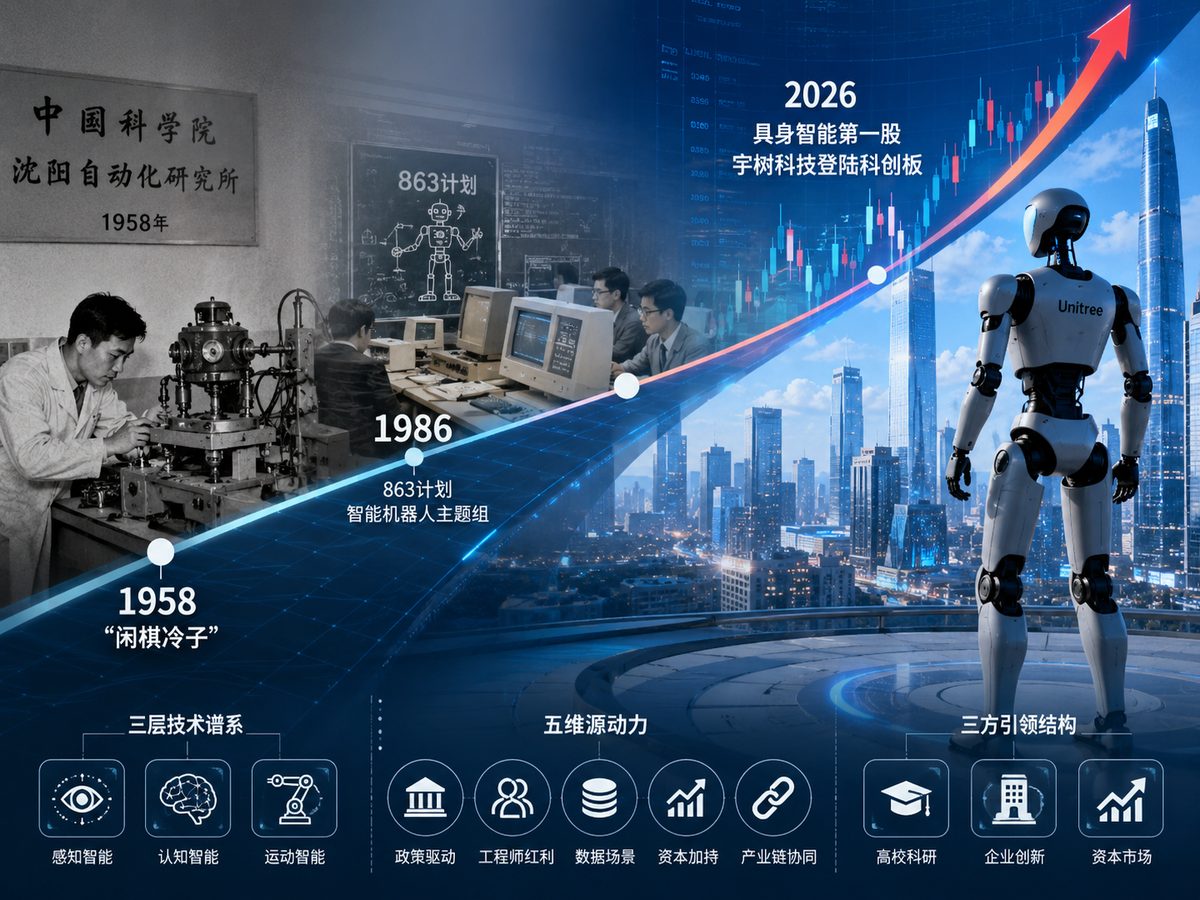
On August 19, 2026, Unitree listed on the STAR Market, China's NASDAQ-style board for tech firms, at RMB 150.80 per share and 219.23 times earnings, raising about RMB 6.10 billion (roughly $850 million), nearly RMB 1.9 billion more than its investment plan called for. An industry that mostly lived in laboratories three years ago has now been fully priced by the capital market, and the A-share market gained its first humanoid-robot stock and its first embodied-AI stock in a single listing. The sprint, however, has a long backstory. Six decades before the listing bell, Jiang Xinsong, the pioneer of Chinese robotics, called robots a "cold piece waiting to be played": placed on the board without anyone knowing when they would be needed. From that cold piece in 1958, to the intelligent-robotics theme group of the 863 Program in 1986, to today's first embodied-AI listing, the arc spans nearly seven decades. What exactly powered the three-year burst, what did the four decades of waiting buy, and why did this explosion happen only in China? This article answers with three technological layers, five drivers, and a three-party leadership structure.
Article structure
- 1. The Technological Origins: Three Layers
- 2. Five Drivers
- 3. Who Is Actually Leading
- 4. Why Only China Can Move This Fast
- 5. Risks and Concerns
On August 19, 2026, Unitree listed on the STAR Market, China's NASDAQ-style board for tech firms, under the ticker 688836. The company priced its IPO at RMB 150.80 per share, implying a market capitalization of about RMB 60.99 billion (roughly $8.5 billion) and a price-to-earnings ratio of 219.23 times, or 35.89 times trailing revenue on a fully diluted 2025 basis. The offering of 40,446,434 shares, equal to 10 percent of post-IPO share capital, raised about RMB 6.10 billion (roughly $850 million), nearly RMB 1.9 billion more than the RMB 4.2 billion (about $590 million) investment plan it was meant to fund. A record 9.78 million investor accounts took part in the lottery-style subscription process, and only 0.018 percent of them received allocations. With that, the A-share market gained its "first humanoid-robot stock" and its "first embodied-AI stock" in one listing.
Three years separate the laboratory from the stock exchange. In 2023, China counted roughly 50 to 60 companies building complete embodied-intelligence machines; by 2025 the number had passed 140, and disclosed funding for the year topped RMB 40 billion (about $5.7 billion). Behind that three-year sprint lies a forty-year relay. The state research system carried the baton of basic research for four decades, private companies took it for the industrialization sprint of the past three years, big tech built the technical foundation underneath, and the government supplied momentum, open scenarios, and capital. This article asks three questions: where does the technology actually come from, what forces are driving it, and who is really leading.
1. The Technological Origins: Three Layers
1.1 The state team's "cold piece" (1958-2020)
China's robotics history begins earlier than most outsiders assume. The Shenyang Institute of Automation (SIA) of the Chinese Academy of Sciences was founded in 1958. In 1972, Jiang Xinsong and his colleagues at SIA made the decision to take up robotics. In 1984, the national robot demonstration project, anchored at SIA, started with RMB 50 million (about $7 million) in investment and a $5.9 million foreign-exchange quota.
The year 1986 was the founding year. The Seventh Five-Year Plan's national science and technology program listed industrial robots as research topic No. 72. The 863 Program, the national high-tech R&D program launched in 1986, created two theme groups in automation: CIMS, for computer-integrated manufacturing systems, and intelligent robotics. Jiang Xinsong was named chief scientist of the automation domain and served four consecutive terms. In the same year, the Harbin Institute of Technology founded its robotics institute, which produced China's first arc-welding and spot-welding robots in the 1980s.
For the next three decades the state team accumulated along several fronts. SIA's Hairen-1 underwater robot made its first dive in 1985, and the CR-01, a 6,000-meter autonomous underwater vehicle, completed its Pacific sea trial in 1995. HIT kept building in space robotics, micro and nano robotics, and medical robotics. Zhejiang University developed the Jueying quadruped robot. Tsinghua, Peking University, and the CAS Institute of Automation built positions in intelligent control, computer vision, and multimodal systems. In 2016, MIIT, the NDRC, and the Ministry of Finance jointly issued the Robotics Industry Development Plan (2016-2020), the country's first systematic industrial blueprint for the sector.
Jiang Xinsong once described robots as a "cold piece waiting to be played": nobody knew when they would be needed, but the state had to place them on the board. That piece took forty years to come into play.
1.2 The foundation-model inflection point (2021-2023)
Between 2021 and 2022, the narrative of the general-purpose humanoid took shape. Tesla's Optimus and Boston Dynamics' robots pushed market expectations to a new high. The actual technical inflection point arrived in 2023, when two things happened at once.
On the technology side, multimodal large models were released in rapid succession, and the VLA (vision-language-action) paradigm emerged, closing the loop from perception to decision to execution. For the first time, robots had a general-purpose "brain." On the policy side, in November 2023, MIIT issued the Guidance on the Innovation and Development of Humanoid Robots, which brought embodied intelligence into the national industrial policy framework for the first time, defined three technology directions ("brain, cerebellum, and body"), and set targets of an initial innovation system by 2025 and a secure industry and supply chain by 2027.
The inflection was fundamentally a combination rather than a single breakthrough. AI foundation models supplied the brain, and China happened to hold the world's most complete hardware supply chain for building the body. With both in place at the same moment, the industry moved from research demonstrations to engineered mass production.
1.3 The private sector's burst (2023-2026)
After 2023, private companies took center stage, and the numbers moved fast. In 2022 there were roughly 30 to 40 whole-machine makers, which raised RMB 3.18 billion (about $450 million) across 34 rounds. In 2023 the count reached 50 to 60, with funding of roughly RMB 8.4 billion to 13 billion (about $1.2 billion to $1.8 billion). In 2024 the field expanded to 80 to 100 players, a period Chinese media called the "battle of a hundred startups," with IT Juzi, a Chinese startup data provider, counting 105 rounds and RMB 9.53 billion (about $1.3 billion) for the year. By 2025 the ecosystem had grown to more than 140 whole-machine makers, 352 core-component firms, and 332 supply-chain companies, with more than 330 products on the market and full-year funding above RMB 40 billion (about $5.7 billion): 333 rounds and RMB 40.6 billion (about $5.7 billion) by IT Juzi's count, up 326 percent year on year. In 2026, the industry entered its first year of scaled delivery.
The leading private companies show how the route was built. Unitree, founded in 2016 by Wang Xingxing, followed a "self-developed hardware, mass production first" strategy, starting from quadruped robots, with purchased parts accounting for only 14 to 18 percent of its cost. Its prospectus shows 2025 revenue of RMB 1.71 billion (about $240 million), net profit attributable to shareholders of RMB 288 million (about $40 million), and a gross margin of 60.13 percent, making it one of the few profitable robot companies in the industry, and it listed today. AGIBOT, founded in 2023 by Peng Zhihui, an alumnus of Huawei's "Genius Youth" talent program, took the AI-first route and proposed its "one body, three intelligences" architecture. In two years it completed nine funding rounds at a valuation above RMB 10 billion (about $1.4 billion), became the controlling shareholder of Shangwei New Materials (上纬新材), a STAR Market-listed materials company, through a share-transfer agreement and a tender offer, and has initiated its Hong Kong listing process.
The other leaders follow the same pattern from different starting points. Galbot, founded in 2023 by Wang He, a Peking University assistant professor, raised a RMB 2.5 billion (about $350 million) round in March 2026 at a valuation above RMB 20 billion (about $2.8 billion). CATL led a June 2025 round, a China Mobile chain-leader fund led another in December 2025, and the March 2026 round marked the first investment in an embodied-intelligence company by the state's flagship fund system. Zibianliang Robotics completed eight funding rounds in two years and open-sourced its Wall-OSS-0.5 VLA model, which deploys with zero-shot generalization. UBTECH, listed in Hong Kong since 2023, says more than 90 percent of the core components in its Walker C1 are supplied domestically.
2. Five Drivers
2.1 Policy: from "cold piece" to national strategy
Chinese policy moved through three levels. The first, from 2016 to 2022, was industry preparation: the Robotics Industry Development Plan (2016-2020) drew the blueprint, but embodied intelligence was not yet a standalone concept. The second level, from 2023 to 2024, established the framework: the November 2023 MIIT guidance brought it into policy for the first time, and in 2024 seven ministries issued the Implementation Opinions on Promoting the Innovation and Development of Future Industries, which ranked humanoid robots first among "innovative landmark products." The third level, from 2025 to 2026, made it national strategy: "embodied intelligence" appeared in the Government Work Report for the first time in 2025; the proposal for the 15th Five-Year Plan listed it as a core future-industry track; MIIT established a standardization technical committee for humanoid robotics and embodied intelligence at the end of 2025; and in 2026 the term appeared in the Government Work Report for the second consecutive year.
What policy supplies that money cannot buy is scenarios. MIIT and SASAC, the state assets regulator, jointly launched a national "real-scenario training" campaign that opens real factories, mines, and power plants to robot companies, with a goal of bringing about ten-thousand-unit-scale deployment by the end of 2026. Handing national-scale real-world environments to startups for training is a form of policy supply no other country can offer.
2.2 Capital: three engines running at once
From 2022 through 2025, the sector recorded 512 investment events with more than RMB 48 billion (about $6.8 billion) in disclosed funding on a conservative count. The money came from three engines running at once. Government industrial funds set the floor: Beijing established a RMB 10 billion (about $1.4 billion) robot industry investment fund, and Shenzhen and Hefei followed with their own. Internet and industrial capital supplied both money and demand: Meituan, Xiaomi, Tencent, Alibaba, and ByteDance are investors and, just as importantly, owners of deployment scenarios. State capital joined directly through vehicles such as the National Artificial Intelligence Industry Investment Fund and the China Mobile chain-leader fund, an industrial-chain investment vehicle run by the state telecom champion.
The structure differs sharply from the American pattern, in which a handful of leading startups absorb most of the capital. China's market is layered: leaders plus a broad field of newcomers, active university spinouts, and deep government-fund participation, with 86 companies completing two or more rounds within 2025 alone. Each layer of money buys something different. Government funds buy strategic positions, industrial capital buys scenario access, and state capital buys supply-chain security.
2.3 Supply chain: full-chain integration and delivery
The harmonic reducer, the largest cost item in a robot joint, shows how far domestic substitution has come. According to gongkong.com (中国工控网), an industrial automation information provider, domestic harmonic reducers supplied more than 40 percent of the reducers used in Chinese robots in 2025, up from about 10 percent in 2020, against a 50 percent target for 2026 set in MIIT's Robot+ Application Action Plan. On price, domestic units run at about one-half to one-third of imported equivalents: Harmonic Drive Systems sells at roughly RMB 1,500 to 3,000 (about $210 to $420) per unit, while domestic products range from RMB 600 to 1,500 (about $85 to $210). Leaderdrive (绿的谐波) achieved scaled production first in 2019 and broke the long monopoly of the Japanese incumbent.
Morgan Stanley estimates that building a humanoid robot on the Chinese supply chain costs about $46,000 in bill-of-materials terms, versus about $130,000 outside it, a gap of nearly three times. Regional clusters divide the work with unusual coordination. The Beijing-Tianjin-Hebei region, anchored by Tsinghua, Peking University, and the CAS Institute of Automation, holds the "brain" layer of foundation-model algorithms. The Yangtze River Delta, with 118 robotics companies across Shanghai, Jiangsu, and Zhejiang, more than one-third of the national total, runs precision manufacturing inside a 100-kilometer supply chain circle. The Shenzhen-Dongguan corridor in the Guangdong-Hong Kong-Macao Greater Bay Area focuses on whole-unit integration, with more than 60 percent of its supply chain localized.
The hardest part to copy is not any single component but system-level integration and delivery. Another country can produce one outstanding part; few can manage the cost, yield, and lead times of a thousand parts at once.