Live Briefs 2026-10-03 · Full coverage of embodied AI
Agility CEO Peggy Johnson talks AI-driven robot skills on Bloomberg TV
Agility CEO Peggy Johnson appeared on Bloomberg TV with Ed Ludlow to discuss the company's humanoid robots, their move into more complex industrial work, and how AI is accelerating the development of new skills.
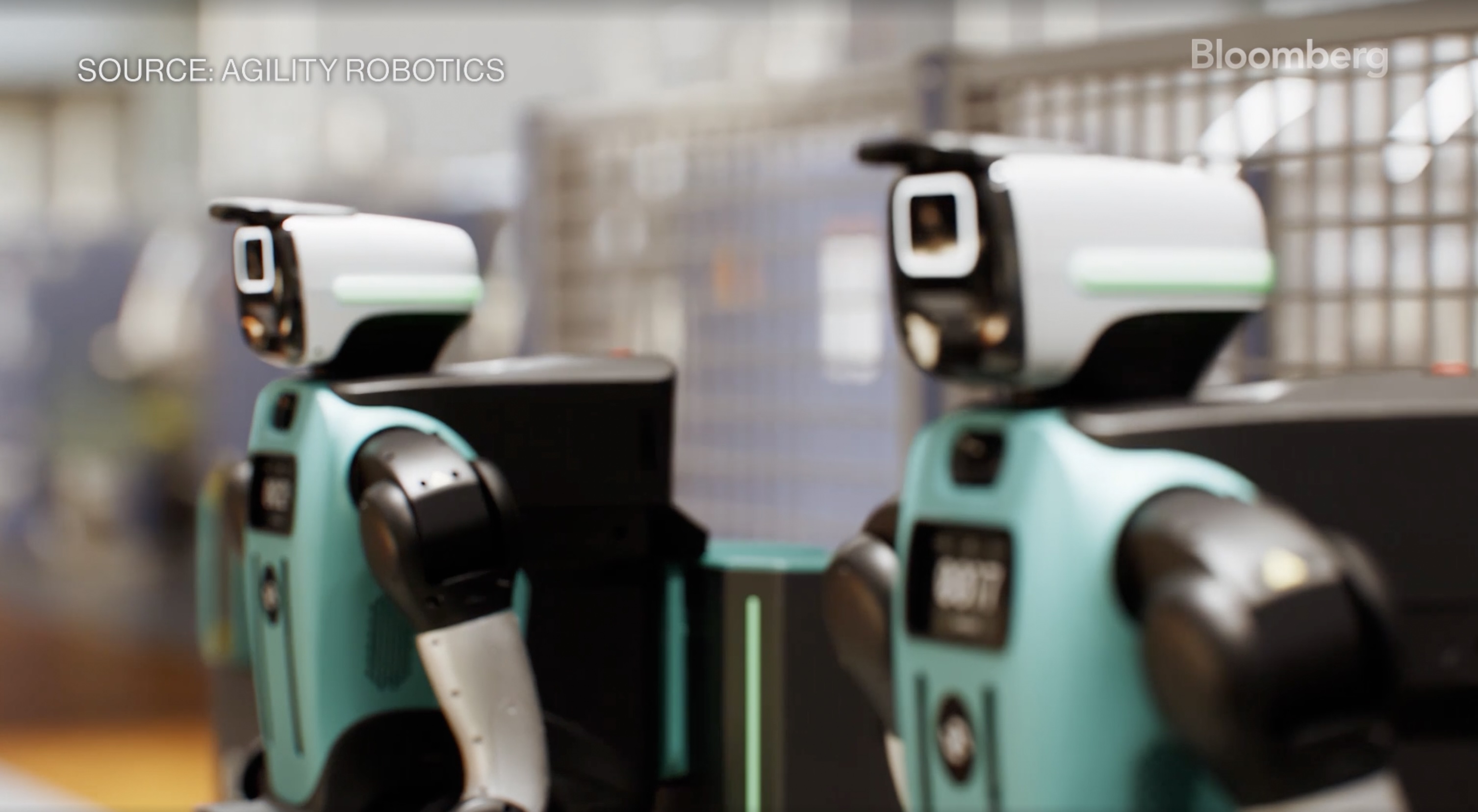
Agility CBO: Home Humanoids Need Cooperative Safety First
Daniel Diez, CBO at Agility, says the public fixation on home robots misses the key requirement: cooperative safety, meaning a robot can work in close proximity to people. He argues the path to the home runs through industry, where the technology must mature first. The remarks follow Agility's unveiling of Digit 5, a humanoid designed to work safely alongside humans, as reported by Bloomberg.
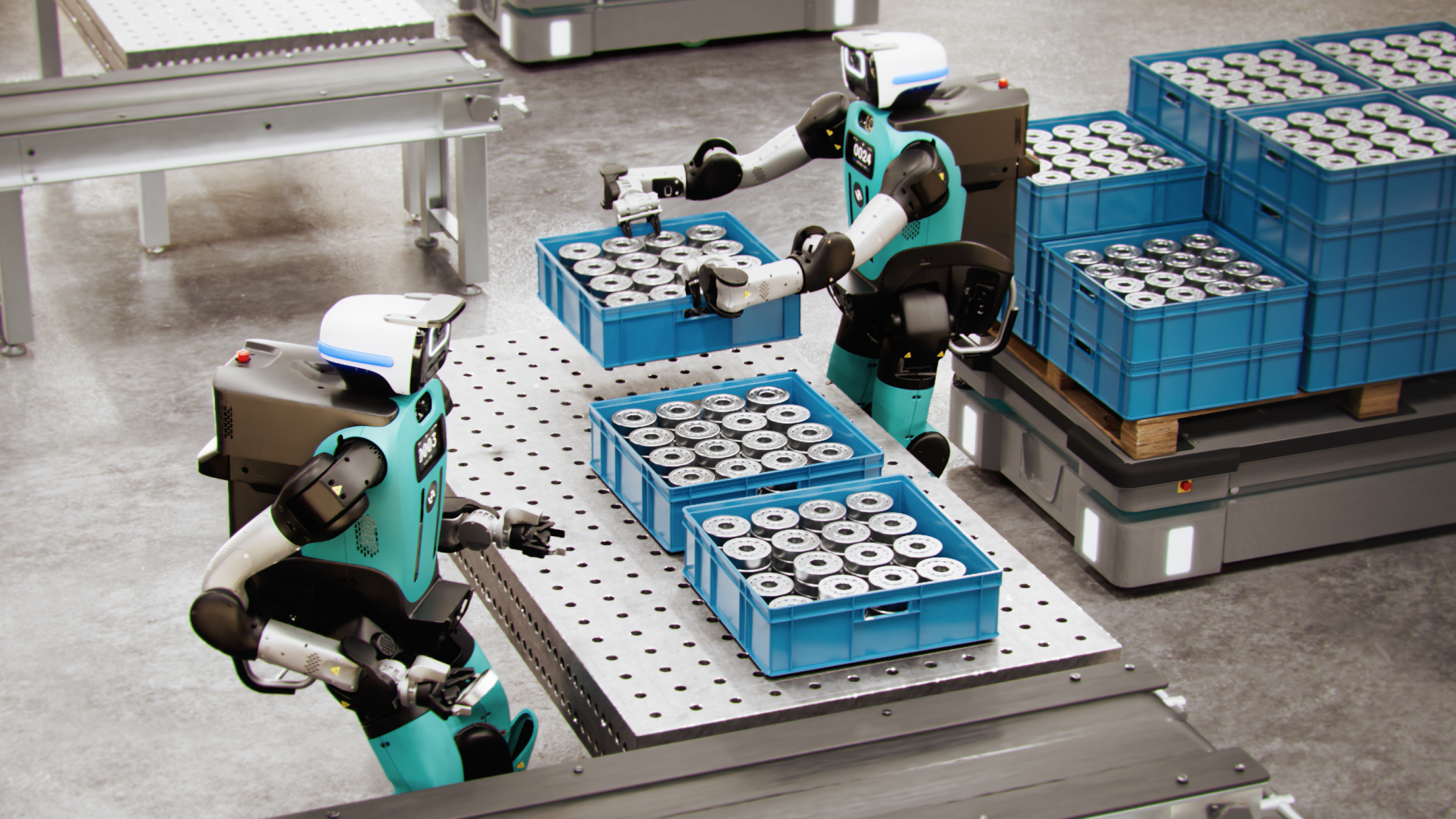
Agility's Digit 5 May Be the First Truly Safe Humanoid Robot Worker
Agility Robotics has unveiled Digit 5, a humanoid robot that can lift 23 kg, work safely alongside humans without barriers, and operate for over 20 hours a day. The company claims it is the first truly safe humanoid worker, with a cost expected to drop below $50,000 at scale.
Boston Dynamics updates Spot and Orbit for agentic factory workflows
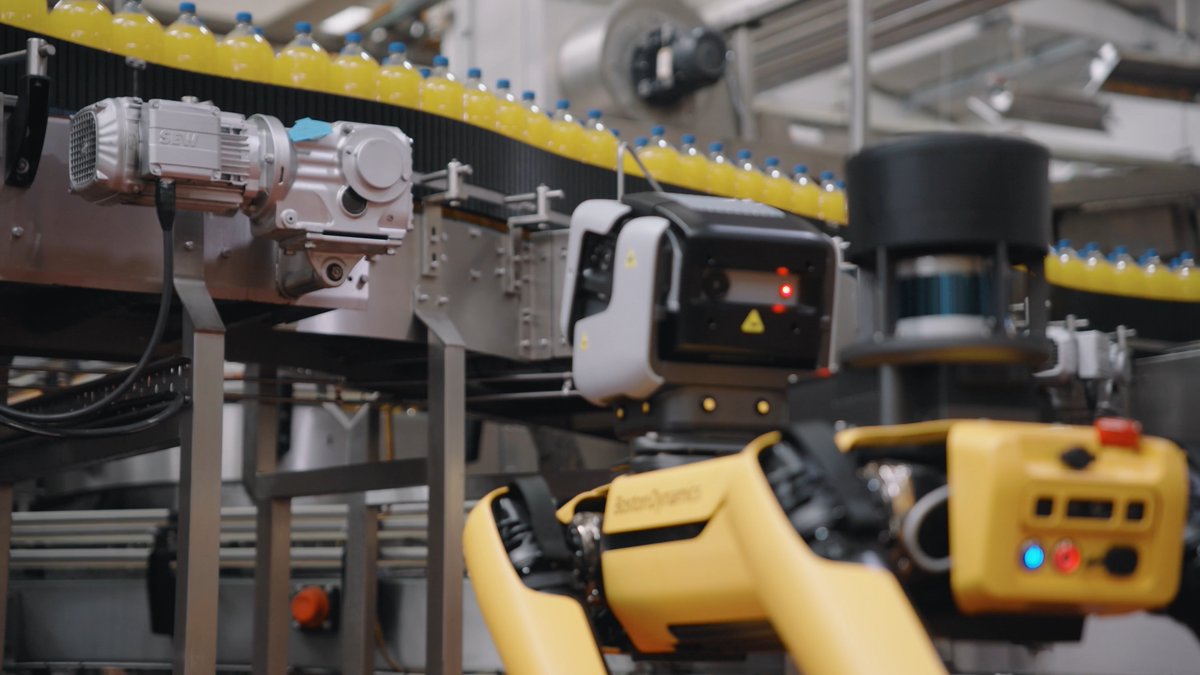
Boston Dynamics has released new updates to Spot and Orbit that break down operational silos and enable agentic workflows. The features allow bi-directional communication between robots and other factory systems, and let Spot take action in response to what it receives. The company presented the capabilities in an on-demand webinar.
Hangcha Group Plans 2.259 Billion Yuan Convertible Bonds for Forklift Robot Expansion
Hangcha Group plans to issue up to 2.259 billion yuan in convertible bonds to fund forklift robot projects. The company's intelligent logistics business revenue grew over 30% in the first half, boosting its robotics push.
MOONS' unveils LiDAR motor solution for intelligent driving
MOONS' Industries has introduced a LiDAR motor solution engineered for the demanding scanning requirements of intelligent driving systems. The company says the motor provides smooth, precise and reliable motion that supports high-quality point cloud data.

Shangluo Electronics Subsidiary's Robot Joint Modules and Motor Drives in Sampling Stage
Shangluo Electronics announced that its subsidiary Fengsuan Intelligence's robot joint modules and motor drive solutions are in the sampling and small-batch stages. This indicates early commercialization progress for the company's robotics components.
InOrbit.AI Releases OpenRobOps, an ISO 21423 Reference Implementation
InOrbit.AI has released OpenRobOps, an open-source robot operations and fleet management foundation. The software provides the industry's first reference implementation of the ISO 21423 interoperability standard, aiming to help OEMs avoid the build trap of custom back ends.
Hesai unveils MT series lidar for high-precision 3D mapping
Hesai Technology has introduced its new MT series lidar, which packs survey-grade, ultra-high spatial resolution into the smallest form factor in its class. The sensor offers an ultra-small beam spot, ultra-high ranging precision and cumulative scan densification. Hesai calls the MT a new benchmark for high-precision 3D lidar used in mapping.

Hangcha Group to Raise Up to 2.259 Billion Yuan for Forklift Robot Projects
Hangcha Group announced a plan to issue convertible bonds to raise up to 2.259 billion yuan, with proceeds earmarked for forklift robot smart factory, new energy forklift expansion, and robotics R&D projects. The move underscores the company's focus on automation and new energy.
CATL Subsidiary to Invest 1.12 Billion Yuan in AI and Embodied Intelligence Fund
CATL's wholly-owned subsidiary Ningbo Wending will contribute 1.12 billion yuan to a venture capital fund with total capital of 5.768 billion yuan, focusing on new energy, AI, and embodied intelligence.
UBTECH humanoid robot factory rolls out 1 unit per 10 minutes
UBTECH says its benchmark humanoid robot smart factory has gone live, rolling one robot off the line every 10 minutes. Capacity climbed from 1,000 to 10,000 units in under 9 months, supported by an intelligent manufacturing system built for 10,000-plus unit production. UBTECH calls the milestone just the beginning and says large-scale industrialization of humanoid robots is close.

Agility Robotics unveils Digit 5 humanoid for barrier-free work
Agility Robotics has introduced Digit 5, its next-generation humanoid robot, engineered for cooperatively safe work at scale. The company says it can operate in close proximity to people without the physical safety barriers that traditional automation requires. It is the fifth generation of the Digit platform.
Lumos Robotics launches NexCore robot skill workflow platform
Lumos Robotics has introduced Lumos NexCore, a platform that connects data, models, skills and robots in one continuous workflow. The company says users can train, test, improve and deploy a robot skill through the same system.

Agility Robotics unveils Digit 5 humanoid robot for industrial work
Agility Robotics has introduced Digit 5, a new humanoid robot built for cooperatively safe work at scale in industrial environments. CEO Peggy Johnson says the machine removes a major barrier to scaling humanoid robots in industrial settings.
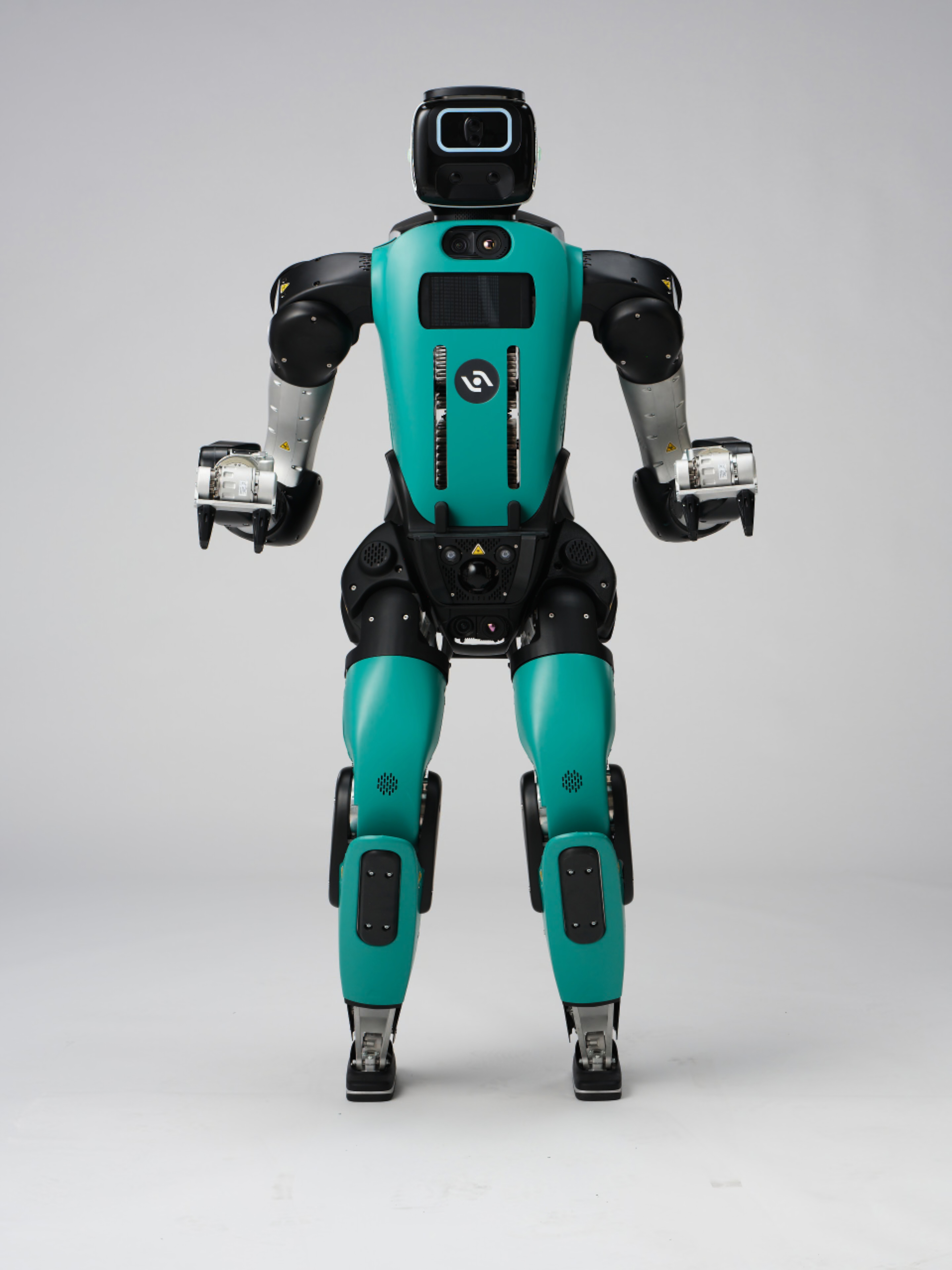
Agility Unveils Digit 5 Humanoid With New Legs, Batteries and Safety Upgrades
Agility Robotics has unveiled Digit 5, a humanoid with more human-like legs, upgraded batteries, faster charging and a safety architecture that lets it work near people without physical barriers. The company, which is going public via a SPAC merger with Churchill Capital Corp. XI, expects early access in the first half of 2027 and general availability by year's end, plus its first deployments outside North America.
LimX podcast: how far are robots from real work?
LimX Dynamics released a podcast episode featuring Rogier Bikker, co-founder of The Robot Bureau. He shared views on real-world robotics and the European market, why LimX stood out to him, and how the modular design behind TRON can support expansion. The episode notes that as automation takes hold in logistics and manufacturing, the next wave of value for humanoid robots lies in complex, low-volume, high-mix tasks.

Trump Calls Jensen Huang to Say AI Danger Theory Is a Scam
At the All-in Summit in Los Angeles, Donald Trump called Nvidia CEO Jensen Huang on speakerphone and dismissed AI danger warnings as a scam, calling data centers the oil of the next 20 to 25 years. Huang replied that Nvidia would not let AI deceleration happen, a stance that contrasts with recent calls by Anthropic and OpenAI leaders to slow powerful model development.
HONOR Robot Phone Opens Agent Skills Interface to Developers
HONOR says its Robot Phone offers an open Agent Skills interface that lets third-party developers build new experiences on the device's gimbal, perception and embodied-interaction capabilities.

HONOR Robot Phone Adds YOYO Robot Mode on MagicOS
HONOR says its Robot Phone, running on MagicOS, introduces a YOYO Robot Mode that combines multimodal perception, contextual understanding, gesture recognition and physical movement.
Sichuan Bets on Exoskeleton Robots: Wellness and Tourism Lead, Medical Rehab Core
Sichuan is accelerating exoskeleton robot adoption, with tourism and wellness as early scenarios and medical rehabilitation as the main track. Companies are advancing AI, brain-computer interfaces, and lightweight designs, while industry experts predict a consumer market boom within a few years.
HONOR Cuts Robot Phone Gimbal Size 65%, Boosts Strength 200%
According to HONOR, the gimbal system in its Robot Phone reduces overall system size by 65% compared with mainstream gimbals, while structural strength is increased by 200%.
HONOR Robot Phone Packs 4-DoF Gimbal, 100+ Patents
HONOR says the Robot Phone integrates an ultra-compact 4-DoF mechanical system built around its Titanium Agile Gimbal. The module went through 60 manufacturing processes, uses more than 100 precision components, and is backed by over 100 patents.
Oke Precision Says Whirlwind Milling Tools Can Process Humanoid Robot Lead Screws
Oke Precision (688308.SH) says its cutting tools can process robot components like lead screws and reducers, and its whirlwind milling tools are applicable to high-precision humanoid robot lead screws such as planetary roller screws.
Companion Robots Sell Nearly 300,000 Units: Embodied AI's First Real Market Is the Living Room
Fuzozo, a 399-yuan companion robot, has sold nearly 300,000 units in China, and Haivivi's BubblePal claimed similar volumes at its US launch, while UBTech's U1 ultra-bionic companion orders dwarf its full-size humanoid sales. The article argues that embodied AI's first validated market is emotional companionship in the home, not the factory.
Shendu Jizhi Brings Embodied AI to Classrooms with PrimeLite Robot
Shendu Jizhi's PrimeLite is a lightweight, 3D-printed robot designed for students to assemble and program. The company bundles curriculum, teacher training, and competition platforms to overcome cost and safety barriers in schools.
Blue Insect Embodied launches modular Mantis Standard humanoid robot from RMB 9,800
Blue Insect Embodied, a Xi’an Jiaotong University technology-transfer company, has launched the modular Mantis Standard humanoid robot, also called Xiaobai, starting at RMB 9,800. The robot offers 22 degrees of freedom, a 7 kg single-arm payload, sub-10 ms teleoperation latency, and a 3 m/s omnidirectional base.
Lei Jun Visits Unitree, Lightly Kicks Humanoid Robot to Test Balance
Lei Jun visited Unitree's Shanghai headquarters on September 14, where he watched humanoid robot demonstrations and lightly kicked one robot, which stepped back and regained balance. The visit followed Shunwei Capital's early investment in Unitree and came after sharp stock volatility, while Lei also stopped by Bilibili's Shanghai headquarters the same day.
Hualong Securities Maintains Buy on Yinlun as Liquid Cooling, Humanoid Robot Efforts Pay Off
Hualong Securities reiterated a “buy” rating on Yinlun Co., saying its digital and energy business is growing rapidly and its liquid cooling and humanoid robot layout is beginning to pay off.
Unitree Launches G1+ Humanoid Robot with Six Major Upgrades Across Motion and Perception
Unitree has launched the G1+, an upgraded humanoid robot with six improvements covering motion, perception, interaction, and endurance. The standard model costs RMB 95,000 in China, while the G1+ EDU version is available by contacting sales.
Sealand Securities Initiates Kaidi at Buy on Xinquan Tie-Up for Auto-Robotics Push
Sealand Securities has initiated coverage of Kaidi with a Buy rating, citing its strategic cooperation with Xinquan to pursue a dual automotive-and-robotics strategy. The brokerage sees the partnership opening a new growth phase.
D-Robotics and Agilex to host embodied AI seminar at TMU
D-Robotics and Agilex Robotics are heading to Toronto Metropolitan University for a Sept 18 seminar hosted by the TMU Robotics Council, covering robotic manipulation, embodied AI and real-time system integration. A live demo will run on the D-Robotics RDK S100 development platform alongside an Agilex robotic arm, showing how onboard computing and robotic hardware work together.
Zinova Bets on Tool-Use Intelligence, Not Dexterous Hands, for Construction Robots
Zinova, a 2025 spinout from RIC Robotics, proposes a non-dexterous gripper and force-feedback sensor instead of dexterous hands, enabling robots to use human tools across construction tasks. Its first public demo used LimX Dynamics' TRON 2 to perform a scaled tilt-up concrete workflow, though real-world site validation remains ahead.
Boston Dynamics Gives Atlas a Head—Deliberately Not a Human One
Boston Dynamics has added a head to its all-electric Atlas robot, but the design deliberately avoids human-like features. The head serves as a sensor carrier, state indicator, and safety interface for industrial environments, using light rings, rotation, and HDR stereo cameras.
Digital Huaxia's Chen Junmin: After Legs and Hands, Humanoid Robots Need Brains
Digital Huaxia cofounder Chen Junmin says humanoid robots have progressed from legs in 2024 to hands in 2025, and 2026 will be about brains—moving from demos into real scenarios. He argues model capabilities may be overestimated while engineering and real-world data are underestimated, and that no player has fully solved commercialization by ROI standards.
Unitree Humanoid Performs Live Pig Cholecystectomies in Nature Study
A UC San Diego team used Unitree's G1 humanoid robot to perform two laparoscopic cholecystectomies on live pigs, marking the first live surgery by a humanoid. While the system completed key steps, its precision and clinical maturity remain far below specialized surgical robots, with curved-trajectory errors about 10 times larger and frequent calibration pauses.
Dutch Scientists Build a Tickle Robot to Study Why Humans Are Ticklish
Researchers at Radboud University in the Netherlands have built a robot that uses a metal needle to tickle participants, aiming to quantify the phenomenon. A survey of 448 people found that tickling mostly occurs at home and targets predictable body parts like the sides, armpits, belly, and feet.
Tokyo's MW Mounts Robot Arms on Ceilings, Eyes 10,000 Robotic Homes a Year
Tokyo-based MW is embedding robotic arms into ceiling tracks instead of building bipedal humanoids, targeting 10,000 robot-equipped homes a year by 2035. The company controls the full chain from land acquisition to AI models, but current prices of $1.3–2.7 million keep the product in the high-end market.
Hesai Technology and JD.com Form Strategic Partnership to Accelerate Physical AI Deployment
Hesai Technology and JD Group have announced a strategic partnership to explore physical AI applications, leveraging high-precision 3D perception to support unmanned logistics and robotics.
Huanchuang Technology Passes Hearing, Focuses on Robot Vacuum Lidar, Product Prices Decline
Huanchuang Technology has passed its listing hearing, focusing on lidar for robot vacuums, but its main product prices are declining.
Panasonic's Unruly Nicobo Robot Tops 10,000 Sales, Builds Emotional Bonds
Panasonic's Nicobo, a 1.5 kg knitted home robot, has sold more than 10,000 units since 2023 despite—or because of—its deliberately limited abilities. Users treat it like a baby or family member, and Panasonic plans to add a large language model to its cloud service to spark imagination, not advanced conversation.
China's Industrial Robot Production Surges 34.6% in August, NBS Reports
In a September 15 press conference, the National Bureau of Statistics reported that China's industrial robot production rose 34.6% year-on-year in August. Output of 3D printing equipment and lithium-ion batteries also grew 29.9% and 57.2%, respectively.
Robot Inspired by Star-Nosed Mole Feels Its Way Without Vision
University of Southern Denmark researchers have proposed a concept robot that substitutes vision with a fluid-filled tactile sensor inspired by the star-nosed mole. The prototype remains conceptual, but it highlights a shift toward multimodal robot perception that combines touch with sight.
Dutch Jewelry Warehouse Deploys Chinese Robots for 14,000 Daily Order Lines
My Jewellery, a Dutch fashion jewelry brand growing 25–30% annually, has adopted Geek+’s RoboShuttle tote-to-person system to upgrade its nearly 9,000-square-meter warehouse. The dual-robot setup runs B2B and B2C fulfillment simultaneously, supports up to 14,000 order lines per day during peak periods, and has led the brand to launch a second-phase automation upgrade.