Company Research Report: Sharpa and the Full Stack Built From One Hand
Why read: the valuation rests less on any single specification than on four segments feeding each other, and a RMB 42 million supply bill is the only external read on shipment pace.
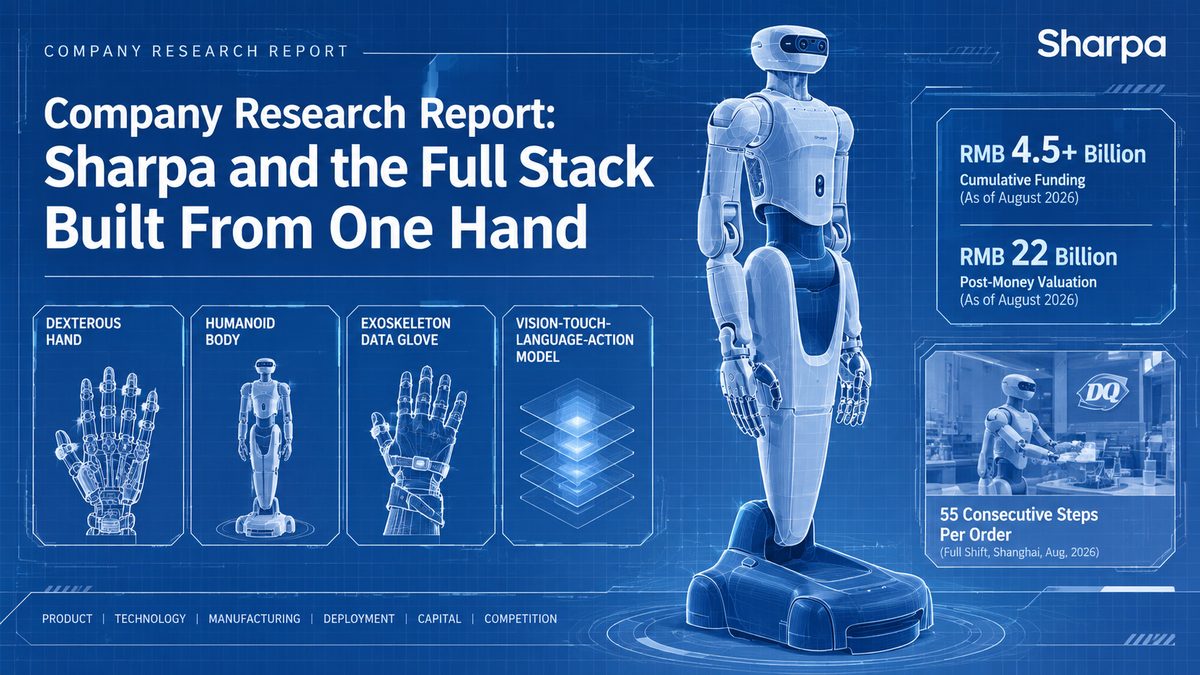
Sharpa (Shanghai Rift Valley Intelligent Technology Co., Ltd.) began with a tactile dexterous hand and extended upward into humanoid bodies, an exoskeleton data glove and a layered vision-touch-language-action model, with physical hardware for sale or on display in all four segments. In August 2026 the company disclosed more than RMB 4.5 billion of cumulative funding at a post-money valuation of RMB 22 billion, and in the same month its humanoid ran a full shift at a Dairy Queen store in Shanghai without any change to the store, completing 55 consecutive steps per order. Scope: product structure, technical coupling, manufacturing and supply, deployment evidence, capital and competition. Market sizing is calculated in-house with stated parameters and boundaries; funding and valuation follow media reports.
Article structure
- 1. Conclusion: what the valuation can be explained by
- 2. Demand: the automation gap in fine manipulation
- 3. The company: legal structure and team
- 4. Products and technology: coverage across four segments
- 5. Customers and delivery: what can and cannot be named
- 6. Supply chain: actuation and manufacturing from outside
- 7. Competition: three tiers and the price band
- 8. Capital and financials: funding history and a scale reference
- 9. Substitutability: four components of switching cost
- 10. Variables: four signals worth watching
1. Conclusion: what the valuation can be explained by
1.1 The judgement and its limits
Sharpa disclosed funding for the first time on 28 August 2026: more than RMB 4.5 billion in total, at a post-money valuation of RMB 22 billion, backed by Alibaba, Meituan, Tencent, JD.com and Transsion as industrial investors, alongside HongShan (Sequoia China), Qiming Venture Partners, Meituan DragonBall and Guanghe Venture Capital12Sharpa discloses more than RMB 4.5 billion in funding for the first timeView the entry below →16Sharpa raises over RMB 4.5 billion at a valuation of about RMB 22 billionView the entry below →. What public material can explain of that valuation rests on one structural fact: along the manipulation chain the company holds four segments at once, namely the contact end, the carrying body, the data-capture entry point and the action model, and all four exist as hardware that is either shipping or on display3D01 product pageView the entry below →4W01 product pageView the entry below →6AE01 product pageView the entry below →7CraftNet pageView the entry below →11Press release on three flagship products at IROS 2026View the entry below →.
That structure means the capability can only be verified through real work; no single component specification can stand in for continuous operation inside a store. A specification sheet states the degrees of freedom and tactile resolution of a hand, but not whether that hand can complete pouring, cabinet opening and repeated topping across a long task sequence. Model capability, likewise, only becomes visible once a body runs in a real environment. The company has written this route into its own material, listing field autonomy alongside the hand platform and the layered model as its three lines of work9About pageView the entry below →.
1.2 Two sets of facts behind the judgement
On the product side the evidence is the form and specification of four devices. W01 is a 22-active-DoF hand built to a one-to-one human scale; W02 reduces the active degrees of freedom to 21 and brings the whole hand under 750 grams; D01 is a body with 66 degrees of freedom including both hands and electronic skin across the chassis; AE01 is an exoskeleton data glove with 22 encoders3D01 product pageView the entry below →4W01 product pageView the entry below →5W02 product pageView the entry below →6AE01 product pageView the entry below →21Sharpa unveils full-body tactile robot, 21-DoF lightweight hand and force-feedback glove at IROSView the entry below →. On the manufacturing side the evidence comes from two Hong Kong Stock Exchange announcements by Hesai Group. Between 25 March and 30 June 2026 Hesai supplied the company with LiDAR, robotic actuators, and the manufacturing and support services that integrate those actuators into dexterous hands, with roughly RMB 42 million actually incurred; on 31 July the annual cap for those transactions was revised from RMB 100 million to RMB 300 million, of which actuators moved from RMB 75 million to RMB 221 million1Revision of Annual Cap under the Revised Supply of Products Framework Agreement (HKEX; SEC Exhibit 99.2)View the entry below →2Continuing Connected Transactions with Sharpa (HKEX)View the entry below →.
The delivery evidence sits at a Dairy Queen store on Wujiang Road in Shanghai. From 29 August 2026 the humanoid has completed the full sequence of 55 steps required for one Blizzard within the 10:00 to 22:00 trading window, using the store's existing equipment, ingredients and workflow without modification. One cup takes about six minutes, against two to three minutes for an experienced crew member10Sharpa x DQ case pageView the entry below →14RMB 4.5 billion: Alibaba, Meituan, Tencent and JD.com bet on an AI robotics companyView the entry below → (Figure 1).
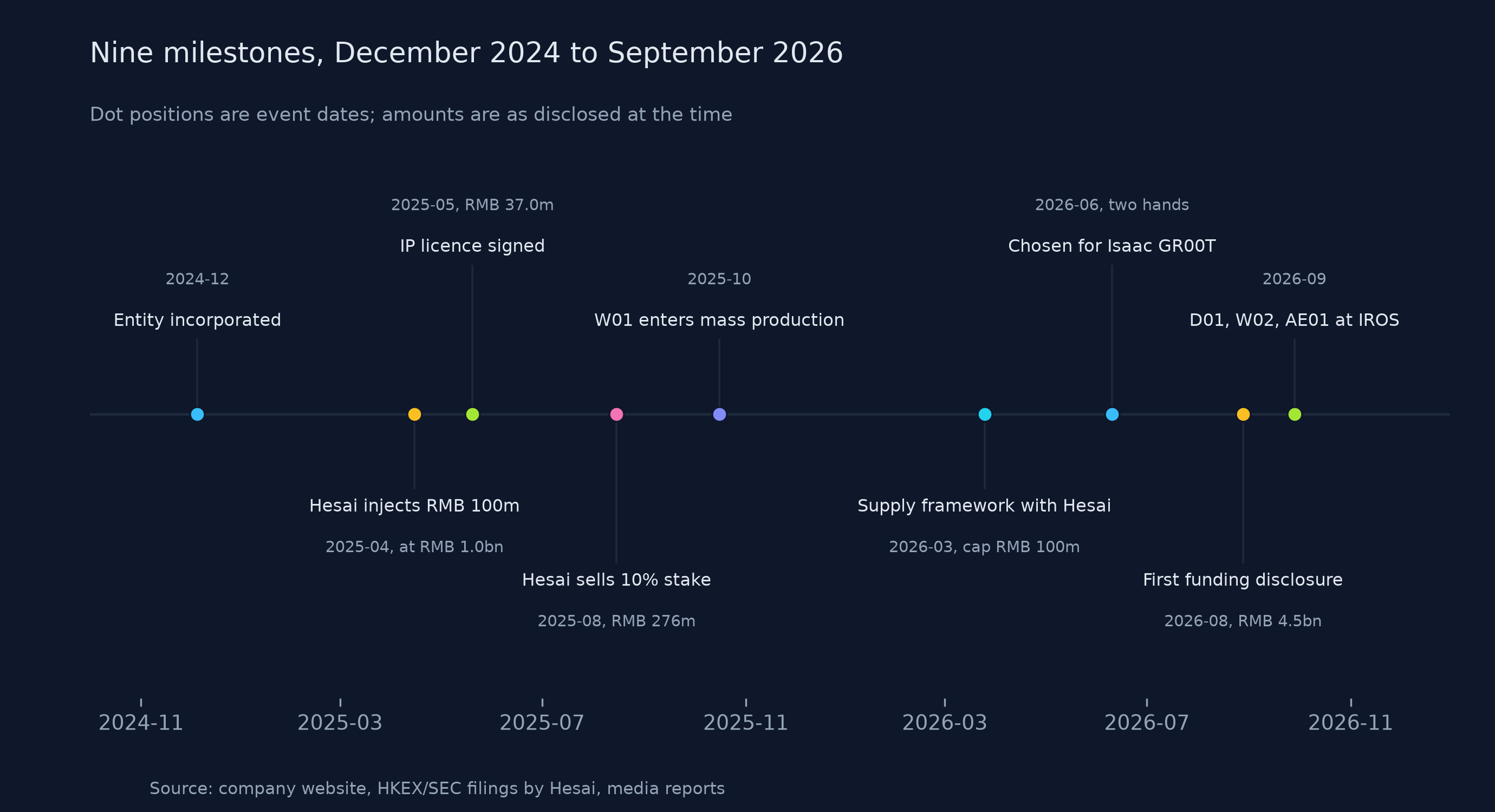
Fig 1 Timeline of corporate, funding, product and supply milestones, December 2024 to September 2026. Sources: company website, Hesai filings with the HKEX and the SEC, media reports.
Three limits have to be stated alongside this. Revenue is not disclosed; externally, only the purchase amount on the Hesai side is available, and that is a cost to Sharpa rather than income1Revision of Annual Cap under the Revised Supply of Products Framework Agreement (HKEX; SEC Exhibit 99.2)View the entry below →. Only one store can be named, so there is no second sample for replication13A Shanghai robot makes dessert, valued at RMB 22 billionView the entry below →. The mobility of D01, the price of the full range and delivery lead times have not been published21Sharpa unveils full-body tactile robot, 21-DoF lightweight hand and force-feedback glove at IROSView the entry below →. Together these three limits confine what can be verified to the product holding up, one deployment holding up, and replication not yet having begun.
2. Demand: the automation gap in fine manipulation
2.1 Three kinds of buyer
Buyers of dexterous manipulation fall into three groups with different decision criteria. Robot OEMs buy a component, fitting a hand onto their own body in exchange for fine manipulation, and they decide on specifications and integration difficulty. Research institutions and universities buy a platform, using teleoperation to collect data and deploying policies on real hardware, and they decide on reproducibility. Restaurants, retailers and service operators buy a body that can work a shift, and they decide on payback at a single site4W01 product pageView the entry below →.
2.2 Where existing options stop working
Four routes currently supply this demand. Low-DoF grippers and dedicated machines are cheap and reliable, at the cost of re-tooling whenever the tool or workpiece changes. Imported high-DoF hands set the performance ceiling, with unit prices long reported in the million-yuan range and customers concentrated in leading laboratories. Domestic mid-range hands have pushed prices to CNY 20,000 to 50,000 each, with comparatively limited tactile capability. The fourth route is to keep using people: one Blizzard takes 55 steps, and a store employee needs about a week of training to master them22Domestic dexterous hand prices fall to CNY 3,900View the entry below →18From lab to line: dexterous hand sales surgeView the entry below →14RMB 4.5 billion: Alibaba, Meituan, Tencent and JD.com bet on an AI robotics companyView the entry below →. The gap sits where a task requires no modification to the environment, several consecutive steps, and contact sensing at the same time.
2.3 The conditions under which demand gets met
The founder frames long-run returns through three variables that can each be checked externally: whether manipulation approaches human level through continuous optimisation, whether the equipment can last more than ten years, and whether mass-production cost can fall from the current hundreds of thousands of yuan to the region of CNY 100,00014RMB 4.5 billion: Alibaba, Meituan, Tencent and JD.com bet on an AI robotics companyView the entry below →. The threshold is those three moving in the same direction at once; a single demonstration does not constitute one.
2.4 Sizing the market
The company publishes no market-size estimate, so the calculation below is in-house, with three parameters.
| Parameter | Value | Basis and boundary consequence |
|---|---|---|
| Global new dexterous hands in 2026 | 88,000 to 117,000 units | 70,200 units expected in China in 2026 (GGII) times a Chinese share of 60 to 80 per cent (assumption, no public data); at 40 per cent, units rise to 176,000 and the total nearly doubles |
| Average unit price | CNY 50,000 to 100,000 | Linkage designs at CNY 20,000 to 50,000, tendon or direct-drive designs above CNY 100,000; at linkage prices the lower bound falls by roughly 60 per cent |
| Serviceable share | 15 to 25 per cent | Assumption, no public data, inferred from the company's high-end positioning; at 50 per cent the serviceable market nearly doubles |
The endpoint arithmetic is 88,000 units at CNY 50,000, giving RMB 4.4 billion, and 117,000 units at CNY 100,000, giving RMB 11.7 billion; the serviceable market runs from RMB 660 million to RMB 2.93 billion. As a sensitivity check, a 40 per cent Chinese share, high-end pricing and a 50 per cent serviceable share lift that to RMB 8.78 billion, roughly 13 times the lower bound. The order-of-magnitude spread comes from two parameters lacking public figures, not from measurement precision. The company also offers no market-size statement, so the estimate cannot be reconciled against one.
2.5 The pace of demand
Purchasing is still dominated by research and data collection. A representative of the joint venture formed by Joyson Electronics told China Business Journal that, judged by end use, demand comes mainly from research, data collection and model training, with the share entering production workstations still very low18From lab to line: dexterous hand sales surgeView the entry below →. Sharpa's own sequence matches this: prove one commercial scenario end to end first, then discuss replication, with entry into the home placed from 202812Sharpa discloses more than RMB 4.5 billion in funding for the first timeView the entry below →.
3. The company: legal structure and team
3.1 Structure and shareholding
The legal entity is Shanghai Rift Valley Intelligent Technology Co., Ltd., incorporated under PRC law on 5 December 2024 and a subsidiary of Sharpa Group, an exempted company registered in the Cayman Islands2Continuing Connected Transactions with Sharpa (HKEX)View the entry below →. The company describes its layout as a global headquarters in Singapore, manufacturing and R&D in Shanghai, and business operations in Mountain View, with the site footer naming Sharpa Pte Ltd10Sharpa x DQ case pageView the entry below →20Sharpa raises over RMB 4.5 billion as it puts robots to work at Dairy QueenView the entry below →. Some Chinese reports place the headquarters in Shanghai; the difference turns on whether the operational base or the registered location is used.
One shareholding point needs stating. Hesai's announcements record that the three co-founders together indirectly hold a majority of the voting rights in the company, which makes Sharpa a connected person of Hesai and brings the transactions under Chapter 14A of the listing rules1Revision of Annual Cap under the Revised Supply of Products Framework Agreement (HKEX; SEC Exhibit 99.2)View the entry below →2Continuing Connected Transactions with Sharpa (HKEX)View the entry below →. That relationship explains where the figures in Chapter 6 come from. Hesai's 2025 annual report disclosed that the three executives have served as directors of Sharpa since January 202613A Shanghai robot makes dessert, valued at RMB 22 billionView the entry below →.
3.2 The founders' industrial record
The three co-founders previously founded Hesai Technology together, serving as chief executive, chief technology officer and chief scientist, and all three are executive directors of Hesai1Revision of Annual Cap under the Revised Supply of Products Framework Agreement (HKEX; SEC Exhibit 99.2)View the entry below →. Li Yifan trained in precision instruments and robot motion control, Xiang Shaoqing in mechanical and electrical engineering and previously worked at Apple on iPhone hardware system integration12Sharpa discloses more than RMB 4.5 billion in funding for the first timeView the entry below →. The record matters less as credentials than as experience taking a hardware line from high cost to volume production: LiDAR unit prices fell from tens of thousands of dollars to the thousand-yuan level under the same team25Inside Sharpa: why a company with no profit is valued close to HesaiView the entry below →. Volume manufacturing is the part of this business that is hardest to build from scratch, and the founding team's composition meant it existed from day one.
3.3 Size and R&D allocation
The company states a headcount of just over 200, with roughly 80 per cent in R&D, plus Sharpa Academia for research and foundation-model work, and splits research resources half to hardware and half to software12Sharpa discloses more than RMB 4.5 billion in funding for the first timeView the entry below →13A Shanghai robot makes dessert, valued at RMB 22 billionView the entry below →. This allocation maps onto the four-segment structure: hardware to the hand and the body, software to the model and the data. One reservation on the figure: LinkedIn shows 77 employees, which counts registered profiles and is not directly comparable to the company figure24Sharpa company pageView the entry below →.
4. Products and technology: coverage across four segments
4.1 Contact end: degrees of freedom traded for touch and weight
W01 has 22 active degrees of freedom at a one-to-one human scale, with a palm-width to hand-length ratio of about 0.618 and a dynamic tactile array in the fingertips that senses pressure, slip, force change and contact location4W01 product pageView the entry below →. W02 cuts the active degrees of freedom to 21, brings the hand under 750 grams, extends touch from the fingertips to electronic skin over fingers and palm, and reaches IP54 protection5W02 product pageView the entry below →21Sharpa unveils full-body tactile robot, 21-DoF lightweight hand and force-feedback glove at IROSView the entry below →. Trading one degree of freedom for lower weight and a larger sensing area shows where the iteration is heading: tactile coverage and integrability.
Specifications only mean something against a benchmark. Twenty-two degrees of freedom sits in the mainstream of high-DoF hands, the third-generation Tesla Optimus hand is also reported at 22, and domestic vendors already offer research versions above 40, so the degrees of freedom are not the differentiator; the differentiator is tactile integration within the same volume18From lab to line: dexterous hand sales surgeView the entry below →25Inside Sharpa: why a company with no profit is valued close to HesaiView the entry below →. A researcher at Shanghai AI Laboratory, in a published comment, described Sharpa as the first maker to integrate visuo-tactile sensing into the fingertip, noting that the structure requires direct drive and self-developed motors25Inside Sharpa: why a company with no profit is valued close to HesaiView the entry below →. The comment comes from an outside researcher rather than the company, which gives it more weight than company material, though it remains a qualitative judgement.
4.2 The body: extending touch beyond the hand
D01's specification sheet gives a checkable set of numbers: 66 degrees of freedom including both hands, 7-DoF arms with one-to-one spherical wrists, about 40 kg without the chassis, an adjustable height between 1,109 and 1,624 mm, a rated payload of 5 kg per arm, end-effector speed above 10.5 m/s, repeatability of 0.2 mm, a control frequency of 1,000 Hz, an NVIDIA Jetson Thor main processor, and four-layer electronic skin with 0.2 N force resolution sampled at 100 Hz3D01 product pageView the entry below →.
Speed, payload and precision usually trade against each other, and the company presents all three together, explaining the combination through spherical wrist joints and an arm payload-to-weight ratio near one to one3D01 product pageView the entry below →11Press release on three flagship products at IROS 2026View the entry below →. North is another model in the same line, specified at 67 degrees of freedom on the company site, with some reports giving 708North pageView the entry below →15Alibaba and Tencent back a dexterous manipulation unicornView the entry below →20Sharpa raises over RMB 4.5 billion as it puts robots to work at Dairy QueenView the entry below →.
4.3 The data entry point: a glove built to the hand
AE01 is an exoskeleton data glove that reads hand joints with 22 encoders and provides 256 levels of haptic feedback at each fingertip, which the company says requires no calibration6AE01 product pageView the entry below →. Its value lies in the isomorphism with the hand: 22 encoders map one to one onto the joints of W01, so a human demonstration transfers directly without retargeting6AE01 product pageView the entry below →11Press release on three flagship products at IROS 2026View the entry below →.
4.4 The model and the interfaces between segments
CraftNet is a layered vision-touch-language-action model split by inference frequency into three tiers: a planning tier at roughly 1 Hz that interprets the task and sequences it, a motion tier at roughly 10 Hz that plans the approach, and a contact tier at roughly 100 Hz that handles tactile feedback and fine motion, with state passed back upward for replanning7CraftNet pageView the entry below →9About pageView the entry below →. Running touch in the innermost tier at the highest frequency is the main difference from other layered models, because tactile change happens on a sub-second scale9About pageView the entry below → (Figure 3).
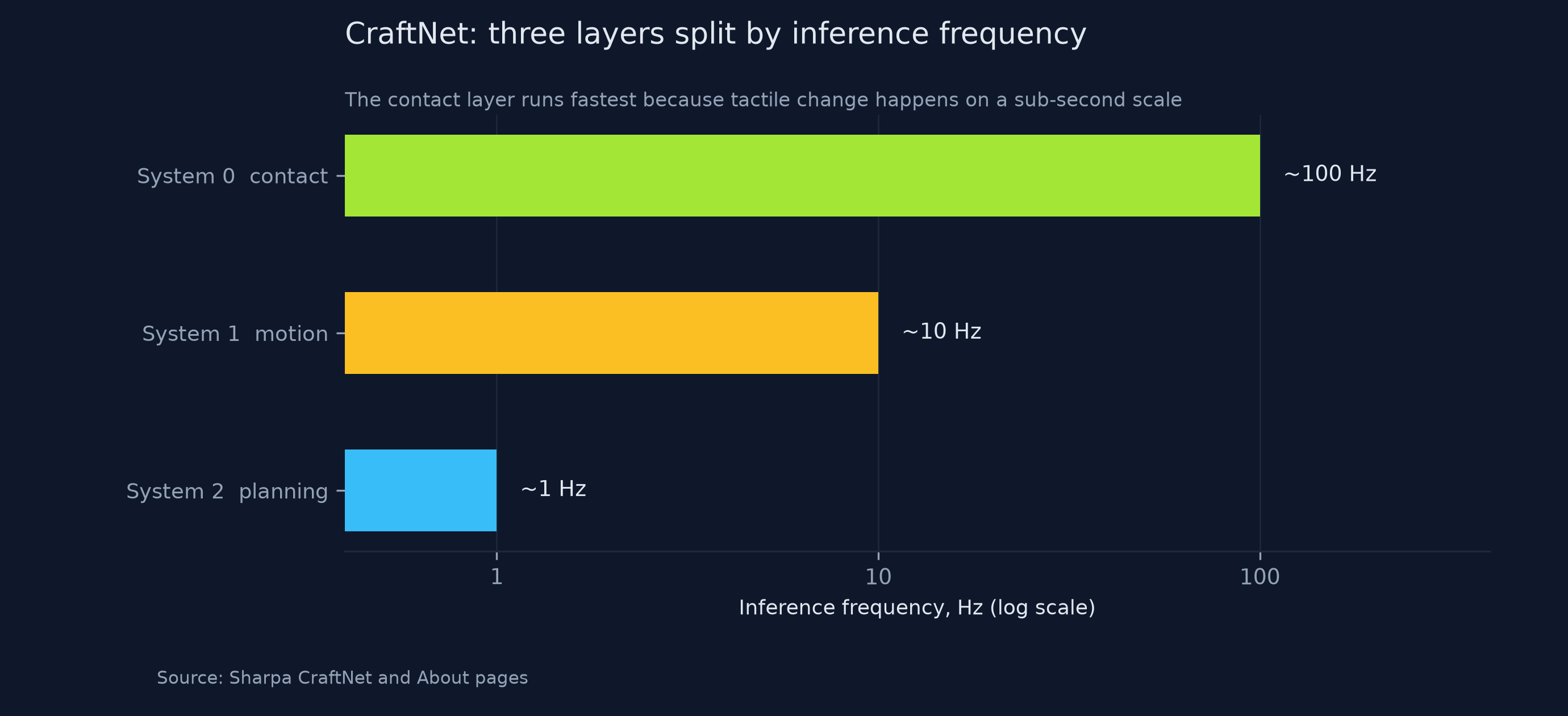
Fig 2 CraftNet's three tiers split by inference frequency. Source: Sharpa CraftNet and About pages.
The four segments chain by signal flow: the glove captures human motion, the model trains on it, the hand generates tactile signals in real contact, the body feeds those signals together with vision and language into the model, and failure cases produced in operation return to training6AE01 product pageView the entry below →7CraftNet pageView the entry below →9About pageView the entry below →. That loop is closed in hardware and still rests on company reporting in effect.
5. Customers and delivery: what can and cannot be named
5.1 Two names that can be cited
Public material allows two partners to be named. The first is Dairy Queen: since 29 August 2026 the store on Wujiang Road in Shanghai has used the humanoid for the full Blizzard workflow, with robotic and staffed counters operating side by side10Sharpa x DQ case pageView the entry below →14RMB 4.5 billion: Alibaba, Meituan, Tencent and JD.com bet on an AI robotics companyView the entry below →. The second is NVIDIA: the Isaac GR00T reference humanoid released in June 2026 uses two Sharpa hands paired with a Unitree H2 Plus body16Sharpa raises over RMB 4.5 billion at a valuation of about RMB 22 billionView the entry below →.
Beyond these, the company discloses customer categories rather than names, dividing buyers into researchers, robot manufacturers and enterprises4W01 product pageView the entry below →; Chinese reports describe customers as leading robotics firms, research institutes and universities13A Shanghai robot makes dessert, valued at RMB 22 billionView the entry below →. The text can therefore go no further than categories: two nameable customers, with names, unit counts and amounts undisclosed for the rest. Official disclosure, media-reported events and third-party inference carry three different levels of certainty and cannot be merged into an assertion of delivery.
5.2 What the 55 steps involve
The store scenario matters for its task structure rather than its demo value. One Oreo Blizzard involves 55 consecutive steps from order intake through cup pickup and dispensing to blending and inverted handover, without cuts or intervention10Sharpa x DQ case pageView the entry below →. Several steps demand more contact control than ordinary grasping: the metal ring must be held by thumb and index finger throughout blending, the cabinet uses a narrow human-scale handle, the three scoops of Oreo must be tracked against the robot's own progress because every scoop looks the same, and the inverted flip requires grip correction as the centre of gravity shifts10Sharpa x DQ case pageView the entry below →.
The company says tactile signals participate directly in 98 per cent of those steps14RMB 4.5 billion: Alibaba, Meituan, Tencent and JD.com bet on an AI robotics companyView the entry below →. That ratio is company-reported and has not been independently checked. What can be checked externally is cycle time: about six minutes per cup against two to three minutes for an experienced crew member, which the company explains as a deliberate trade of speed for reliability at this stage14RMB 4.5 billion: Alibaba, Meituan, Tencent and JD.com bet on an AI robotics companyView the entry below →.
5.3 Delivery volume
Delivery can only be stated in two ways. On the body side it is a single store, one nameable site with no second sample10Sharpa x DQ case pageView the entry below →13A Shanghai robot makes dessert, valued at RMB 22 billionView the entry below →. On the component side it is indirect: Hesai recorded roughly RMB 42 million actually incurred in supplying actuators and manufacturing services in the first half of 2026, and stated that second-half actuator volume is expected to be about nine times the first half1Revision of Annual Cap under the Revised Supply of Products Framework Agreement (HKEX; SEC Exhibit 99.2)View the entry below →. Both figures describe purchasing rather than sales. Unit counts, order values and concentration are undisclosed, so concentration cannot be quantified.
6. Supply chain: actuation and manufacturing from outside
6.1 Upstream structure
Actuation and manufacturing come from Hesai, and this is the most complete evidence in the report. The framework agreement of 25 March 2026 provides for Hesai to supply LiDAR products and robotic actuators, and to provide manufacturing and support services that integrate actuators into dexterous hands, covering ancillary material procurement, assembly, testing, packaging and delivery2Continuing Connected Transactions with Sharpa (HKEX)View the entry below →. Pricing falls into two classes: LiDAR at market price referenced to at least three recent orders to independent third parties, and actuators on a cost-plus basis given their high degree of customisation2Continuing Connected Transactions with Sharpa (HKEX)View the entry below →.
The revision of 31 July 2026 gives three checkable numbers. The annual cap rose from RMB 100 million to RMB 300 million, split as RMB 2 million for LiDAR, RMB 221 million for actuators, RMB 53 million for manufacturing and support, and RMB 24 million as a buffer; RMB 42 million had been incurred by mid-year; and the cost-plus margin range for actuators and manufacturing was lifted from 40 to 50 per cent and 35 to 45 per cent respectively to 70 to 80 per cent1Revision of Annual Cap under the Revised Supply of Products Framework Agreement (HKEX; SEC Exhibit 99.2)View the entry below →. The stated reason is that a rising share of the key components integrated into Sharpa's products is now developed in-house by Hesai, and that specifications have evolved with performance requirements1Revision of Annual Cap under the Revised Supply of Products Framework Agreement (HKEX; SEC Exhibit 99.2)View the entry below → (Figure 4).
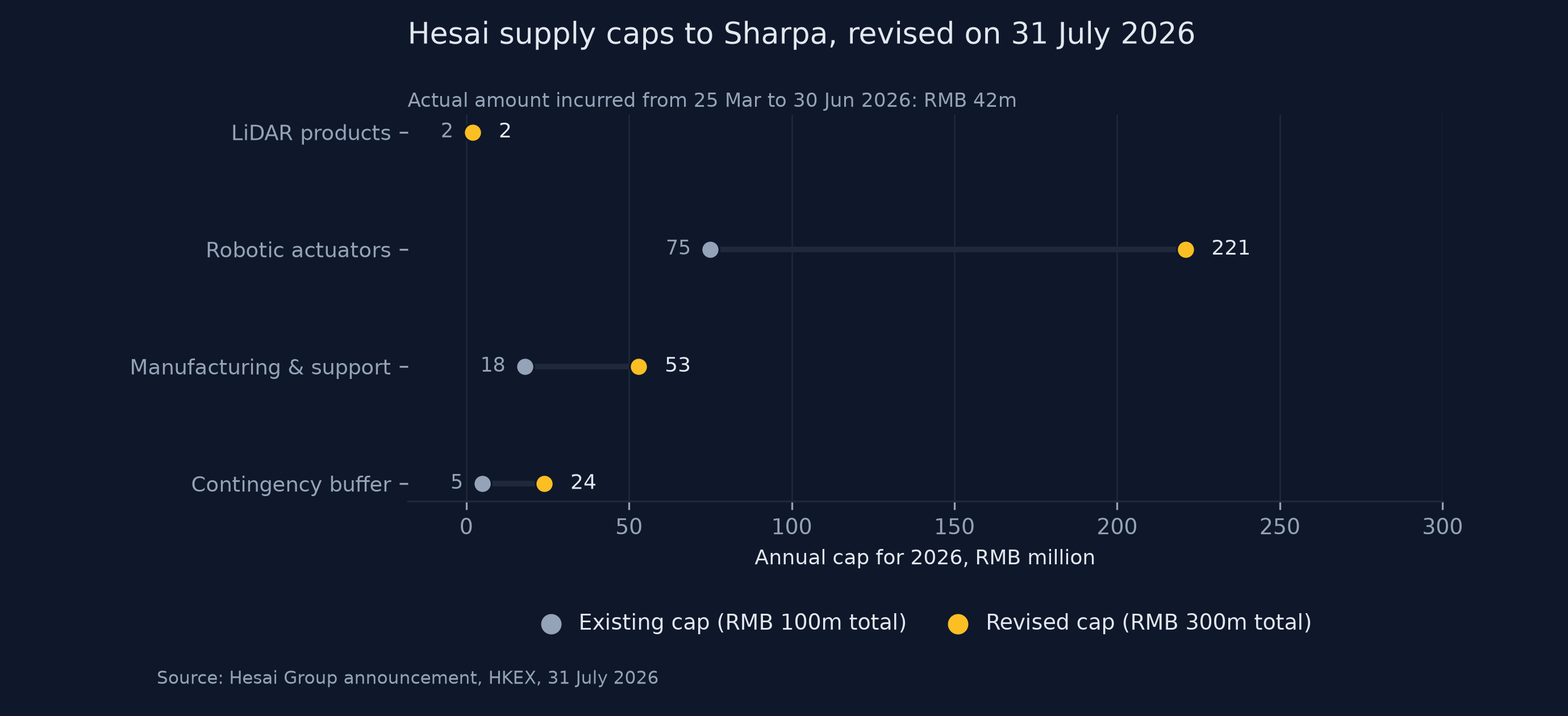
Fig 3 Hesai's 2026 annual cap for supplies to Sharpa, before and after revision. Source: Hesai Group announcement, HKEX, 31 July 2026.
Two things follow. Capacity and quality systems are not paper promises, since the counterparty is a listed company with automotive-grade manufacturing experience; and shipment pace has an external figure to check against, because purchasing volume shows up in the next filing. One boundary applies throughout: RMB 42 million is a purchase amount, not revenue, and the two point in opposite directions.
6.2 Downstream chains
Three chains run downstream. Components go direct to OEMs, with NVIDIA's reference design taking two hands as publicly verifiable evidence16Sharpa raises over RMB 4.5 billion at a valuation of about RMB 22 billionView the entry below →. Bodies and components go direct to researchers, with the company positioning itself on teleoperated data capture and policy deployment on real hardware4W01 product pageView the entry below →. Bodies go to end sites, with no nameable end site besides the Dairy Queen store10Sharpa x DQ case pageView the entry below →.
7. Competition: three tiers and the price band
7.1 Defining the competitive set
Competition is defined by the same budget rather than the same product category. Direct competition is high-DoF hands at similar customers and price levels, including Inspire Robots, LinkerBot, BrainCo, the hand unit spun off by AgiBot, and PaXini Tech, with Inspire Robots shipping more than 10,000 units in 202518From lab to line: dexterous hand sales surgeView the entry below →19LinkerBot seeks a RMB 40 billion valuationView the entry below →. Indirect competition comes from robot makers developing hands in-house, including Tesla, Unitree and AgiBot18From lab to line: dexterous hand sales surgeView the entry below →. Substitution comes from manual labour and dedicated automation, against which Sharpa runs alongside staffed counters rather than replacing a line10Sharpa x DQ case pageView the entry below →.
7.2 The price bands
Published prices fall into three bands. The entry band is domestic linkage designs at CNY 20,000 to 50,000 per hand; the high band is direct-drive and tendon designs generally above CNY 100,000, with overseas high-end direct-drive hands reaching CNY 400,000 to 600,000; above that sit imported hands used by a handful of laboratories at around CNY 1 million and more18From lab to line: dexterous hand sales surgeView the entry below →22Domestic dexterous hand prices fall to CNY 3,900View the entry below →. Sharpa publishes no prices, with every product page offering only a quote request3D01 product pageView the entry below →4W01 product pageView the entry below →, and a Chinese report citing public data puts one hand at about USD 50,000, a single-source figure13A Shanghai robot makes dessert, valued at RMB 22 billionView the entry below → (Figure 2).
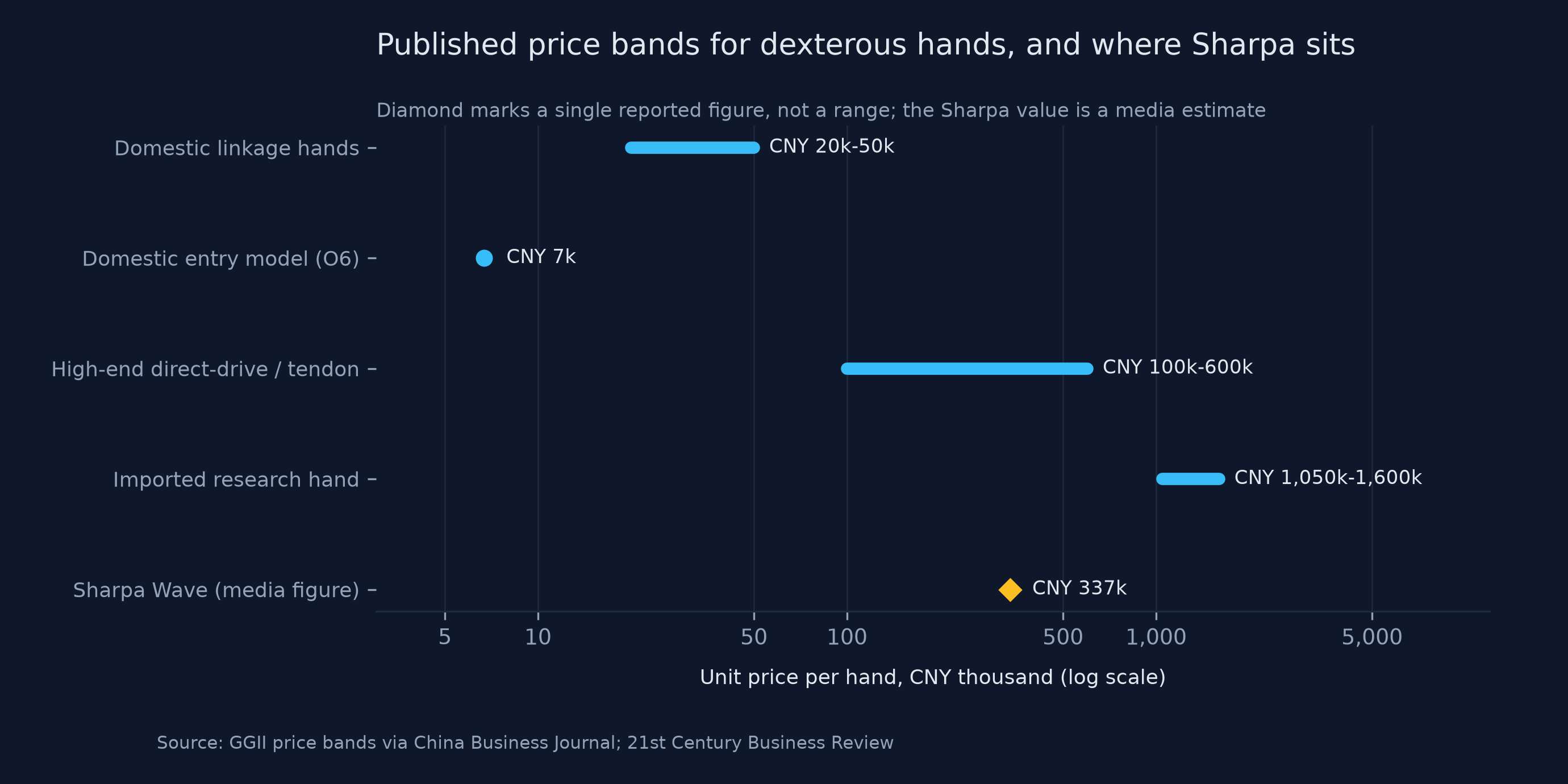
Fig 4 Published price bands for dexterous hands and Sharpa's position; diamonds mark single reported figures rather than ranges. Sources: GGII price bands via China Business Journal; 21st Century Business Review.
Plotted against price and fine-manipulation capability, the lower-left is crowded and the upper-right is sparse. Sharpa sits in the upper-right: pricing at the top of comparable products, capability described around tactile coverage and body integration, with few public peers in the same quadrant and long procurement cycles because buyers must integrate either a component into their own body or a body into their own workflow. That position runs against the current direction of price cuts in the industry, and its logic has to be answered by the customer mix. Research buyers and high-end OEMs weigh capability ceilings more than price, while food-service operators weigh price more than degrees of freedom4W01 product pageView the entry below →13A Shanghai robot makes dessert, valued at RMB 22 billionView the entry below →.
8. Capital and financials: funding history and a scale reference
8.1 Funding and equity timeline
Six funding events are publicly traceable. In April 2025 Hesai injected RMB 100 million in cash at a valuation of RMB 1 billion. In May 2025 the two sides signed an IP licence and transfer agreement for RMB 36.97 million. In August 2025 Hesai transferred a 10 per cent stake to two independent third parties for RMB 276 million in cash, implying a valuation above RMB 2.7 billion. In December 2025 a second IP transfer agreement followed at RMB 4.02 million. In March 2026 Hesai disclosed the relationship in its annual report. In August 2026 the cumulative RMB 4.5 billion and the RMB 22 billion post-money valuation were made public for the first time13A Shanghai robot makes dessert, valued at RMB 22 billionView the entry below →12Sharpa discloses more than RMB 4.5 billion in funding for the first timeView the entry below →. The span from RMB 1 billion to RMB 22 billion is sixteen months.
8.2 Revenue: what is available and what is missing
Revenue is undisclosed, the largest data gap in the report. Two substitutions are available. The founder says the company draws hardware revenue from selling bodies and hands, which eases the pressure12Sharpa discloses more than RMB 4.5 billion in funding for the first timeView the entry below →. Chinese reporting describes the current mix as one store for bodies with limited shipments, with revenue still resting on hands and other components13A Shanghai robot makes dessert, valued at RMB 22 billionView the entry below →. Both point the same way without numbers. The text can therefore state that hardware revenue exists and the amount is undisclosed, and cannot state either that there is no revenue or that revenue has reached scale.
8.3 A scale reference for the valuation
Where revenue and unit volume are missing, a scale reference beats an inferred multiple. At the media figure of USD 50,000 per hand, equivalent to about CNY 337,000, a RMB 22 billion valuation corresponds to the sales value of about 65,000 hands; GGII expects 70,200 units to be sold in China in 202613A Shanghai robot makes dessert, valued at RMB 22 billionView the entry below →18From lab to line: dexterous hand sales surgeView the entry below →. The two numbers sit in the same order of magnitude. The comparison indicates only that the sales scale implied by the valuation is of the same order as the whole Chinese market, not that the valuation follows from it, and it cannot be inverted to infer actual shipments.
9. Substitutability: four components of switching cost
9.1 The four components
A buyer switching suppliers faces four items at once. The contact end costs a moderate amount to replace: a hand of the same size can be swapped, but the tactile interface and teleoperation mapping must be rewritten because taxel layout and force computation differ by vendor4W01 product pageView the entry below →. The body is costly to replace, since electronic skin coverage and arm structure have no common interface3D01 product pageView the entry below →. The data entry point is equally costly, because the glove is built to the hand and a change of hand forces a change of capture end6AE01 product pageView the entry below →11Press release on three flagship products at IROS 2026View the entry below →. The model carries the highest cost, since model, body and data are inputs to each other and replacing any one invalidates the experience embedded in the other two7CraftNet pageView the entry below →9About pageView the entry below →.
9.2 What can and cannot be shown
The four switching costs follow from structural coupling and can be read directly from published product material. Two things cannot be shown: the number and exclusivity of patents, since no public count exists; and exclusivity of data, since the company argues that failure cases from real sites are higher-quality data but such assets cannot be quantified from public material14RMB 4.5 billion: Alibaba, Meituan, Tencent and JD.com bet on an AI robotics companyView the entry below →. On defensibility the text therefore stops here: differentiation exists and switching requires redoing four items at once, while whether that holds over time lacks public support.
10. Variables: four signals worth watching
10.1 Pace of replication
The first signal is a second operating store. Only the Wujiang Road site exists today10Sharpa x DQ case pageView the entry below →. If a second appears, whether it carries the same brand or a different one matters: same-brand replication suggests the scenario is still being refined, while a different brand suggests capability spilling into other workflows.
10.2 Upstream structure
The second signal is utilisation of the Hesai cap and the number of suppliers. The RMB 300 million cap is a projection, and actual utilisation will appear in the next filing or annual report1Revision of Annual Cap under the Revised Supply of Products Framework Agreement (HKEX; SEC Exhibit 99.2)View the entry below →. Whether a second actuator supplier is introduced also matters: a single source is stable but offers little bargaining room, while multiple sources usually indicate expanding volume.
10.3 Shift in customer mix
The third signal is how the customer description changes. The site currently divides buyers into researchers, robot manufacturers and enterprises4W01 product pageView the entry below →. Whether that order and weighting change in later funding or hiring material indicates where revenue is moving: more weight on research means tools, more on OEMs means components, more on end sites means shift capacity.
Closing
Holding all four segments inside one company is the most easily misread thing about Sharpa. Seen as a component maker, its hand is in the mainstream of high-DoF hands and priced at the top, which leaves limited bargaining power; seen as a body maker, it has one store and replication has not begun, and neither view alone supports a RMB 22 billion valuation. Layered together, a third reading appears: the four segments feed each other, capture and execution are isomorphic, the innermost model tier handles touch directly, and manufacturing is carried by a listed company with automotive-grade experience. That chain is closed in public material, and the price of closing it is written on the same chain. Building every segment in-house means carrying the capacity, yield and iteration cost of every segment, and those are precisely the two numbers still unpublished.
Sources
All figures and facts in this report come from publicly verifiable sources. The main references are listed below.