China's Humanoid Price Revolution: Inside the $12,000 Unitree G1
Why it matters: the most complete public accounting of how China's supply chain crushed humanoid robot costs, from a unit-level teardown to the industry-wide price avalanche.
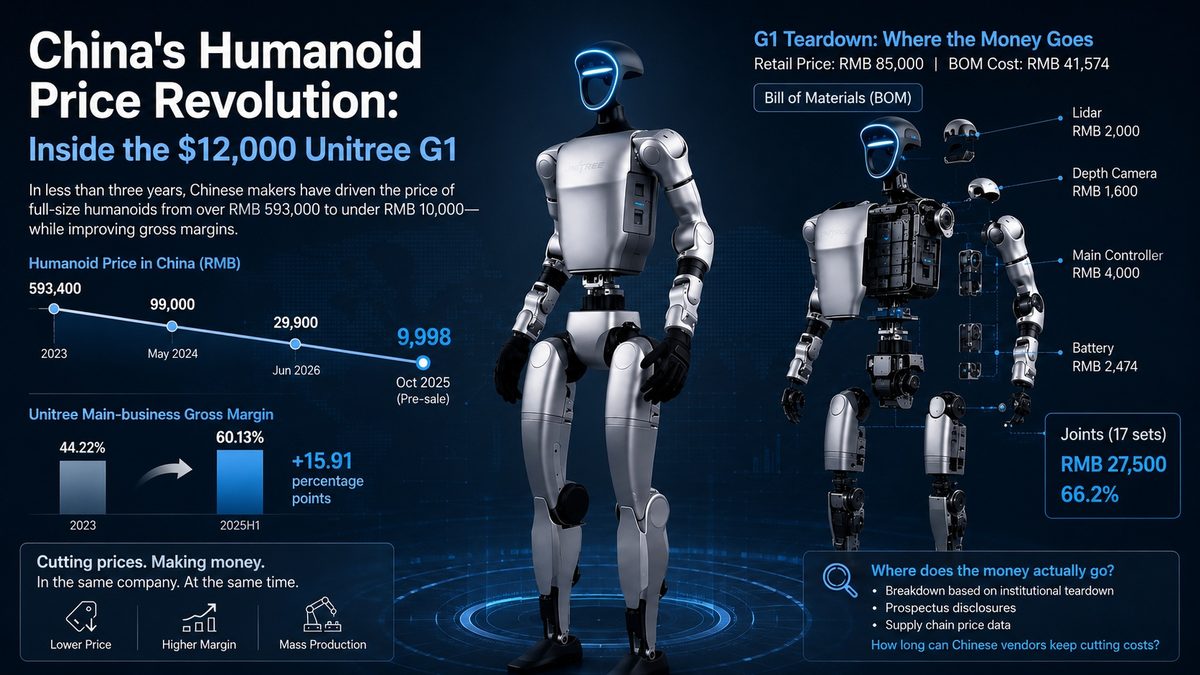
AlphaTypeE Lab · Embodied AI Frontier
In May 2024, Unitree launched its G1 humanoid at RMB 99,000, pulling full-size humanoids below the RMB 100,000 mark for the first time. In October 2025, Noetix Robotics began pre-selling its Bumi at RMB 9,998, the first humanoid priced under RMB 10,000. In June 2026, Unitree cut the R1 Air to RMB 29,900 and shipped it from stock. From Unitree's RMB 593,400 average humanoid price in 2023 to Noetix's RMB 9,998 pre-sale in 2025, the industry's price anchor fell in less than three years. Over the same period, Unitree's main-business gross margin rose from 44.22% to 60.13%, up about 16 percentage points. Cutting prices and making money happened in the same company at the same time. Tear open a G1 that retails for RMB 85,000 and the bill of materials comes to RMB 41,574, of which joints take RMB 27,500, with lidar, depth camera, main controller and battery splitting the rest. Where does the money actually go, and how long can Chinese vendors keep cutting costs? This article follows an institutional teardown report, prospectus disclosures and a chain of verifiable price data to find out.
Article structure
- 1. The Price Revolution: The Industry Anchor From RMB 600,000 to RMB 9,998
- 2. Teardown of a Unitree G1: A RMB 41,574 Bill of Materials
- 3. The Cost King: Joints and the Parts-Price Avalanche
- 4. The More It Cuts Prices, the More It Earns: Unitree's Margin Story
- 5. Three Cost Strategies From Competitors (and What the West Is Doing)
- 6. The Endgame: Hardware Near Cost, Competition Moves to Software
1. The Price Revolution: The Industry Anchor From RMB 600,000 to RMB 9,998
1.1 Unitree's Average Price Curve: Down 72% in Two Years
Unitree's own IPO prospectus draws the steepest price curve in the industry. The average selling price of its humanoid robots fell from RMB 593,400 (about $83,600) in 2023 to RMB 260,400 in 2024, then to RMB 166,400 (about $23,400) in 2025, a decline of about 72% over two years. Two caveats frame those numbers. Unitree sold only a single-digit number of humanoids in 2023, so that first average reflects an early, high-end product mix more than a market price. The 2025 figure, by contrast, sits on 5,215 units sold, a far more solid base.
The product line shows the same rhythm at the level of individual machines. Unitree launched the G1 in May 2024 at RMB 99,000 (about $13,900, confirmed on its official site in August 2024), and by June 2026 the same robot sells for RMB 85,000 (about $12,000). On July 25, 2025, the company unveiled the R1 at RMB 39,900 (about $5,600), the first full-size biped robot priced under RMB 40,000. On June 24, 2026, it cut the R1 Air to RMB 29,900 (about $4,200) and made it available from stock. Unitree's own lineup now spans a price band from RMB 29,900 (R1 Air) to RMB 650,000 (H1).
1.2 The Timeline of the Fall: From RMB 99,000 to RMB 9,998
The price decline is not Unitree's solo act. Lined up in chronological order, publicly announced prices since 2024 trace one continuous fall:
• May 2024: Unitree launches the G1 at RMB 99,000.
• March 2025: EngineAI, a Shenzhen startup, prices its PM01 commercial version at RMB 88,000.
• July 25, 2025: Unitree launches the R1 at RMB 39,900.
• August 18, 2025: AgiBot opens sales across its full lineup: the Yuanzheng A2 Youth Edition at a launch-period promotional price of RMB 168,000, and the Lingxi X2 Youth Edition at RMB 98,000.
• October 24, 2025: Noetix Robotics starts pre-sales of the Bumi at RMB 9,998, the first humanoid under RMB 10,000. The first batch of 500 units sells out within two days.
• June 24, 2026: Unitree cuts the R1 Air to RMB 29,900, from stock.
In two years, the anchor of the price band moved from the RMB 600,000 level to below RMB 10,000. For context, recall what AgiBot itself said at its August 2024 launch event, describing the industry as selling humanoids for RMB 600,000 to 700,000 with costs of RMB 200,000 to 300,000. By 2026, that description is history.
1.3 The Global Benchmark: A $20,000 Target and a Few Hundred Units
Placed against the global benchmark, the gap looks even wider. Tesla set a cost target of under $20,000 per unit (about RMB 139,000) for Optimus in February 2026, yet its planned 2025 production of 5,000 units was not achieved. Actual output for the year was only a few hundred units, less than 10% of the plan, largely because of defects in the dexterous hands and insufficient autonomous decision-making. In June 2026, Tesla raised its capacity target to 70,000 units a year, as reported by Wallstreetcn, a Chinese financial news site. American peers are not cheap either. Agility's Digit carries a price of about $250,000 (per the 2022 reporting caliber, roughly RMB 1.65 million), and Figure has chosen a leasing route for its Figure 03, entering homes at about $600 a month (roughly RMB 4,000).
The price fall is not one company's choice; it is a collective act of China's supply chain. CCID, a state-affiliated industry research institute, counts 2025 global humanoid shipments at about 17,000 units, of which China shipped 14,400, or 84.7%. The volume sits in China, and so does the machinery that drives costs down.
2. Teardown of a Unitree G1: A RMB 41,574 Bill of Materials
2.1 The RMB 41,574 Material List
In April 2026, China Post Securities, the brokerage arm of China Post Group, published a teardown of the Unitree G1, republished by Sina Finance, NetEase and other outlets. The report puts the material cost of a mass-produced G1 base version at RMB 41,574, plus about RMB 3,000 in processing fees. Measured against the RMB 85,000 retail price, the base version's gross margin is about 40.7% (the report's own caliber, which includes other costs); the EDU education edition carries a gross margin of 63.5% to 66.7% and is listed at RMB 169,000 on JD.com. The breakdown:
| Component | Cost (RMB) | Note |
|---|---|---|
| Joint modules | 27,500 | 14 small joints plus 9 large joints |
| Lidar | 3,840 | supplied by DJI |
| Depth camera | 1,869 | supplied by Intel |
| Structural parts | 2,500 | shell and skeleton |
| Battery | 2,000 | lithium battery pack |
| Main controller | 1,415 | Rockchip RK3588 platform |
| Power | 1,180 | power supply and management |
| Wiring harness | 270 | internal cables |
| Miscellaneous | 1,000 | auxiliary materials and assembly parts |
| Total | 41,574 | material cost |
The joint modules, at RMB 27,500, account for about 66% of the entire BOM, by far the largest single line item.
2.2 Joints: Two-Thirds of the BOM
The teardown splits the G1's joints into two tiers. The 14 small joints cost RMB 1,000 each: RMB 300 for the planetary reducer, RMB 200 for the motor, RMB 200 for the encoder, RMB 150 for structural accessories and RMB 150 for the driver board. The 9 large joints cost RMB 1,500 each: RMB 400 for the reducer, RMB 300 for the motor, RMB 300 for the encoder, RMB 200 for structural accessories and RMB 300 for the driver board.
For RMB 1,000 or RMB 1,500, the buyer gets a complete four-in-one integrated module: motor, reducer, encoder and driver sealed into a single unit. The 23 joints together cost RMB 27,500, pressing two-thirds of the machine's material cost into one component category. That is where the whole-robot cost battle is fought.
2.3 A Bearing's Logo and a Chip's Grind Marks
Two details from the teardown are worth recording. First, the main controller chip has visible grinding marks on its surface; the model number and markings were deliberately removed, a standard anti-reverse-engineering measure. Second, the only component in the entire robot that carries a supplier logo is a bearing from Luoyang Baina Bearing, a specialist cross-roller bearing maker. The first detail shows cost control taken down to the surface of a chip. The second shows a supply chain that is almost entirely anonymized: only one bearing is willing to show its face.
2.4 The Two-Track Structure: Self-Developed Core Parts, Purchased Mature Parts
The secret of this machine's cost profile sits in Unitree's prospectus procurement structure. Direct materials account for more than 80% of its main-business cost, of which mechanical parts are about 48% and electronic components about 25%, with the remainder going to batteries, wiring, steel, aluminum, copper and auxiliary materials. The procurement list contains no finished motors, no finished reducers and no finished encoders; these core parts are all developed and produced in-house. Self-develop the core, buy the mature basics, run both tracks in parallel. That is the underlying structure that keeps the G1's material cost at RMB 41,574.