Embodied AI in China: A Beginner's Guide to the Industry
Why it matters: the site's first beginner's guide to China's embodied AI industry, a single map covering the concepts, the value chain, China's 2026 coordinates, and a reusable method for reading it.
By AlphaTypeE Lab · Embodied AI Frontier
August 23, 2026
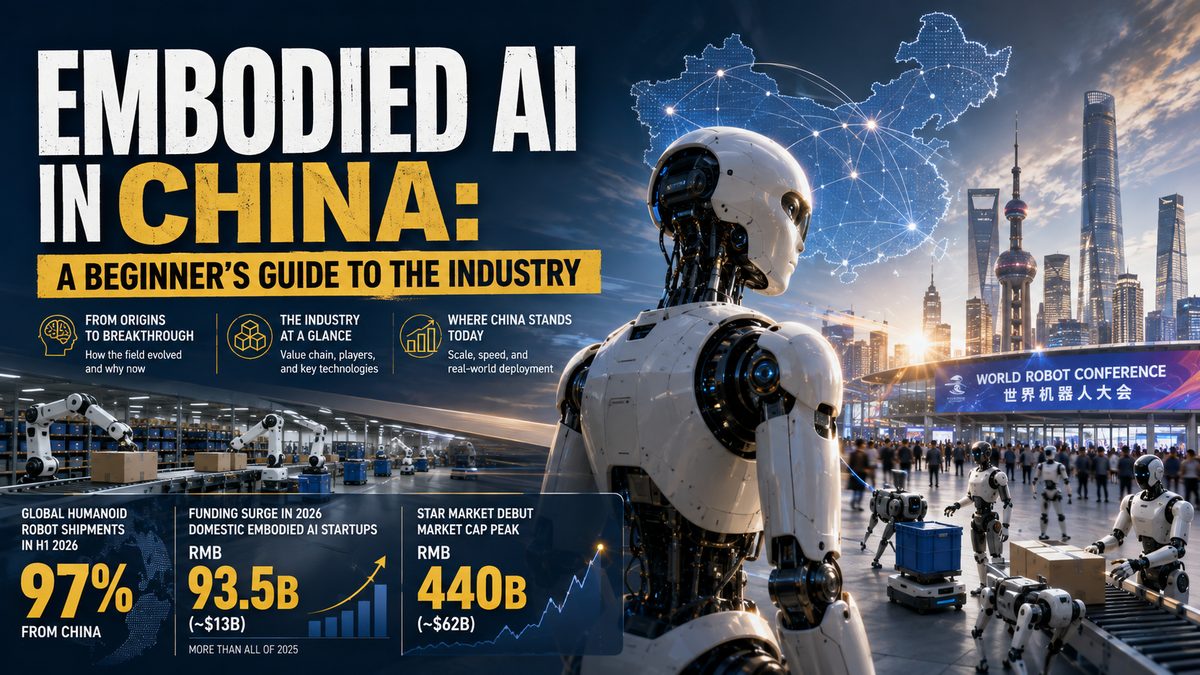
In the first half of 2026, China accounted for 97 percent of humanoid robot shipments worldwide, and domestic embodied AI startups raised RMB 93.5 billion (~$13B), more than the total for all of 2025. In August, the country's most closely watched humanoid company listed on the STAR Market and briefly touched a market value of RMB 440 billion (~$62B); that same week, at the World Robot Conference in Beijing, the robots that once drew the biggest crowds with backflips were largely ignored, while robots quietly sorting parcels on conveyor belts drew the notebooks. The industry is moving faster than most people's intuition, yet its real structure, its evaluation standards, and its risk profile are easy to miss in the noise. This guide is written for readers approaching embodied AI for the first time: where the field came from, how the value chain is organized, where China stands today, and how to judge what comes next on your own terms.
Article structure
- 1. What Is Embodied AI?
- 2. The Industry Map: How a Robot Is Built
- 3. Where China Stands: Five Reference Points for 2026
- 4. WRC 2026: Reading an Industry Through One Trade Show
- 5. A Field Guide for Newcomers: Five Habits
1. What Is Embodied AI?
1.1 Embodied AI Is Not the Same as Humanoid Robots
The concept of embodied intelligence dates back to 1950. It describes a form of intelligence that does not sit in a server processing text and images, but occupies a body and understands the world through continuous interaction with its physical environment. Industry researchers put it more directly: embodied AI is a system that couples a "body" with an "intelligence" to perform tasks in complex environments.
A common mistake is to equate embodied AI with humanoid robots. Humanoids are the most visible vehicle for embodied AI, but they are not the only one. Quadruped robots, wheeled robots, robotic arms, and even an autonomous vehicle can all serve as the "body." What makes a system embodied is not whether it looks human, but whether it can perceive its environment, make decisions on its own, and execute actions, while continuously learning and improving in real work settings.
Why did this academic-sounding concept become a national conversation in 2026? The answer is not in the concept itself, but in the technology inflection point behind it.
1.2 Brain, Cerebellum, and the Nerve Center
To understand the embodied AI industry, start with how a robot's "body" is organized. The industry uses a simple division of labor: the brain, the cerebellum, and the nerve center.
The brain decides what to do. It corresponds to foundation models, which handle perception, understanding, reasoning, and task planning. When a robot enters an unfamiliar room, recognizes a cup, understands the request "hand me the cup," and works out which foot to move first, that is the brain's job.
The cerebellum controls how to move. It corresponds to motion control systems, which handle real-time control, balance, and limb coordination. Keeping a foot stable on the ground and recovering posture after a collision is the cerebellum's job.
The nerve center connects the two. In 2026, a new term entered the industry's vocabulary: the physical AI operating system. It sits between the brain and the cerebellum, translating high-level intentions such as "assemble this part" into a sequence of concrete actions, while coordinating simulation training, data management, and task orchestration.
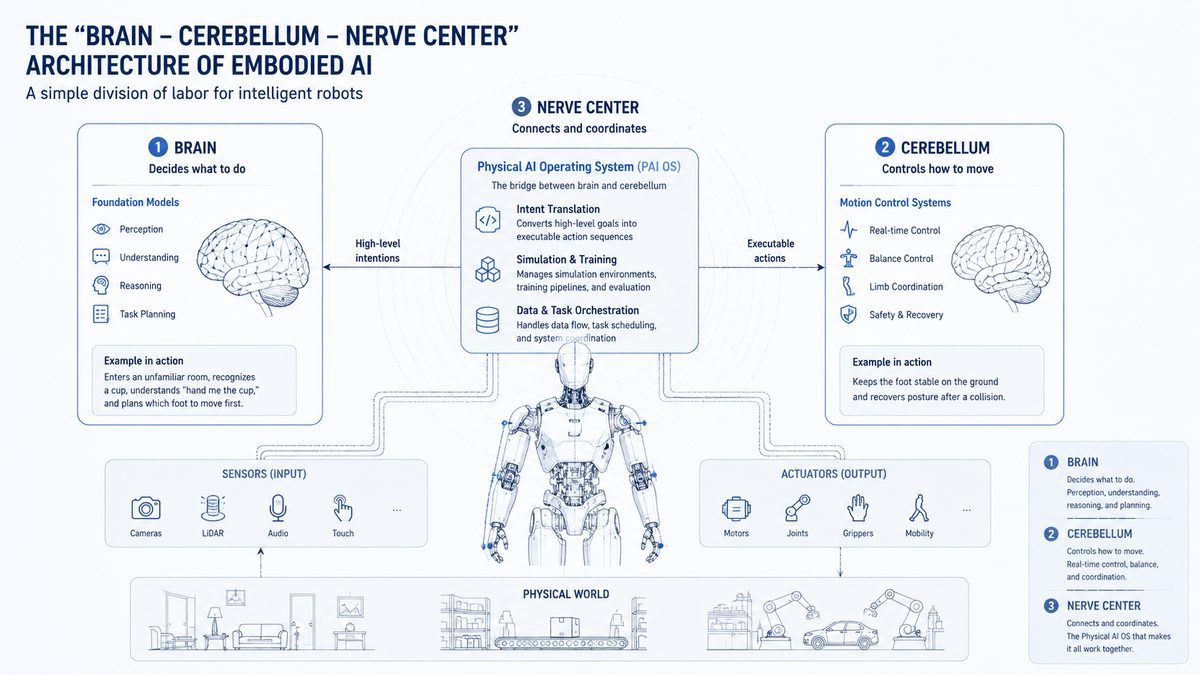
Fig 1 The brain-cerebellum-nerve center architecture of embodied AI
This division is easy to understand, but it explains the most important shift of 2026: as robots move from show floors to factory floors, the bottleneck is moving from "can the hardware move" to "can the system coordinate." Each of the three layers maps to different companies, different technologies, and very different valuation logics.
1.3 Why Now: Moravec's Paradox Meets Foundation Models
In 1988, AI researcher Hans Moravec articulated a famous observation: tasks that are hard for humans, such as chess or calculus, are easy for computers, while tasks that are trivial for humans, such as walking and grasping, are extremely difficult for machines. This became known as Moravec's Paradox.
The robotics industry has been trapped in this paradox for decades. Traditional industrial robots are highly capable in fixed environments, performing repetitive, high-precision work. But they struggle when the environment changes, when a part shifts position, or when a product changes specification. They have a "body" but no "brain."
Foundation models changed the picture. Between 2021 and 2023, large language models gave machines their first credible ability to understand complex instructions and generalize to unfamiliar scenarios. NVIDIA CEO Jensen Huang divides the evolution of AI into four stages: perceptual AI, generative AI, agentic AI, and physical AI. By 2026, the global technology industry has converged on a shared judgment: physical AI is the next great battleground, and embodied AI is its vehicle.
One sobering fact remains. Generalization is still the hardest unsolved problem: model performance drops visibly when faced with situations the training data never covered. That is the core technical challenge of the "brain" side, and it defines the industry's central competitive battleground for the next decade.
2. The Industry Map: How a Robot Is Built
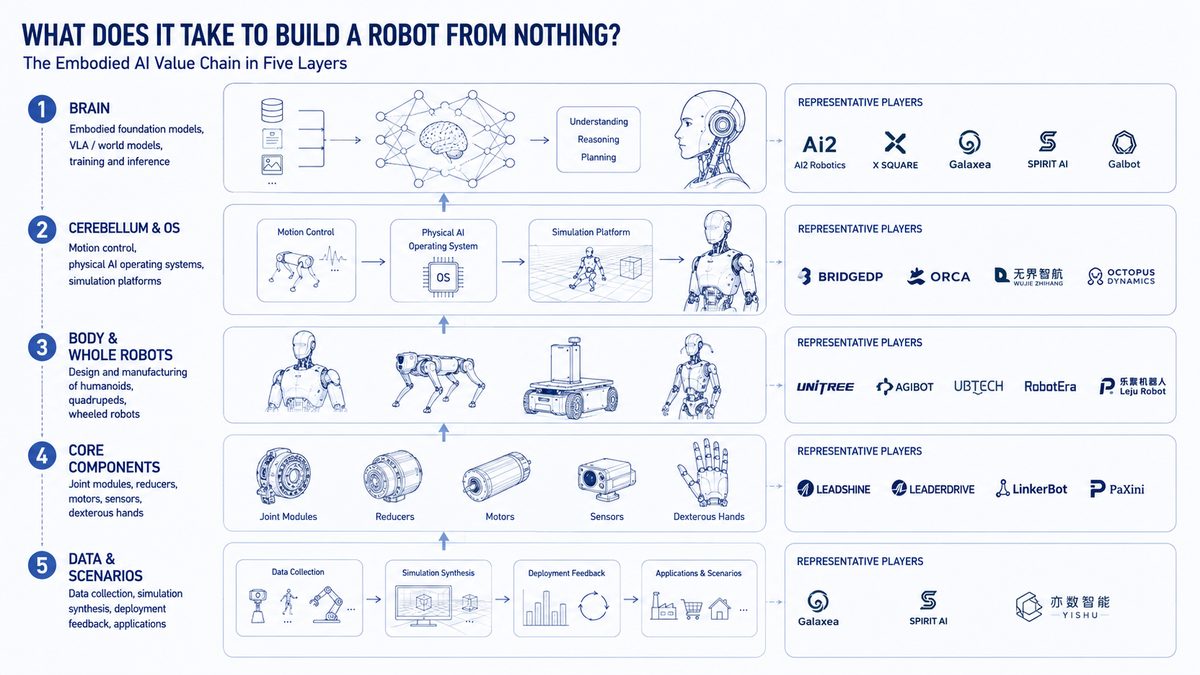
Fig 2 The five-layer value chain of China's embodied AI industry
If "understanding the embodied AI industry" can be reduced to one question, it is this: what does it take to build a robot from nothing? The answer is a value chain that can be mapped in five layers.
| Layer | Core Content | Representative Players |
|---|---|---|
| Brain | Embodied foundation models, VLA / world models, training and inference | AI2 Robotics, X Square, Galaxea, Spirit AI, Galbot |
| Cerebellum & OS | Motion control, physical AI operating systems, simulation platforms | Bridgedp, ORCA, Wujie Zhihang (无界智航), Octopus Dynamics |
| Body & Whole Robots | Design and manufacturing of humanoids, quadrupeds, wheeled robots | Unitree, AgiBot, UBTECH, RobotEra, Leju Robot |
| Core Components | Joint modules, reducers, motors, sensors, dexterous hands | Leadshine, Leaderdrive, LinkerBot, PaXini |
| Data & Scenarios | Data collection, simulation synthesis, deployment feedback, applications | Galaxea, Spirit AI, Yishu (亦数智能) |