Backflipping Robots Are Missing Logistics' Most Profitable Math
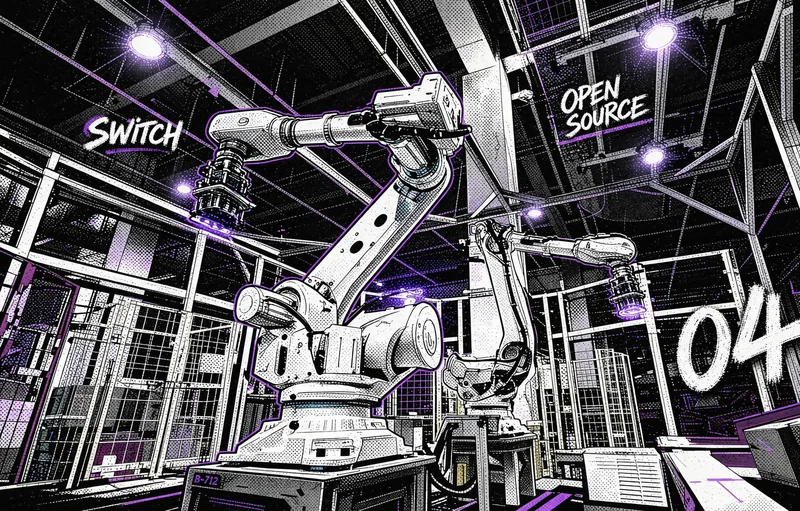
While the tech world still applauds humanoid robots for folding clothes or boxing, JD Logistics has deployed nine categories and 11 robot models of different shapes into warehouses and sorting lines across more than 20 Chinese provinces. One dexterous arm has already crossed the threshold to a positive single-machine economic model.
The irony is sharp: the industry pays for whether a robot looks human, but the robots actually making money look nothing like humans. The article from Leaderobot argues that humanoid robots are currently the biggest vanity project in embodied AI. JD takes the opposite route—form follows working conditions.
Most warehouse tasks are essentially transport. On flat floors, wheeled chassis are far more efficient than bipedal legs. Shelves are about two meters high, so a lifting column can cover every level. In narrow aisles, a single arm has more operating room than dual arms. These plain engineering truths are closer to industrial reality than any backflip video.
Consider an overlooked data set: more than 70% of global warehouses still rely heavily on human labor, with automation penetration below 25%. Even in automated warehouses with robots, flexible tasks such as picking and sorting consume more than half of operating costs. Non-standard goods—irregular or soft items—account for only about 20% of volume but absorb nearly 80% of logistics workers' effort. Automation investment keeps rising, yet machines take only the easy jobs while people carry the hardest work.
JD is targeting that gap. Its embodied dexterous arm, Yilang, stores nearly 100 hand configurations and uses micro-force and visual feedback to adaptively adjust grasping postures. Regular cartons, slippery liquid packaging, and deformable soft bags each have their own grip. The hard numbers: per-piece operating cost falls by more than 20% versus traditional manual sorting; it is the first to achieve positive single-machine unit economics; human intervention is below one in a thousand; system stability exceeds 99.99%; and it has handled over 13 million real packages in 7×24 continuous sorting. This is not a lab demo but a ledger already running on production lines.
JD did not blindly bet on general-purpose humanoids. It chose heterogeneous collaboration: a unified intelligent hub schedules a group of robots designed for different scenarios. In a -20°C cold storage, the Smart Wolf low-temperature version raises storage capacity by 100%, improves operating efficiency by 200%, and cuts per-order operating cost by 10%. In medical scenarios, the Mother Wolf health version integrates inbound, storage, picking, and review-packing, achieving 100% dispensing accuracy under 7×24 unattended operation. For existing warehouse retrofits, the Warehouse Wolf does not change current shelf layouts, completes deployment in two weeks, and covers more than 85% of goods in the whole warehouse.
Behind these numbers is a plain industrial reality: customers will not pay a premium because a robot uses a world model or has a certain number of parameters. They look only at the payback period. JD's assessment line for mature hardware is a three-year payback—and that three years includes equipment procurement, warehouse renovation, server deployment, project delivery, long-term spare parts, and even temporary rental costs during warehouse relocation. In 2024, the first airport express clothing warehouse project had an actual payback period of about two years. In 2025, the program expanded to 20 projects; in 2026, it will reach nearly 60. From a single showcase to batch replication—this is the threshold physical AI has truly crossed.
The underlying flywheel is deep symbiosis between data and production scenarios. For most robot companies, a customer's workshop is a test site. For JD, a full-chain scenario with hundreds of millions of packages per day is first its own production system. Every grasp adjustment, every path replanning, every cold-chain defrost returns as physical feedback to the Super Brain large model. During last year's Double 11, Super Brain was invoked 1.9 billion times, supporting 24 Smart Wolf warehouses. The scenario is both a means of production and a training ground, freeing physical AI from the costly custom-project label.
So the real question is not when humanoid robots will be able to work. It is: after JD uses nine heterogeneous robot categories to make unit economics positive across warehousing, sorting, transport, and delivery, how many more funding rounds can the humanoid companies still relying on backflips afford?