Company Research Report: The Parts Business Inside ROBOTERA
Why read: the hand sold to peers is the unusual part. Eight rounds funded two lines at once, and the financial statements that would price that position do not exist yet.
By Embodied AI Frontier
Date: Nov 17, 2026
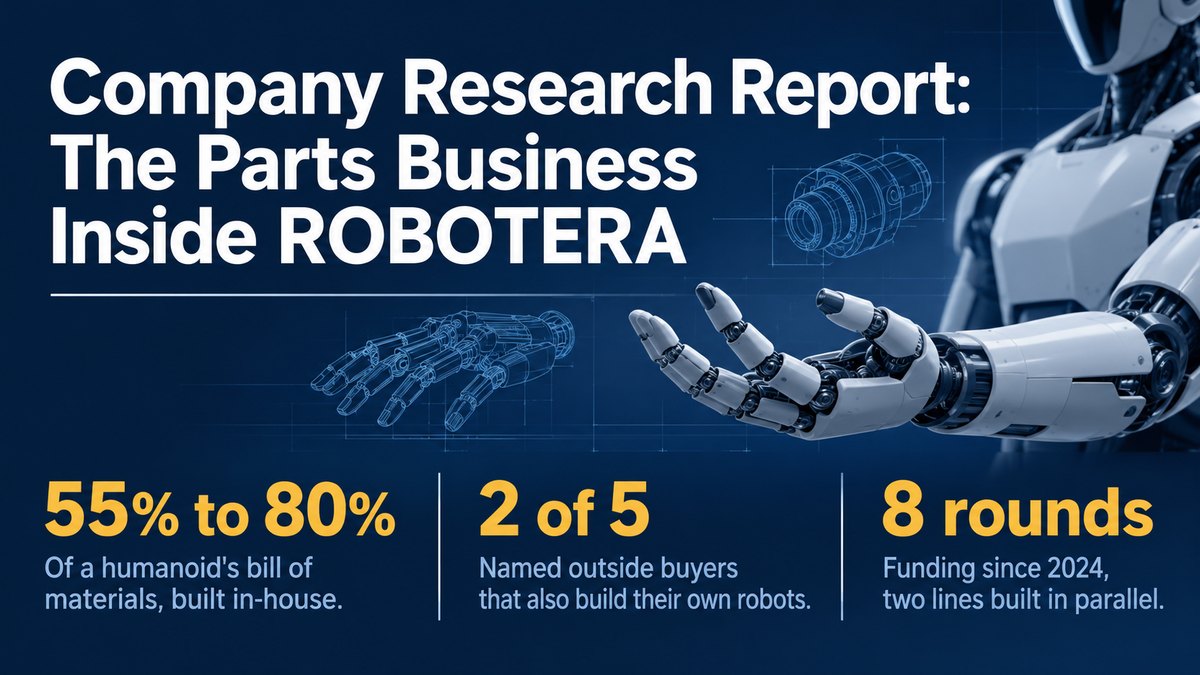
ROBOTERA (Beijing Xingdongjiyuan Technology) builds the two most expensive modules of a humanoid robot as well as the robot itself. Joint modules account for 35% to 60% of bill-of-materials cost and dexterous hands for about 20%, which together cover 55% to 80% of the BOM. Both modules go into its own machines, and the hand is also sold to other robot makers and to embodied-model companies, and is used in NVIDIA's data-collection stack. Three questions follow: how that position formed, what it earns and what it constrains, and which public numbers can support or overturn the judgement. Cost shares come from brokerage and industry breakdowns, the self-development ratio and unit figures are company statements, and the market sizing is calculated here.
Article structure
- 1. The verdict: two positions inside one body maker
- 2. Products and technology: why the two positions are one
- 3. The company: ownership, people and footprint
- 4. Demand: the sorting work outside the automation line
- 5. Customers and delivery: payers, shareholders and same-layer buyers
- 6. Supply chain: what is made and what is bought
- 7. Competition: the same layer and the price trend
- 8. Capital: eight rounds and a missing revenue line
- 9. Substitutability: what a customer pays to switch
- 10. Signals: four things to watch
1. The verdict: two positions inside one body maker
ROBOTERA occupies two positions at once. It builds the two modules that carry most of a humanoid robot's bill-of-materials cost, and it assembles the complete machine. Joint modules take 35% to 60% of that cost and the dexterous hand about 20%, which gives the two modules a combined share of 55% to 80%41Humanoid industry development blueprint 2026View the entry below →. A second breakdown puts actuators and joint modules at 45% to 65% of hardware cost, and close to 60% once joint modules are counted on the Optimus teardown basis36The money is all going to the supply chainView the entry below →. The company describes the same structure as a hardware self-development ratio above 95%4Robot Era reported to plan a Hong Kong IPO raising up to USD 1 billionView the entry below →.
That structure sets the revenue shape. Whole machines are delivered to logistics customers against a specific job, while hands are sold by the unit to buyers at the same layer of the chain. The two transactions settle on different bases and carry different risks. The first depends on one customer's site adaptation and repeat orders, and the second depends on whether other robot makers design its hand into their machines. The two revenue lines together constitute the business basis for three rounds closed within twelve months5Valuation passes CNY 10 billion as Robot Era closes a CNY 1 billion strategic roundView the entry below →6Top venture, industrial and state capital invest in roboticsView the entry below →.
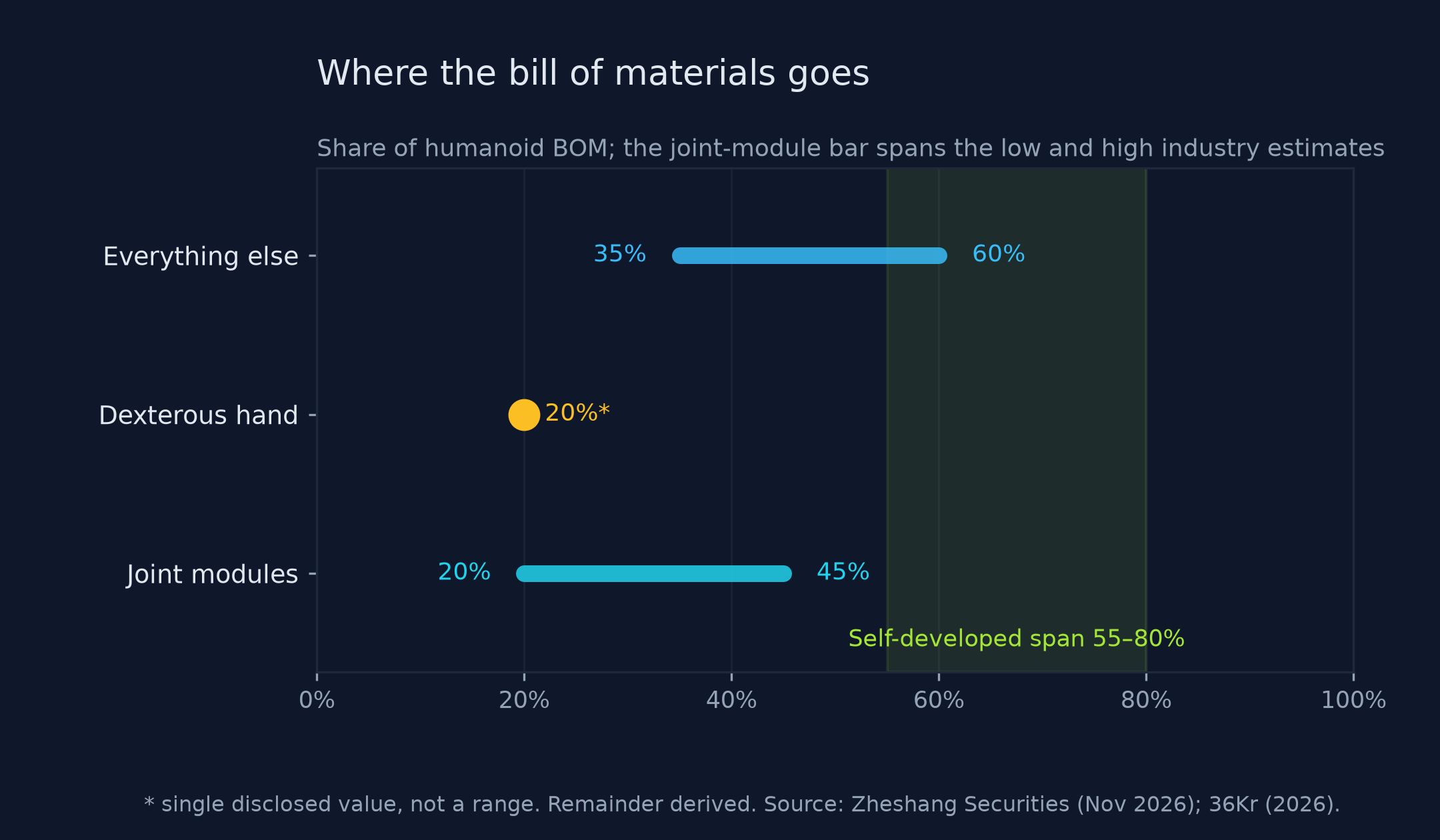
Fig 1 Joint modules and dexterous hands together cover 55% to 80% of humanoid BOM cost. Source: Zheshang Securities; 36Kr.
The structure also sets the constraints. What is bought in is concentrated in the compute module, a small share of cost with a large influence on machine performance, and that constraint does not ease as the self-development ratio rises. One logistics customer is also a shareholder, since SF Group led the April 2026 round of more than USD 200 million6Top venture, industrial and state capital invest in roboticsView the entry below →. Competition runs in two directions at once: component makers are extending into assembly and contract manufacturing, while robot makers treat an in-house hand as a qualification threshold8Body builders and suppliers: dexterous hand funding in 2026View the entry below →.
The judgement can be tested. If externally sold hands shift towards one-off purchases by research groups, the same-layer supply claim needs to be revised downward. If a third party establishes that the self-made share of BOM falls below 50%, the two-module claim needs the same treatment. As of 16 November 2026, the first has a list of named adopters behind it and the second rests on the company's own figure.
2. Products and technology: why the two positions are one
2.1 The hand product line
ROBOTERA sells four hands. The XHAND 1 has 12 active degrees of freedom, weighs 1,100 grams, lifts 25 kilograms with the whole hand and carries a tactile array covering 270 degrees around the fingertip. The XHAND 1 Lite has six active and five passive degrees of freedom, weighs 730 grams and carries a 12-newton fingertip load. The XHAND 1 PRO uses a fully direct-drive design with 21 degrees of freedom, 18 tactile sensing points and a repeatability of plus or minus 0.1 millimetres, and ships in under a month3Robot Era XHAND series product pagesView the entry below →. The XHAND 1 Pro-U, released on 16 November 2026, has 16 degrees of freedom and a global run of 40 units22XHAND 1 Pro-U goes on limited releaseView the entry below →23ROBOTERA launches XHAND 1 Pro-U, featured in NVIDIA GR00T 2 DexUMI demonstrationView the entry below →.
The range from six to 21 degrees of freedom maps onto different buyers rather than one product strategy. The light hand goes into education and service work, the main hand into industrial tasks and the company's own machines, and the high-freedom version into research and model training. ROBOTERA does not publish prices for any of them; the one figure it has given is that the XHAND 1 sells for tens of thousands of renminbi per unit17More than CNY 4 billion raised: the Tsinghua professor's robots go to work for SFView the entry below →.
2.2 The machine product line
The machines follow a similar pattern. The L7 is a 1.71-metre biped with 55 degrees of freedom including the hands, a 20-kilogram dual-arm payload, 400 newton-metres of peak knee torque, a running speed of four metres per second and 80 TOPS of X86 compute alongside 275 TOPS of Orin compute1Robot Era L7 product pageView the entry below →. The M7 puts the same upper body on a pedestal at 792 millimetres, with 43 degrees of freedom and teleoperation through a Quest headset2Robot Era M7 product pageView the entry below →. The Q5 is a wheeled service machine at 1.65 metres with 44 degrees of freedom, a 10-kilogram dual-arm payload and more than four hours of battery life24Robot Era Q5 product pageView the entry below →.
The shared upper body is the hardware basis for the one-machine claim. A logistics customer buying one configuration gets arms and hands that can move between two forms by changing only the base, which gives picking, packing and parcel feeding a common hardware platform and supports the company's one-machine, three-process claim25Robot Era presents embodied logistics at CeMAT Asia 2026View the entry below →.
2.3 External evidence for the isomorphism
There is one external piece of evidence that the two positions are genuinely the same. NVIDIA's GR00T 2, released in November 2026, uses a wearable exoskeleton to record human demonstrations, and that exoskeleton reproduces the XHAND 1 Pro-U joint for joint across 16 degrees of freedom, with contact surfaces and wrist-camera mounts aligned26GR00T 2: Scaling robot foundation models for generalization, dexterity and adaptationView the entry below →27GR00T 2 whitepaper, appendix E.4: DexUMI exoskeleton hardwareView the entry below →. On the robot side, a dual-arm machine fitted with two XHAND 1 Pro-U hands prepares banana yoghurt, scoops granola and strikes a match, with success rates of 60%, 80% and 75%23ROBOTERA launches XHAND 1 Pro-U, featured in NVIDIA GR00T 2 DexUMI demonstrationView the entry below →. The kinematic correspondence appears in NVIDIA's own documentation; the success rates come from the company's release, and the two carry different evidential weight.
That evidence establishes a specification position rather than an internal tool. An exoskeleton has to replicate a hand that an outside ecosystem can select for, and the same configuration can then be assembled onto the company's own machines. The isomorphism of the two positions therefore rests on third-party selection rather than on the company's own description.
The model sits behind both. The end-to-end model ERA-42 drives all 55 degrees of freedom, and VPP2, released in October 2026, took first place on the RoboDojo world-action-model leaderboard and was open-sourced28Robot Era model pageView the entry below →. The model is not licensed out. It serves the internal loop between hand and machine, which is what keeps the data inside the company.
3. The company: ownership, people and footprint
3.1 Incorporation and ownership
The legal entity is Beijing Xingdongjiyuan Technology Co., Ltd., a joint-stock company since June 2026. It was founded in August 2023 out of Tsinghua University's Institute for Interdisciplinary Information Sciences, with the university holding equity contributed as intellectual property, a direct Tsinghua stake that the company presents as unique among Chinese embodied-AI companies13Tsinghua technology transfer case: Beijing XingdongjiyuanView the entry below →14About Robot EraView the entry below →. The change of corporate form in June 2026 is normally read as a preparatory step towards public markets rather than a financing event15Robot Era completes restructuring into a joint-stock companyView the entry below →.
The founder, Chen Jianyu, is an assistant professor and doctoral supervisor at the same institute, with a doctorate from UC Berkeley and a research focus on reinforcement learning and robot control. The chairmanship changed once in July 2026, from co-founder Xi Yue to Shi Xuanyang, and Zhang Zhi is legal representative and manager16Robot Era leadership change: co-founder Xi Yue steps down as chairmanView the entry below →. Headcount is only available from third-party records, which put insured staff at 171.
3.2 People and footprint
The physical footprint is split. Research and offices sit in Haidian, Beijing, a scenario-validation centre and export base were placed in Tianjin, and the company signed with Hangzhou's Qiantang district to set up what it calls a large industrial centre14About Robot EraView the entry below →20The only Tsinghua-held embodied AI company settles in QiantangView the entry below →21Coordinated innovation: the spatial breakout of the Beijing-Tianjin-Hebei robotics industryView the entry below →. No production capacity figure has ever been disclosed, so capacity can only be inferred from delivery cadence and deployment time.
4. Demand: the sorting work outside the automation line
4.1 Who does the sorting work
Demand starts with the structure of sorting employment. At one postal sorting site in Longgang, Shenzhen, about 200 people work the sorting floor, mostly women over 40, paid by the day, on a shift that runs from 19:00 to 02:00. Indoor temperatures sit above 40 degrees Celsius, and comparable sites in Guangzhou peak above 509Robot colleagues take over the night shift at logistics hubsView the entry below →. The work is a repeated cycle of bending, grabbing, turning and placing, thousands of times in a night shift.
4.2 What automation already covers
Express sorting is already heavily automated, but not everywhere. Cross-belt, tilting-tray and swing-wheel systems handle standard parcels, and industry estimates put automated sorting penetration at 20% to 30%44Temp workers hold their rate through Singles' DayView the entry below →. What remains manual falls into three groups: irregular items that cannot be gripped, soft packaging that cannot be located reliably, and parcels that must be turned face-up. Those three are where machine vision and grippers have historically failed, and the choice of equipment form does not rest on positioning accuracy alone.
4.3 The human benchmark and the disclosed figures
The benchmark for any machine is human throughput. Sorters at the Shenzhen site average more than 1,000 parcels per hour, with experienced workers reaching 1,2009Robot colleagues take over the night shift at logistics hubsView the entry below →. ROBOTERA's disclosed numbers come in two generations, and the two baselines should not be joined into a single curve. In the version deployed at the Shenzhen site from November 2025, internal testing reached 600 parcels per hour, the first day on site fell to about 100, March 2026 recovered to 900 and late May held at 1,2009Robot colleagues take over the night shift at logistics hubsView the entry below →. In the version described in November 2026, the laboratory figure is 1,200, the first weeks on a live line fall to 800 to 900, and the current peak is 1,50010Robot Era sorting robots deployed in more than ten logistics centres, peak 1,500 parcels per hourView the entry below →11Robot Era sorting peak reaches 1,500 parcels per hour during Singles' DayView the entry below →35At CeMAT: one machine for picking, packing and feedingView the entry below → (Figure 2).
The two sets of figures belong to different environments. The 1,500 figure is a peak inside a live warehouse, while the 2,000 figure quoted by staff at the 2026 World Robot Conference is described in the same conversation as an internal limit test, with 1,200 given as the on-site rate12Robot Era sorting robot at WRC 2026View the entry below →. The 2,000 claim sits a third above the live-warehouse peak, and the two do not form a single series.
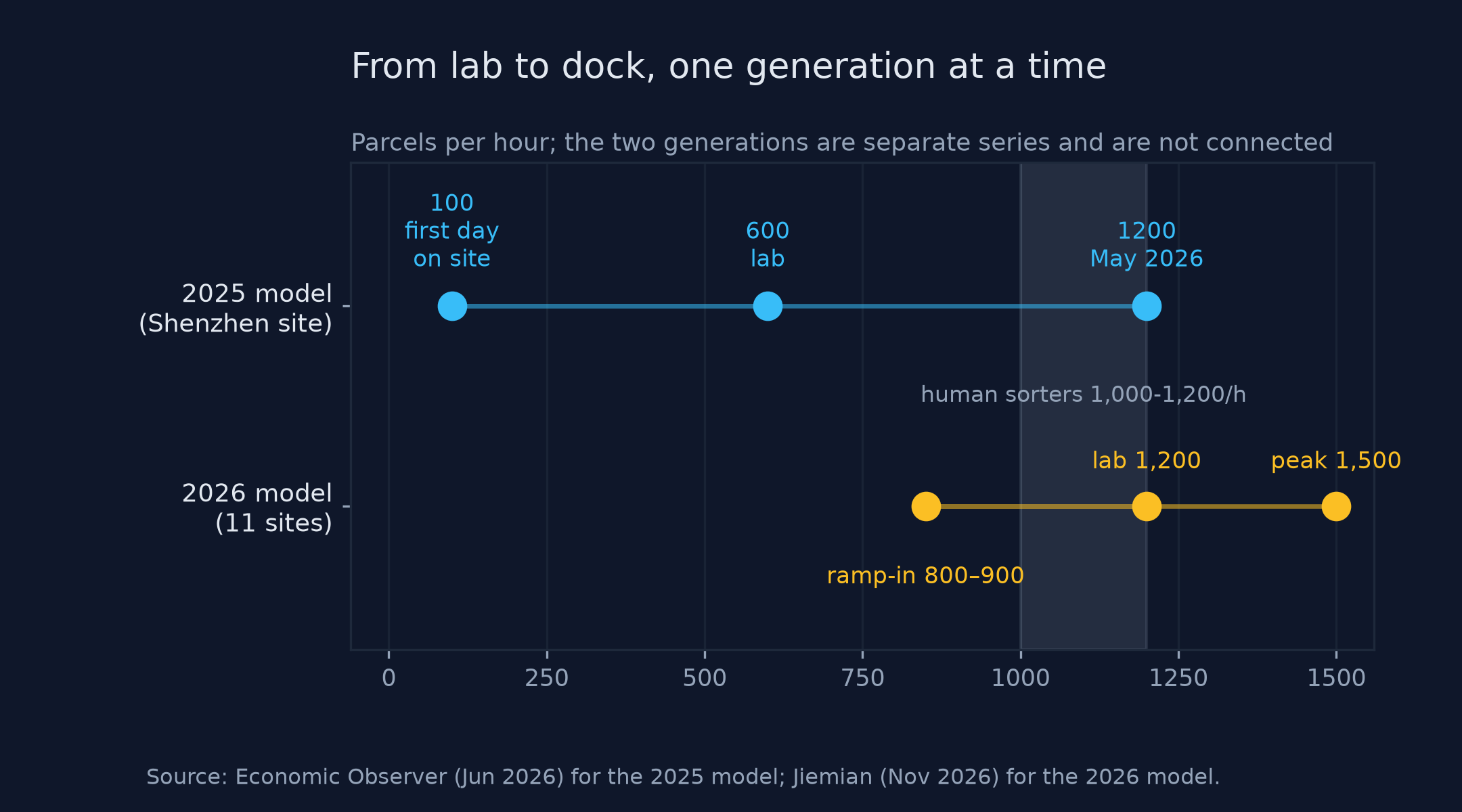
Fig 2 Two generations of sorting throughput. The baselines differ and are not joined into one curve. Source: Economic Observer; Jiemian News.
4.4 Parameters and the market calculation
The company has published no market sizing, so the calculation below is this site's own. It covers only express-parcel sorting and excludes warehousing, manufacturing, commercial service, and solution or integration revenue.
| Parameter | Value | Basis, and what a boundary value would do |
|---|---|---|
| Daily parcel volume | 551 million | The State Post Bureau reported more than 150 billion parcels by 29 September 2026, divided by 272 days; a Singles' Day peak would multiply this several times, and is not used |
| Human sorting rate | 1,100 parcels/hour | Shenzhen site average above 1,000 and experienced workers at 1,200, midpoint taken; at 1,200 the equivalent station count falls about 8% |
| Automated sorting penetration | 20% to 30% | Industry estimate from 2024 (source 44); at 30% the replaceable stations fall 12.5% |
| Share of work open to humanoids | 20% to 35% | An assumption with no public basis, drawn from the three manual task groups; at 35% the unit count rises about 75% |
| Shifts replaced per unit | 2 to 3 | Sites run two shifts, three at peak; at 2 shifts the unit count rises 50% |
| Unit price | CNY 150,000 to 450,000 | Public listings for comparable bipedal machines run from CNY 200,000 to CNY 700,000, and the company says its pedestal version costs about a third less; at the top of the range the market triples |
| Replacement cycle | 5 years | An assumption with no public basis; at 8 years the annual market shrinks about 40% |
The chain is reproducible: 551 million parcels divided by 1,100 per hour gives 501,000 station-hours per day; divided by 24 hours, 20,889 equivalent stations; less the 25% already automated, 15,700 manual stations; times a 27.5% share open to humanoids, 4,308 stations; divided by 2.5 shifts, 1,723 units; times CNY 300,000, CNY 520 million of installed-base market; over a five-year cycle, CNY 100 million a year.
The sensitivity is wide. When penetration, the open-work share and shift count all take their boundary values, the unit range is 975 to 2,924, the price range CNY 150,000 to 450,000, and the installed-base market CNY 146 million to CNY 1.32 billion, a spread of about nine times (Figure 3). The spread comes from missing public parameters rather than from measurement precision.
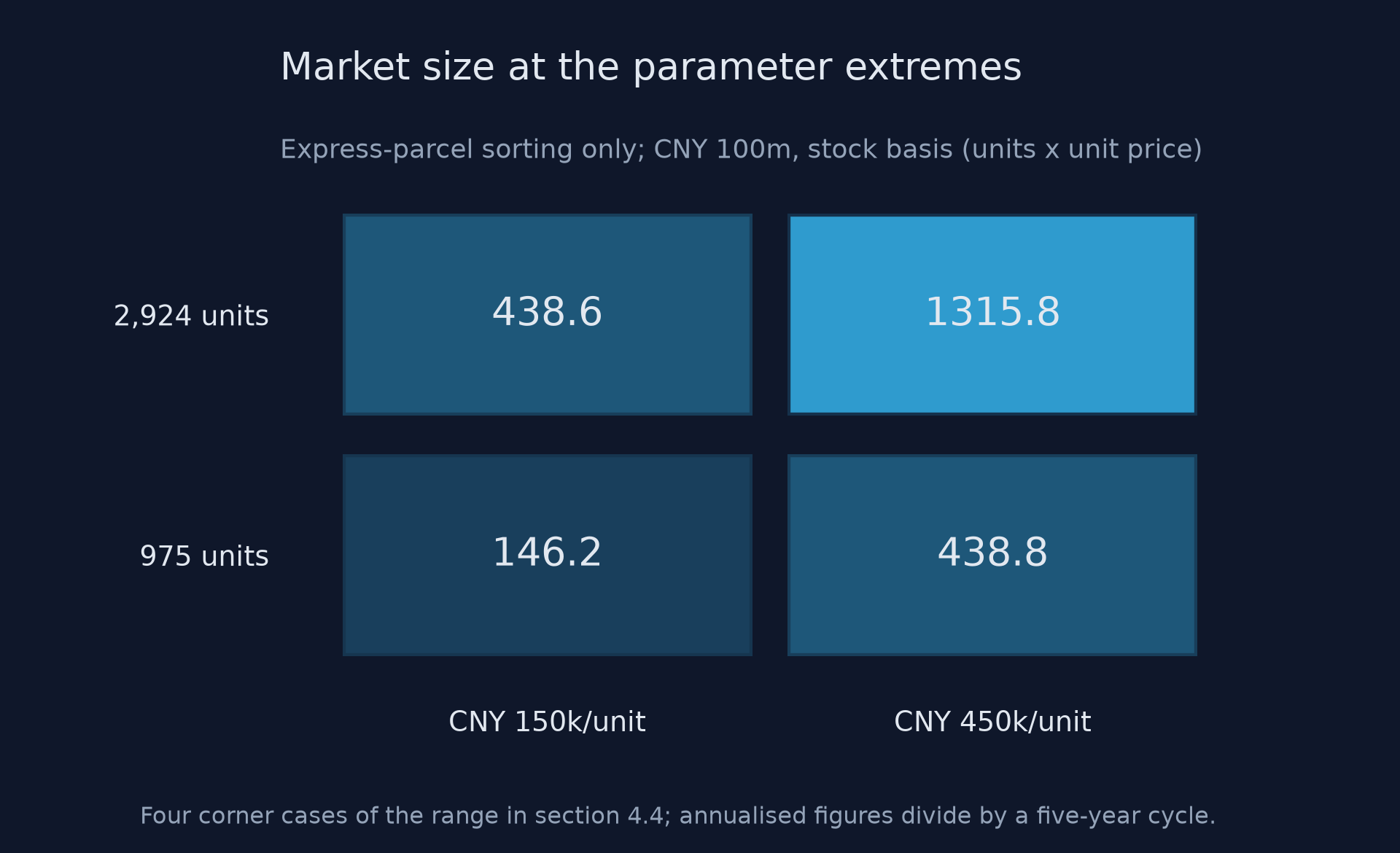
Fig 3 Installed-base market at the four corner cases of unit count and unit price. Source: calculations in section 4.
4.5 What the result means
Demand timing depends on two conditions: whether customers write these machines into an annual procurement plan, and whether the packing and feeding jobs can be replicated as quickly as picking. The threshold is already visible. A machine has to match or exceed the 1,200-parcel hour of an experienced sorter and hold it through a night shift before it enters a purchase list.
The calculation explains why the second revenue line exists. The express-sorting segment is a market measured in the hundreds of millions to low billions of renminbi at current prices, which cannot support the capital structure built by eight financing rounds. Components that are made in-house therefore need customers outside the company.
5. Customers and delivery: payers, shareholders and same-layer buyers
5.1 A customer with two roles
Two logistics customers can be named: China Post and SF Group. The company says the two are running in more than ten logistics centres across five provinces and municipalities, and that Singles' Day 2026 was the first full peak test17More than CNY 4 billion raised: the Tsinghua professor's robots go to work for SFView the entry below →10Robot Era sorting robots deployed in more than ten logistics centres, peak 1,500 parcels per hourView the entry below →.
The relationship involves overlapping roles. SF Group led the April 2026 round of more than USD 200 million6Top venture, industrial and state capital invest in roboticsView the entry below →, and co-founder Xi Yue has said publicly that several shareholders were customers before they invested, a pattern he describes as characteristic of the cap table29Interview with Robot Era co-founder Xi YueView the entry below →. The overlap cuts both ways: order visibility is higher than for a typical startup, and pricing power sits with the customer.
5.2 The same-layer buyer structure
Buyers at the same layer are the second group. Five adopters are public: Skild AI, Rainbow Robotics, Extend Robotics, Discover Robotics and Humanoid AI's HMND 0118Robot Era raises CNY 2.5 billion in two months as state capital joinsView the entry below →31Robot Era raises CNY 2.5 billion in two monthsView the entry below →, with a separate release covering the Skild AI deployment30Skild AI adopts Robot Era's direct-drive XHAND1View the entry below →. Two of them, Rainbow Robotics and Humanoid AI, build their own machines and compete with ROBOTERA at the machine layer. Skild AI builds models and does not make robots. The remaining two, Extend Robotics and Discover Robotics, are not classified in public material.
The mix of buyers defines the nature of the business. Selling to a model company means supplying a platform for data collection and algorithm validation, where the requirements are degrees of freedom and reproducible tactile signals. Selling to a robot maker means supplying the hand that its machine lacks, where the requirements are lead time and unit-to-unit consistency. The two demands pull the product versions and pricing in different directions.
5.3 How delivery counts are disclosed
Delivery counts have appeared in three steps: a dozen or so units during the 2025 pilot, more than one hundred by late May 2026, and "several hundred" on the company's own account in November 2026 (Figure 4)9Robot colleagues take over the night shift at logistics hubsView the entry below →25Robot Era presents embodied logistics at CeMAT Asia 2026View the entry below →. Each figure carries a different basis: field measurement, a reporter's interview and an exhibition statement. They should be quoted with their dates and sources attached.
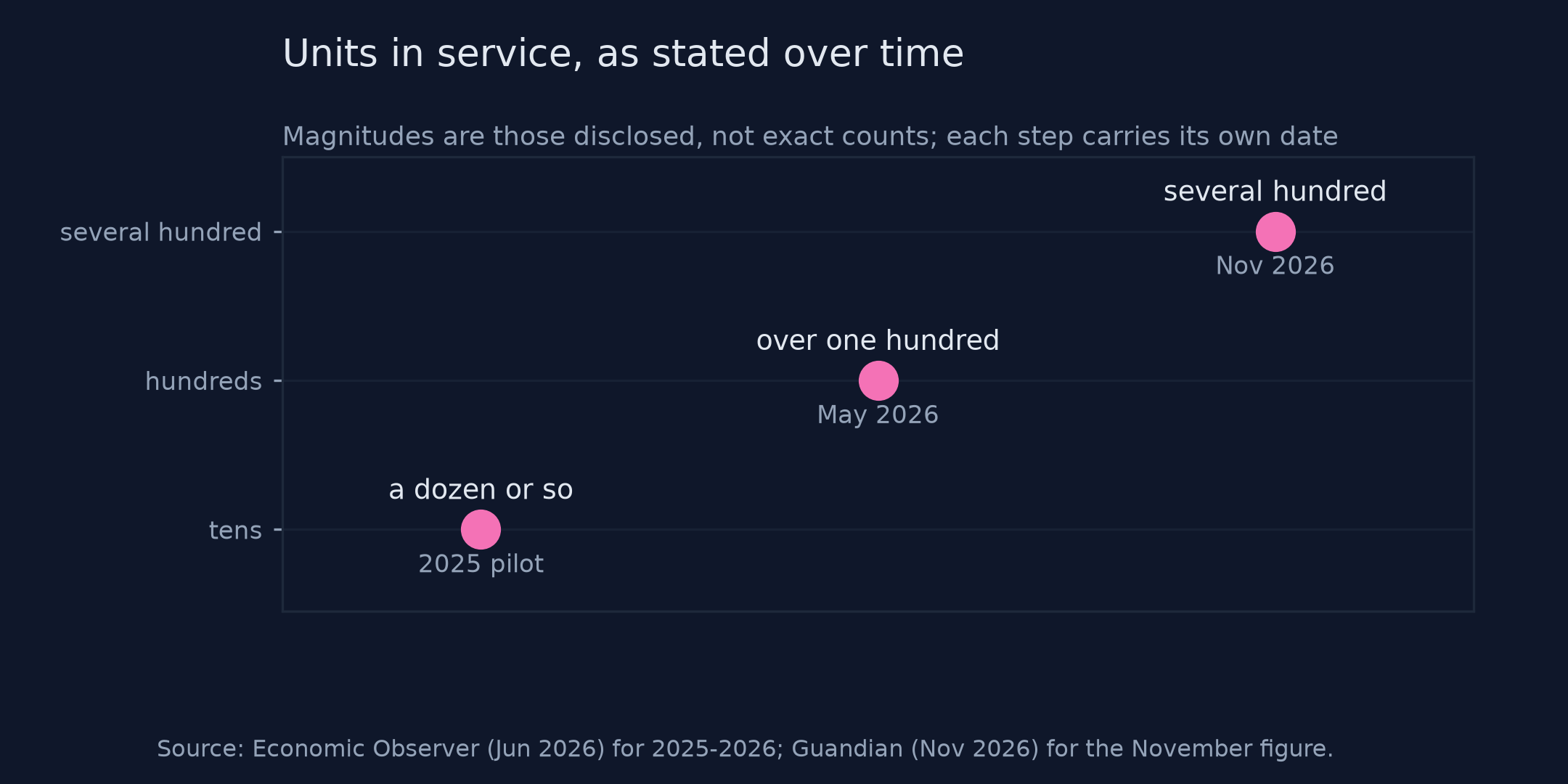
Fig 4 Three steps in units delivered, all company statements given as magnitudes. Source: Economic Observer; Guandian.
5.4 One piece of counter-evidence
One counter-example belongs in the record. In June 2026 the Guangzhou mail centre of China Post introduced a sorting robot rated at up to 1,200 parcels per hour, and the report as carried on China Post's own site does not name ROBOTERA as the supplier33Robot sorter goes on duty at China PostView the entry below →. Postal procurement is already running parallel suppliers, so ROBOTERA is not a sole supplier and its share will move with benchmarking and price comparison.
6. Supply chain: what is made and what is bought
6.1 What is made in-house
The company states that more than 95% of its hardware is developed in-house, covering motors, drivers and reducers4Robot Era reported to plan a Hong Kong IPO raising up to USD 1 billionView the entry below → as well as controllers, joint modules and hands45November embodied AI: 35 funding deals, nearly half above CNY 100 millionView the entry below →, with a small set of basic components bought in9Robot colleagues take over the night shift at logistics hubsView the entry below →. The specification sheets are consistent with this. The L7 lists 80 TOPS of X86 compute and 275 TOPS of Orin compute1Robot Era L7 product pageView the entry below →, and 275 TOPS matches NVIDIA's Jetson AGX Orin module, which is a purchased part. Lidar, depth cameras and batteries are also bought in, and no supplier has been named.
6.2 What is bought in, and the constraint
The bought-in share is small in value and large in leverage. The compute module decides whether a model can run on the machine, lidar and depth cameras define the perception envelope, and the battery sets continuous operating time. None of the three is a commodity that can be swapped without redesign.
There is an inverse relation between in-house share and bargaining power. Once 95% of the value chain sits inside the company, the remaining 5% narrows the supplier options, because the rest of the machine is designed around those modules. Switching cost therefore appears at machine level rather than at component level, which gives a testable claim: if a third-party module appears that can be fitted without redesign, this structural reading needs revision.
7. Competition: the same layer and the price trend
7.1 Three layers of same-layer competition
The representative comparison at the same position is LinkerBot, a pure component supplier whose products cover direct-drive, linkage and tendon routes. 36Kr, citing Reuters, reports a new funding round targeting a valuation of USD 6 billion34LinkerBot seeks a valuation larger than its marketView the entry below →. The difference from ROBOTERA is the machine business, which LinkerBot does not have.
At the machine layer the competitors include Geek+ and Figure. Geek+ released Gino 1, its first general-purpose humanoid warehouse robot, in February 202642Geek+ releases the first general-purpose humanoid warehouse robotView the entry below → and showed it at the November logistics exhibition42Geek+ releases the first general-purpose humanoid warehouse robotView the entry below →. Figure has run long live demonstrations of sorting work, and ROBOTERA's co-founder benchmarks its own hardware against Figure's continuous run9Robot colleagues take over the night shift at logistics hubsView the entry below →. Figure reports three machines sorting about 249,600 parcels over 200 continuous hours, which works out to roughly 416 parcels per hour per machine43Figure robot ends factory trial after 200 hours of uninterrupted workView the entry below →, a different measure from ROBOTERA's 1,500 peak and usable only as a directional comparison.
One layer out are the robot makers themselves. Unitree, AgiBot and UBTECH all develop their hands for internal use, competing with ROBOTERA for machine orders, and neither appears as a buyer or a supplier of ROBOTERA in public material. The two same-layer buyers named in section 5, Rainbow Robotics and Humanoid AI, also sit on this layer, which makes them customers and machine competitors at once.
7.2 Price trends and pressure from both sides
The position is exposed from both sides. A 36Kr survey of the segment splits 47 hand companies into 15 body makers that develop hands in-house and 32 suppliers that sell hands as a product, and places ROBOTERA in the first camp on the ground that its hands mainly equip its own machines8Body builders and suppliers: dexterous hand funding in 2026View the entry below →. The same survey finds that in-house hands have become a qualification threshold for body makers, while tactile sensors, micro motors and precision screws remain largely bought in8Body builders and suppliers: dexterous hand funding in 2026View the entry below →. ROBOTERA sits across the two camps: it develops its own hand and also supplies it to outside buyers.
Price trends set how much margin the position can keep. The average price of harmonic reducers fell nearly 30% in two years, planetary roller screws reached CNY 499 at volume, and dexterous hands fell from the million-renminbi level to the low thousands36The money is all going to the supply chainView the entry below →. As components standardise, the cost advantage of in-house production is eroded by the industry price decline, and what remains defensible is process and data rather than capacity.
8. Capital: eight rounds and a missing revenue line
8.1 The missing revenue line
ROBOTERA has never disclosed revenue, gross margin, net result or cash flow. The only public numbers adjacent to revenue are order and delivery claims: a media-reported company figure of more than CNY 500 million in cumulative orders as of November 20257Robot Era closes nearly CNY 1 billion, total orders exceed CNY 500 millionView the entry below →, and a company plan for volume delivery at the thousand-unit level starting in the second quarter of 202617More than CNY 4 billion raised: the Tsinghua professor's robots go to work for SFView the entry below →32Robot Era solutions to ship at volume in logistics this yearView the entry below →. Orders are not revenue, and planned delivery is not delivered delivery, so neither figure supports a financial judgement.
8.2 How the investor mix shifted across eight rounds
Across the eight rounds that can be matched to public reporting, the change in investor mix carries more information than the amounts. The seed round was led by Century Jinyuan with Turing Ventures participating; the angel and pre-A rounds were dominated by financial investors, including Lenovo Capital, Qingkong Tiancheng, Qingliu Capital, Yuanjing Capital and Alibaba; the 2025 A and A+ rounds brought in industrial partners, led by Haier Capital, CDH VGC and Geely Capital; the three 2026 rounds added Samsung, Singtel, SF Group and CGTC, with CGTC marking the first investment by a national-level state capital operating company in a humanoid robot maker18Robot Era raises CNY 2.5 billion in two months as state capital joinsView the entry below →19Robot Era closes an angel round above CNY 100 millionView the entry below →37CNY 1 billion led by CGTC as Robot Era raises againView the entry below →. The March 2026 round is called a strategic round by the company and classified as a Series B by Tianyancha.
The shift in investor type matches the capital requirement. Component lines and machine delivery were built at the same time, and the cash needed exceeds what a single-scenario capacity expansion would require; eight rounds funded two lines in parallel rather than one (Figure 5).
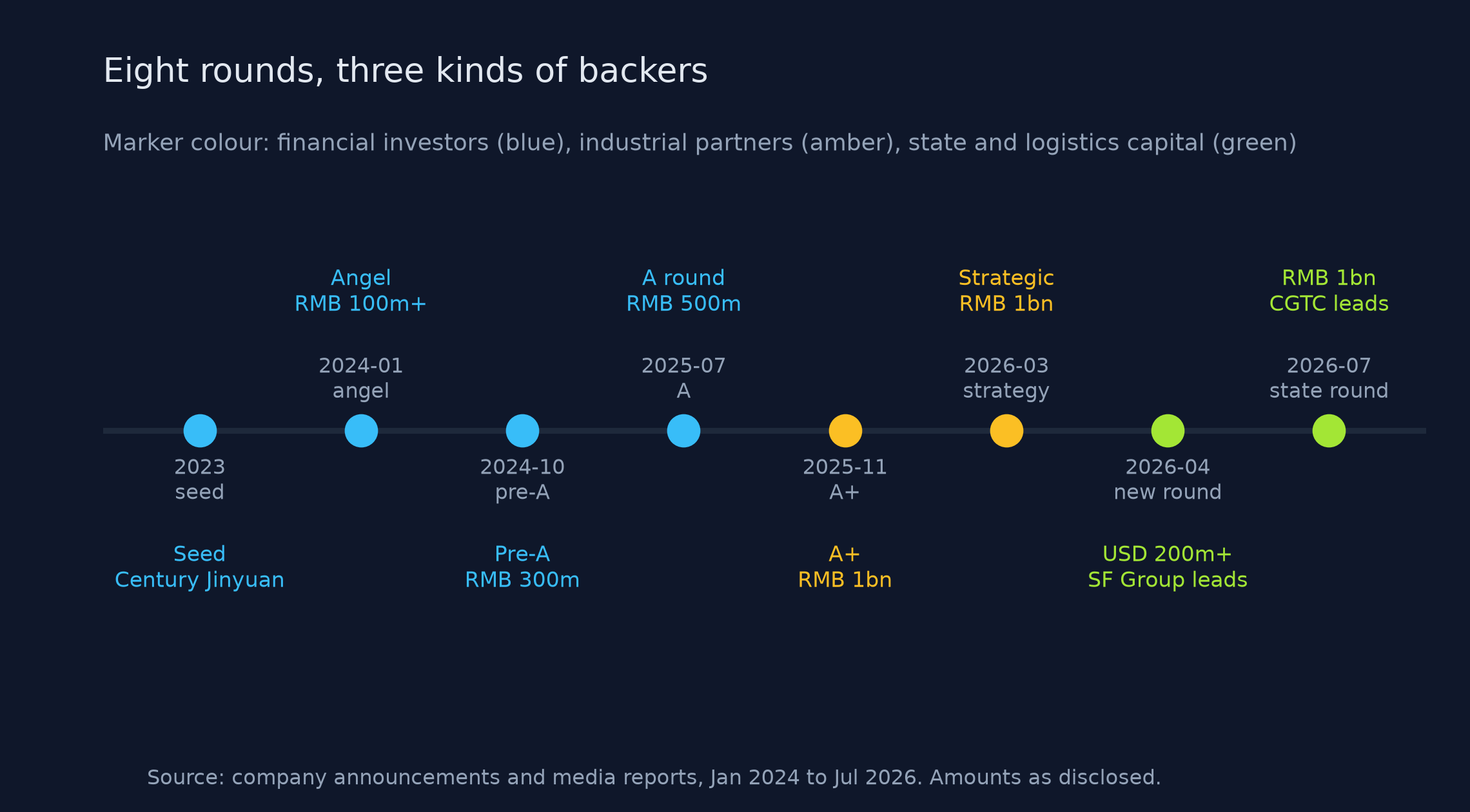
Fig 5 Eight financing rounds and three phases of investor mix. Source: company announcements and media reports.
8.3 Three accounts of a listing
Three public statements about listing do not fully agree, and they are set out here without a conclusion.
On 25 March 2026, at the Boao Forum, founder Chen Jianyu said the details could not yet be disclosed but that the company does have a plan38Chen Jianyu on listing plansView the entry below →.
On 17 August 2026 Bloomberg reported that the company was working with advisers on a Hong Kong listing targeting USD 800 million to USD 1 billion, without naming its sources39Robot Era reported to weigh a Hong Kong IPO of up to USD 1 billionView the entry below →.
In August 2026 a company representative told a reporter that the report was "untrue", and the company has not commented formally since40Humanoid capitalisation heats up as two companies are reported to target Hong KongView the entry below →.
One procedural fact matters here. Hong Kong Exchange's public disclosure channel shows no filing from the company, and specialist technology companies may file confidentially, which means an absence of public records is not evidence of absence46Humanoid robotics capitalisation heats up as two companies are reported to sprint for Hong KongView the entry below →. Taken together, confirmed events amount to the change of corporate form and the change of chairman.
8.4 Valuation and multiples
On valuation, the company's own line is that it passed CNY 10 billion at the March 2026 round; the two later rounds did not disclose post-money values5Valuation passes CNY 10 billion as Robot Era closes a CNY 1 billion strategic roundView the entry below →. Third-party reverse calculations are not used here. Because revenue is missing, a valuation multiple cannot be computed, and that gap is itself part of the picture: every discussion of whether the company is expensive currently lacks a denominator.
9. Substitutability: what a customer pays to switch
9.1 What switching costs consist of
Switching costs fall into four items: equipment depreciation, in-warehouse process adaptation, migration of models and data, and spares and service. Three of the four are tied to the industrial position, because they depend on whether the hand and arm geometry fits the site, whether the training data can only be collected on this hardware, and whether parts are made in-house.
9.2 Two facts that lower them
Two facts on the same chain lower those costs. First, one logistics company invited three humanoid robot makers to validate on site before choosing ROBOTERA, a month-long comparison that makes the procurement process itself comparable9Robot colleagues take over the night shift at logistics hubsView the entry below →. Second, another China Post site runs sorting robots from a different supplier (see 5.4)33Robot sorter goes on duty at China PostView the entry below →, which shows the same customer using different vendors at different sites.
Set side by side, the conclusion sits in the middle: switching costs exist but do not lock a customer in. The stickiness of the position comes mainly from data. Replacing a machine means re-adapting a process; replacing a supplier means rebuilding site data, and the second is more expensive than the first.
10. Signals: four things to watch
10.1 The composition of external buyers
The composition of hand buyers is the most direct signal. If new customers remain robot makers and model companies, the same-layer supply reading holds; if they shift to one-off research purchases, that reading needs revision. The current list covers both robot makers and model companies, and direction matters more than count.
10.2 Third-party verification of the in-house ratio
Whether a third party can establish the in-house share of BOM is the second. The only figure available is the company's own 95%, with no supply-side verification. Once that figure is broken down, both the margin and the capital spending attached to the two modules will be repriced.
10.3 How fast the other two processes replicate
Whether the packing and feeding jobs produce their own time series is the third. At present only exhibition statements exist, with a peak above 1,500 parcels per hour for parcel feeding25Robot Era presents embodied logistics at CeMAT Asia 2026View the entry below →35At CeMAT: one machine for picking, packing and feedingView the entry below → and no ramp curve. If a year passes with only static numbers, the replication speed of the third job is slower than the one-machine, three-process claim suggests.
10.4 Confirmation from the customer side
Whether customers mention these machines in their own periodic reports is the fourth. SF Holding's 2026 interim report and two investor-relations records have been located but not yet retrieved; a named or quantified reference there would give the efficiency figures external validation.
The four signals point to one structure. Buyer composition and the in-house ratio test whether the two-module position holds; replacement speed and customer confirmation test whether the machine position holds. If either pair fails, the overlap dissolves and the company converges with ordinary robot makers.