Company Research Report: Lingyi iTech and the Lines That Build Robots
Why read: robotics revenue is never broken out, and capacity is the only verifiable metric. The margin gap explains why a contract manufacturer also builds its own machines.
By Embodied AI Frontier
Date: Nov 15, 2026
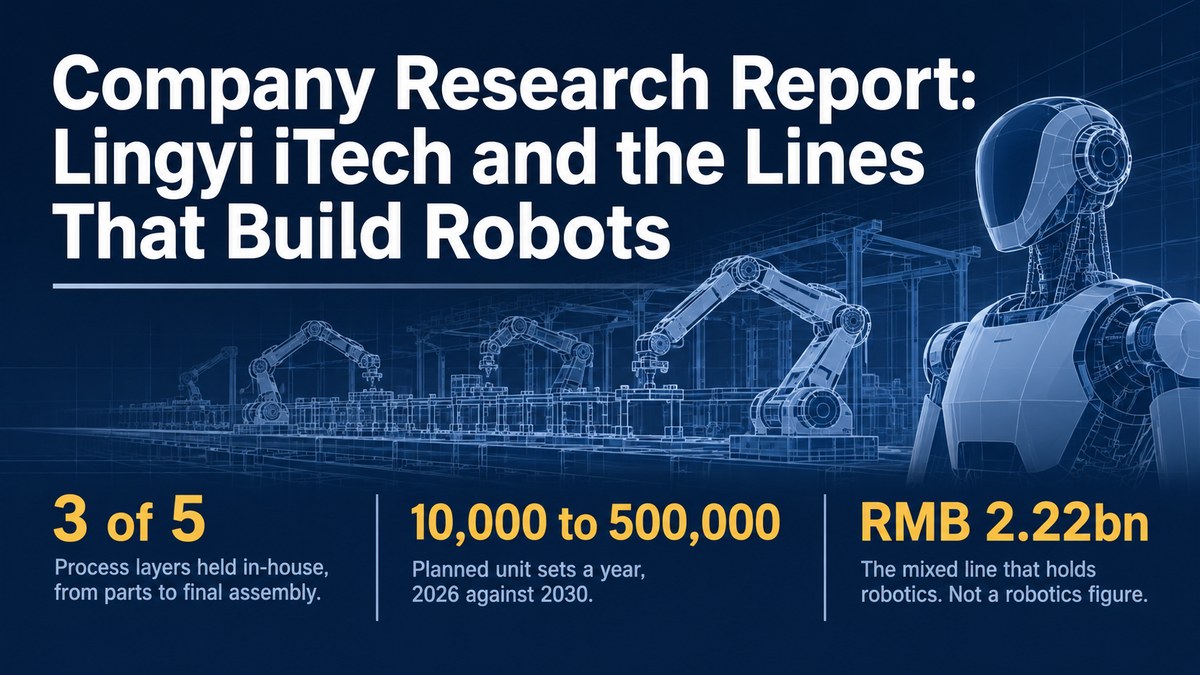
Lingyi iTech (002600.SZ / 01688.HK) builds humanoid robots for other companies. Its robotics business sits one step upstream of the brand layer: body structural parts, four classes of in-house components (reducers, integrated drive-and-control units, servo drives, structural parts), joint and head modules, and an eight-stage final assembly line. The three process layers are run by production lines inside one corporate group. Settlement differs by layer. Manufacturing is billed by process and unit, branding is billed by finished-unit price, and the two produce different margins on the same machine: Lingyi reported an overall gross margin of 15.2% for 2025, UBTECH an overall 37.7%. Robotics revenue has never been disclosed as a separate line item. The verifiable quantitative disclosure is capacity: 10,000 unit sets at the Beijing plant in 2026, 20,000 in 2027, and 500,000 by 2030. Coverage takes in products, customers, supply chain, competition and financial disclosure for the robotics business. The market sizing for the manufacturing layer is an estimate produced by this site, not a company figure.
Article structure
- 1. Position in the chain
- 2. Where demand comes from
- 3. Company history
- 4. What the factory actually makes
- 5. Customers
- 6. Suppliers and delivery
- 7. The same layer's six names
- 8. Financials and pricing
- 9. The cost of switching
- 10. Tracking indicators
1. Position in the chain
1.1 The definition of the manufacturing layer
The humanoid robot supply chain divides into five layers: raw materials, components, modules, final-unit ODM (original design manufacturing, where the supplier builds to a customer's specification), and brand. Lingyi's robotics business occupies the middle three. The company holds four classes of in-house parts, namely reducers, integrated drive-and-control units, servo drives and structural parts, and supplies joint modules, head assemblies, dexterous-hand assemblies and body shells. Below that it runs eight stages of final assembly, from chassis build and arm and head build through electrical assembly, calibration, performance and fatigue testing, to shell packing12026 Interim ReportView the entry below →9Lingyi iTech's robotics strategy: three pillars alongside consumer electronics and autosView the entry below →. The three process layers are run by production lines inside one corporate group (Figure 1). That separates the company from a pure structural-part supplier on one side and a pure assembly shop on the other.
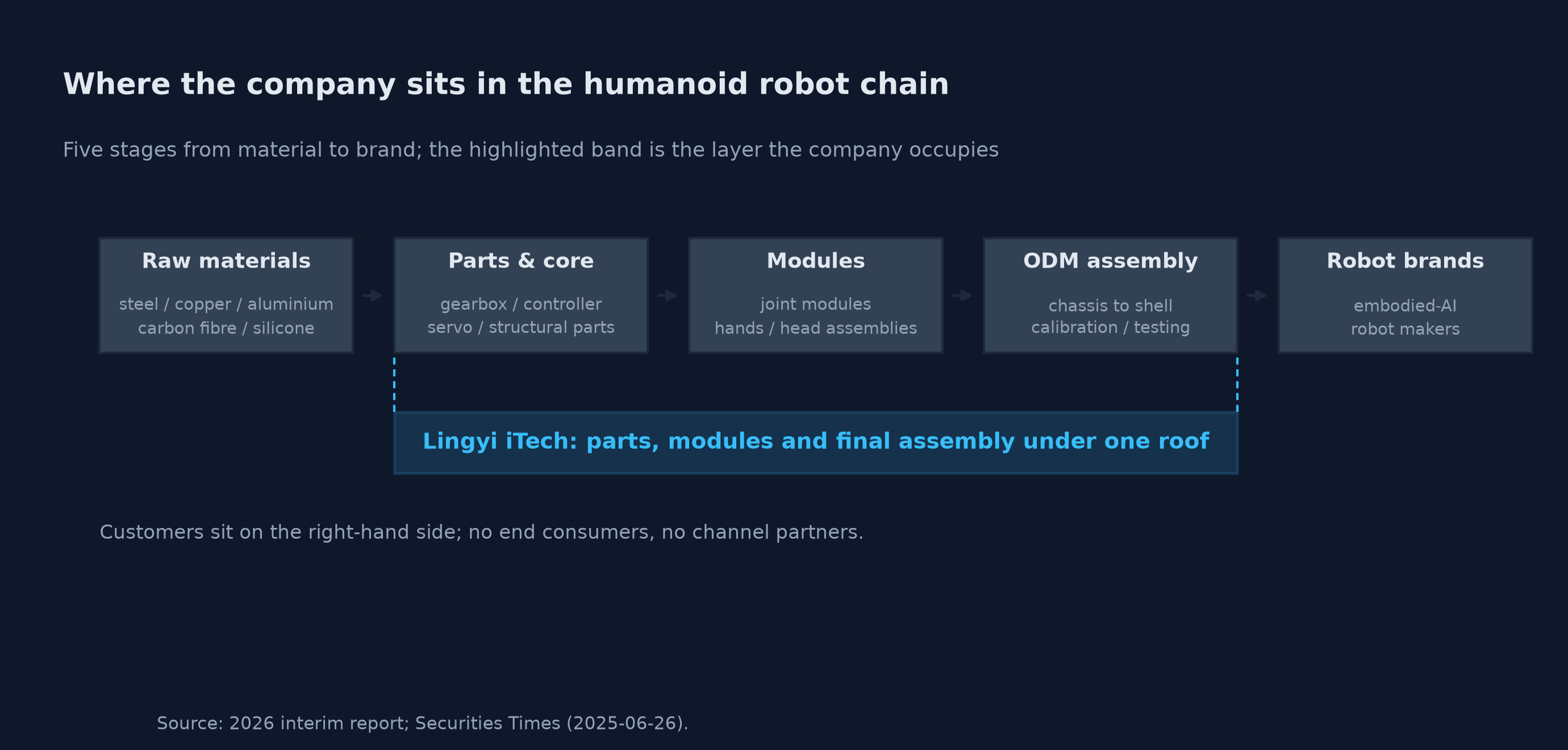
Fig 1 Where the three build layers sit on the humanoid robot chain, and how many of them Lingyi holds in-house. Source: company 2026 interim report; Securities Times.
1.2 How settlement differs by layer
Settlement differs between the two layers. Manufacturing is billed by process and by unit count. Branding is billed by the price of the finished machine. The same robot therefore carries two sets of margins. Lingyi reported an overall gross margin of 15.2% for 2025, while UBTECH, which sells under its own brand, reported an overall 37.7%10The company building robots for UBTECH and HONOR heads for a Hong Kong listingView the entry below →. The two figures describe two pricing methods on one chain. They cannot be used to compare how well either company is run.
1.3 What the company does and does not disclose
Robotics revenue has never appeared as a separate line in the periodic reports. The closest reporting line is "premium assembly and related, including edge-side and physical AI robots", which came to RMB 2.22 billion in the first half of 2026 and mixes edge-device precision assembly with robotics12026 Interim ReportView the entry below →. It cannot be read as robotics revenue. The verifiable quantitative disclosure is capacity: the Beijing super factory, the group's dedicated humanoid plant in the city's Yizhuang district, was planned at 10,000 unit sets a year in 2026, 20,000 in 2027, and 500,000 by 20307Beijing Yizhuang builds a benchmark super factory for embodied intelligenceView the entry below →.
That reading has a falsification condition. If the robotics business had reached the brand layer, the reports would carry standalone revenue for its own machines. Instead, the sales status and prices of the four own-brand models, Xingzhe, Panshi, Linglong and Lingyue, are not disclosed separately, and the figure the company gives for deliveries is "several thousand units of hardware and complete-unit assembly services"12026 Interim ReportView the entry below →. The business has entered delivery while a separately auditable revenue line has not yet appeared.
2. Where demand comes from
2.1 Why brands outsource, and who takes the work
The division of labour is set by what the downstream customer cannot do alone. A team can handle design and model capability. Volume production needs tooling, process, certification and supply chain in place at the same time, and none of the four can be built in two or three years. The production head at the Beijing super factory described the structural problem as "many prototypes, few production-ready units": a startup that makes every part itself spends its energy on manufacturing and loses time on development6Inside Lingyi's Beijing super factory: breaking the "many prototypes, few production-ready units" deadlockView the entry below →.
Supply takes two routes. One is for the brand to build its own line. UBTECH's Liuzhou plant runs a ten-minute takt (one unit off the line every ten minutes), Unitree has rolled out 18,000 units cumulatively, and AGIBOT operates plants in Lingang and Zhangjiang11Humanoid robot lines run at full speed as the volume year meets its commercial testView the entry below →. The other route hands the work to the manufacturing layer. Besides Lingyi, Luxshare Precision, Lens Technology, PIA Automation and Dongfang Precision all announced final-assembly or module lines around 202624Luxshare Precision expects to ship 3,000 humanoids this yearView the entry below →25PIA Automation rolls out 200 embodied robotsView the entry below →11Humanoid robot lines run at full speed as the volume year meets its commercial testView the entry below →.
2.2 Volume constraints and the price threshold
Shipment volume is the binding constraint on this layer. Global humanoid shipments in the first half of 2026 fall between 25,000 and 36,000 units, and the two third-party counts disagree: Frost & Sullivan recorded 36,000 units and USD 540 million, while IDC recorded just under 25,000 units and more than USD 740 million. Unit counts and dollar totals move in opposite directions, and neither firm states its counting boundary122026 Global Humanoid Robot Market Research ReportView the entry below →13Half-year shipments of 25,000 units, up 432.1%: global humanoid commercialisationView the entry below → (Figure 2). At small volumes automation costs more than it returns. Overall automation at the Beijing plant runs at 10% to 20%, against roughly 70% in the mature car industry, and the company targets 30% to 40%6Inside Lingyi's Beijing super factory: breaking the "many prototypes, few production-ready units" deadlockView the entry below →.
The price threshold has a quantified form. The same interview put the cost of deploying one humanoid at RMB 200,000 to 300,000, equivalent to two years of labour cost6Inside Lingyi's Beijing super factory: breaking the "many prototypes, few production-ready units" deadlockView the entry below →. Matching two years of wages is the precondition for this layer to move from project work to volume delivery. On timing, first-half 2026 shipments already exceeded all of 2025, and practitioners place volume commercialisation after 2027 or 202811Humanoid robot lines run at full speed as the volume year meets its commercial testView the entry below →.
2.3 Sizing the manufacturing layer
The company publishes no market size figure. The estimate below is produced by this site from four parameters.
| Parameter | Value | Basis and effect on the bounds |
|---|---|---|
| Global shipments, 2026 | 50,000 to 70,000 units | Frost & Sullivan and IDC figures for H1 2026 annualised separately. The two methods exclude each other rather than complement each other, and taking IDC's lower bound cuts the result by about 30% |
| Deployment cost per unit to the customer | RMB 200,000 to 300,000 | Figure given by the Beijing plant's production head. It is the customer's deployment cost, not the company's quote. Using the lower bound cuts the result by a third |
| Manufacturing share of unit value | 50% to 70% | Assumption, no public data. Anchors: a full-size humanoid uses 20 to 30 joint modules, key modules take more than 40% of bill-of-materials cost, and structural parts and assembly sit on top |
| Share outsourced to this layer | 30% to 50% | Assumption, no public data. Anchors: named third-party capacity totals about 15,000 to 25,000 unit sets, covering Lingyi's 10,000, Dongfang Precision's 10,000-plus line, Luxshare's 3,000 and PIA's 2,000-plus. Whether Dongfang counts sets the ends of the range. Its top divides by 50,000 units to give 50%, its bottom divides by 70,000 to give 20%; the two use different denominators, so the figure taken here is 30% to 50%11Humanoid robot lines run at full speed as the volume year meets its commercial testView the entry below →24Luxshare Precision expects to ship 3,000 humanoids this yearView the entry below →25PIA Automation rolls out 200 embodied robotsView the entry below → |
The endpoints multiply two layers. The floor is 50,000 units × RMB 200,000 × 50%, which gives RMB 5.0 billion. The ceiling is 70,000 units × RMB 300,000 × 70%, which gives RMB 14.7 billion. Multiplying by the outsourced share puts the serviceable market between RMB 1.5 billion and RMB 7.35 billion. On sensitivity, doubling volume to 140,000 units while holding both other parameters at their floor gives about RMB 14 billion, close to the RMB 14.7 billion ceiling. The width of the range comes from parameters with no public baseline, not from the precision of the arithmetic, and the same formula reproduces any other assumption.
The estimate cannot be reconciled against a company figure. What the company offers is a capacity schedule and one goal, becoming a top-three global manufacturer of embodied AI hardware9Lingyi iTech's robotics strategy: three pillars alongside consumer electronics and autosView the entry below →. Neither is a market size statement, so the estimate stands only as an order of magnitude.
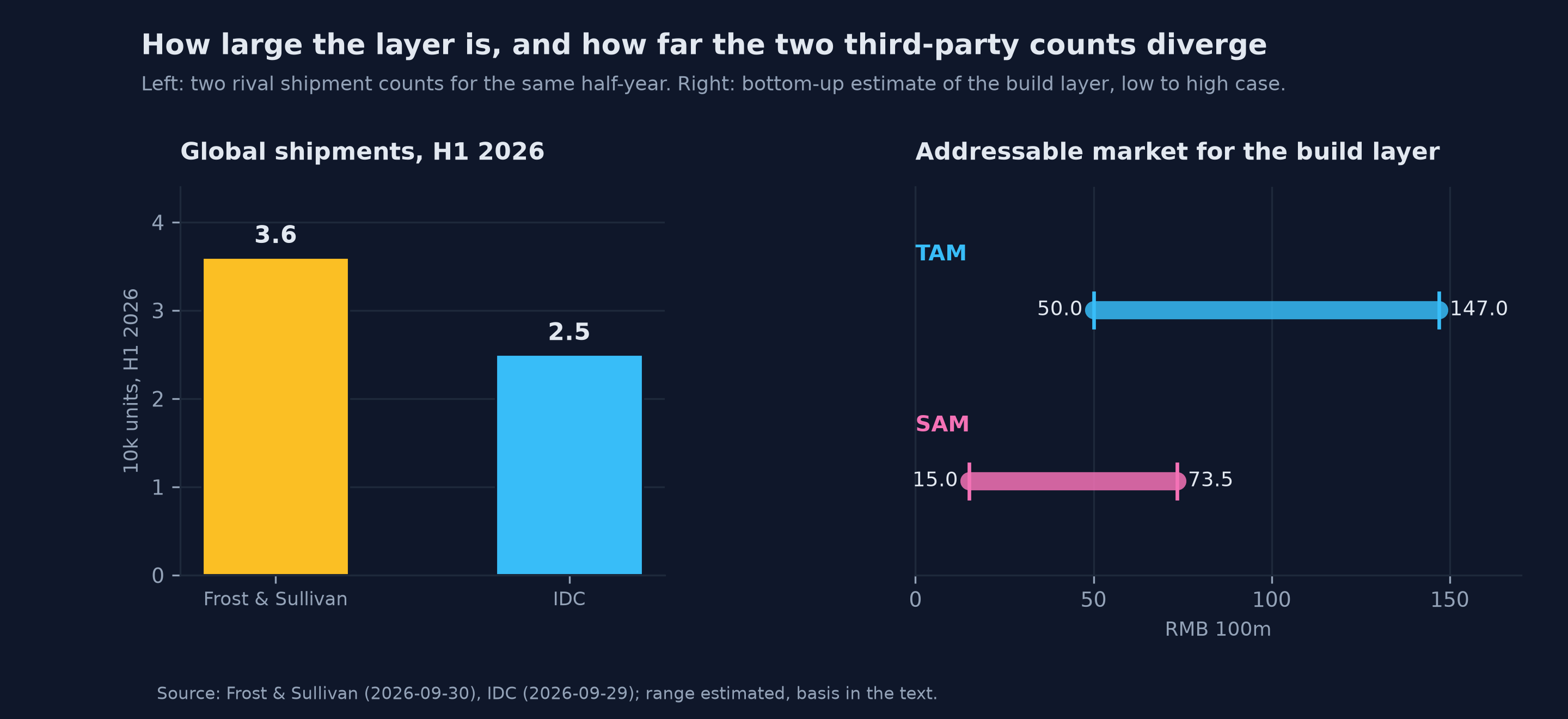
Fig 2 Two third-party counts of H1 2026 humanoid shipments, and the serviceable market range this site derives for the manufacturing layer. Source: Frost & Sullivan; IDC; range estimated by this site.
3. Company history
3.1 Three different founding years
The listed legal entity was set up in 1975 as a state-owned enterprise and converted to a joint-stock company in 2008, under the name Guangdong Jiangfen Magnetic Materials. The founding business began in 2006 as Lingsheng Electronics, cutting and converting adhesive parts. In March 2018 the operating business was injected through a reverse takeover into Jiangfen Magnetic Materials (JPMF Guangdong), already listed in Shenzhen under code 002600. The Hong Kong main board listing followed on 26 June 2026, a dual listing in Shenzhen and Hong Kong that domestic coverage calls an A-plus-H structure3Hong Kong Listing ProspectusView the entry below →42025 Annual ReportView the entry below →. The three years point to three different entities. Public material that mentions a twentieth anniversary refers to the founding business, not to the listed company. Headcount stood at 100,870 at the end of 2025, across 80 manufacturing bases and regional centres42025 Annual ReportView the entry below →3Hong Kong Listing ProspectusView the entry below →.
3.2 The engineering base underneath
The execution-layer capability comes from an older industrial-robot line. The company built the Delta robot Banjiu in 2009, launched the LRV-20E reducer prototype in 2014 with a national invention patent, brought out the Dasheng integrated servo drive-and-control unit in 2019 and the Desheng in 2022, and added a six-axis magnetic levitation planar motor, Qiangqiang, plus a bionic dual-arm robot in 2023. A hollow absolute optical encoder followed in 202412026 Interim ReportView the entry below →. That stack moved into the humanoid business as volumes began to build in 2025.
3.3 The vehicle for the robotics business
The business sits in subsidiaries. Shenzhen Lingpeng Intelligent Technology handles research and the robot body, with more than 400 patents, five series and ten robot models, six in-house reducer models and two series covering six in-house controllers22Lingyi iTech: fourth-quarter net profit up 92.20%, building humanoid core componentsView the entry below →. A joint venture with AGIBOT, Lingzhi Innovation, runs the Dongguan, Chengdu and Zhengzhou lines, with the group holding between 75% and 80%12026 Interim ReportView the entry below →. No separate executive owns robotics at board level. The business is pushed at group level by chair and general manager Zeng Fangqin, whose public commitment is at least RMB 200 million a year for three years into front-end robotics research9Lingyi iTech's robotics strategy: three pillars alongside consumer electronics and autosView the entry below →.
4. What the factory actually makes
4.1 Structural parts and core components
The bottom layer is structural parts, where the company started. Seven processes run there: die cutting, stamping, CNC, injection moulding, metal injection moulding, die casting and 3D printing, with CNC tolerance in the micron range and delivery either as a whole part or as a skeleton sub-assembly12026 Interim ReportView the entry below →6Inside Lingyi's Beijing super factory: breaking the "many prototypes, few production-ready units" deadlockView the entry below →. The barrier in this layer is multi-process coordination and batch consistency, not any single machine.
The core-component layer is where in-house depth is highest. The CSV reducer is an evolution of the cycloidal-pin design, has passed a 10,000-hour rated-life test, comes in six models, and holds invention patents in China, the United States and Japan. The integrated drive-and-control unit runs two generations, Dasheng and Desheng, across two series and six models. Servo drives, a hollow absolute optical encoder and the six-axis magnetic levitation planar motor sit alongside21Lingyi shows reducers, controllers and dual-arm manipulators at Shenzhen Industrial FairView the entry below →12026 Interim ReportView the entry below →. Holding four classes of parts in-house at once separates this company from an assembly shop.
4.2 Modules and final assembly
Modules and assembly turn loose parts into a shippable machine. Joint modules use custom bearings, the precision-manufacturing dexterous hand uses an interface compatible with mainstream humanoid and collaborative arms, and the body shell combines a carbon-fibre frame with a medical-grade silicone contact layer12026 Interim ReportView the entry below →. The assembly stage runs a U-shaped line of ten adjustable stations on a forced three-minute cycle, with fixture changeover under 15 minutes6Inside Lingyi's Beijing super factory: breaking the "many prototypes, few production-ready units" deadlockView the entry below →.
4.3 Product lines and what is withheld
There are three product lines. The humanoid ODM standard unit stands 1.35 metres tall, comes in X1, X2 and X3 versions, and runs on an Orin NX compute platform. The wheeled quadruped handles a 100 kg static limit load, clears obstacles of 25 cm and exposes a ROS2 interface. The LRC04-Pro general chassis uses a four-wheel four-steer layout, carries 100 kg rated and positions to within plus or minus 10 mm23Lingyi iTech's three core products at WRC 2026View the entry below →2Investor Relations Activity Record No. 2026-012View the entry below →.
Disclosure stops at a clear boundary. Degrees of freedom, dead weight, payload and endurance for the humanoid standard unit, and every figure for joint modules and dexterous hands, are withheld by the company. The interim report states ahead of its product table that some products are not listed because of confidentiality agreements with customers12026 Interim ReportView the entry below →. Peers publish degrees of freedom and joint torque routinely, and customer-side specifications cannot be filled back in as standard-unit data. The layer therefore cannot be compared model against model, and only a list of demonstrated capabilities plus the disclosure gap can be assessed.
5. Customers
5.1 Named customers and delivery evidence
Official material names 12 customers. They include the Beijing Humanoid Robot Innovation Center, AGIBOT, HONOR, Hanson Robotics, BrainCo, Astribot, Jiutian Innovation, OYMotion, Haohai Xingkong, Zhejiang Xiantong and the Shenzhen Institute of Artificial Intelligence and Robotics for Society, plus Runze Digital Information (Langfang), signed in November 202612026 Interim ReportView the entry below →2Investor Relations Activity Record No. 2026-012View the entry below →. Seven of the 12 have only a strategic cooperation agreement, with no unit counts and no confirmation from the counterparty, so they count as intent.
Three carry delivery evidence. The Beijing super factory completed its first humanoid roll-off in April 2026, covering the Tiangong Ultra and Tiangong 3.0 built for the Beijing Humanoid Robot Innovation Center16First humanoids roll off Lingyi's Beijing super factoryView the entry below →8A visit to the Beijing super factory as volume production beginsView the entry below →. The Chengdu base delivered 200 custom general-purpose humanoids to AGIBOT in May 202615Lingyi's Chengdu base delivers 200 general-purpose humanoidsView the entry below →. HONOR's Lightning won the 2026 humanoid half-marathon in Beijing's Yizhuang district, and the company supplied core structural parts and surface treatment, which it describes as already in volume delivery18Behind HONOR Lightning's win: Lingyi supplied the full structural-part set and surface treatmentView the entry below →.
5.2 Unnamed customers and disclosure limits
Overseas customers cannot be named. The standing wording is "core supplier to several leading North American AI model and robotics companies", supplying humanoid core hardware, modules, bodies and ODM services, with new overseas ODM pre-development projects in 20262Investor Relations Activity Record No. 2026-012View the entry below →. Asked for names, the company cites confidentiality agreements.
The company's delivery figure is "several thousand units of hardware and complete-unit assembly services"12026 Interim ReportView the entry below → (Figure 3). Media report a more specific number, more than 5,000 units cumulatively by the end of 2025. That figure comes from media reporting rather than a filing11Humanoid robot lines run at full speed as the volume year meets its commercial testView the entry below →.
5.3 Customer concentration
Customer concentration is one of the more concentrated items in the company's financial structure. The top five customers accounted for RMB 29.56 billion of 2025 sales, or 57.47% of the total, with the single largest customer at 19.15%42025 Annual ReportView the entry below →. Over three years the two ratios move in opposite directions: the top five rose from 52.0% to 56.0% and then 57.5%, while the largest single customer fell from 24.2% to 22.0% and then 19.2%3Hong Kong Listing ProspectusView the entry below →. Growth came from several existing large customers ordering more at once, not from one customer scaling up (Figure 4).
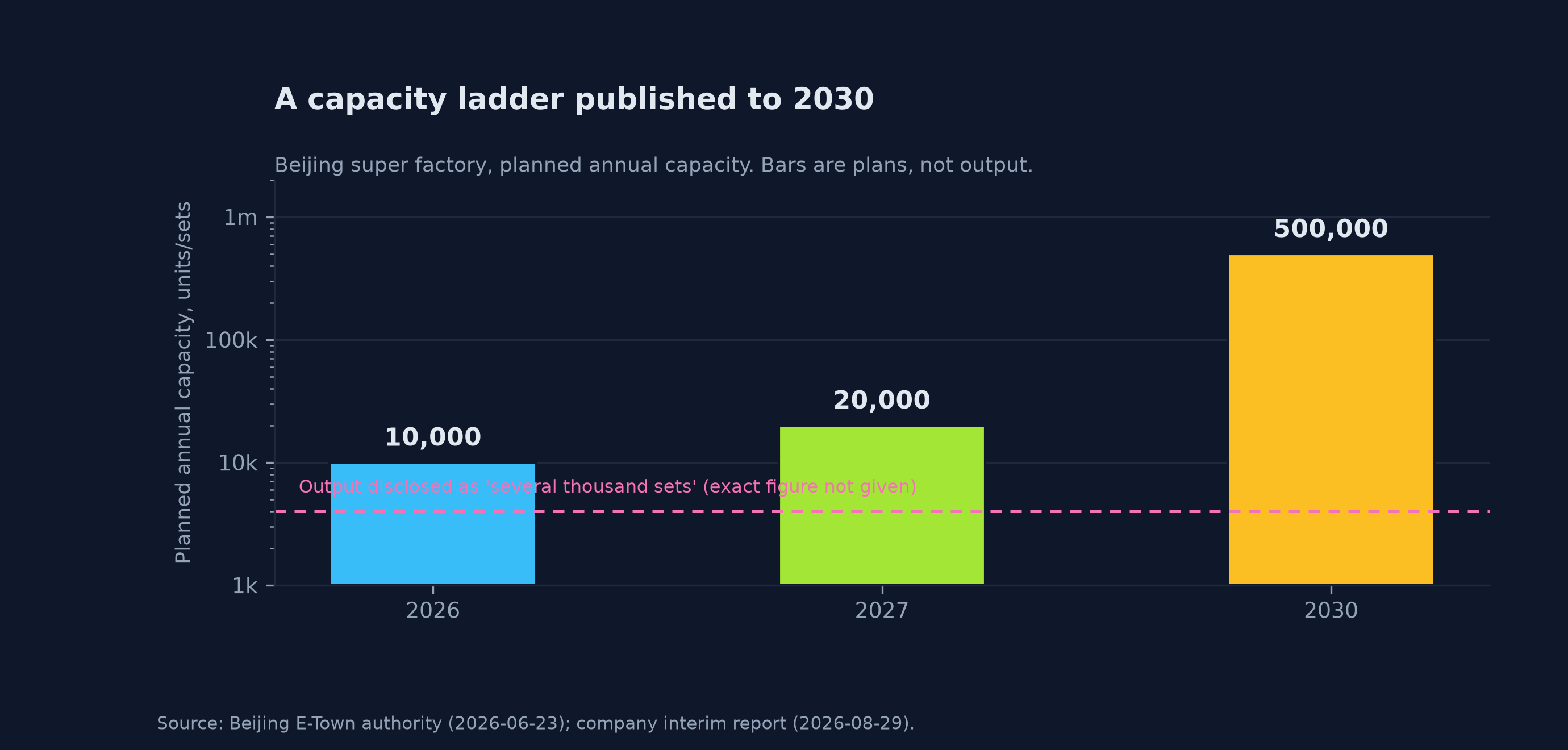
Fig 3 Planned capacity at the Beijing super factory against the delivery figure in company filings. Source: Beijing Economic-Technological Development Area; company 2026 interim report.
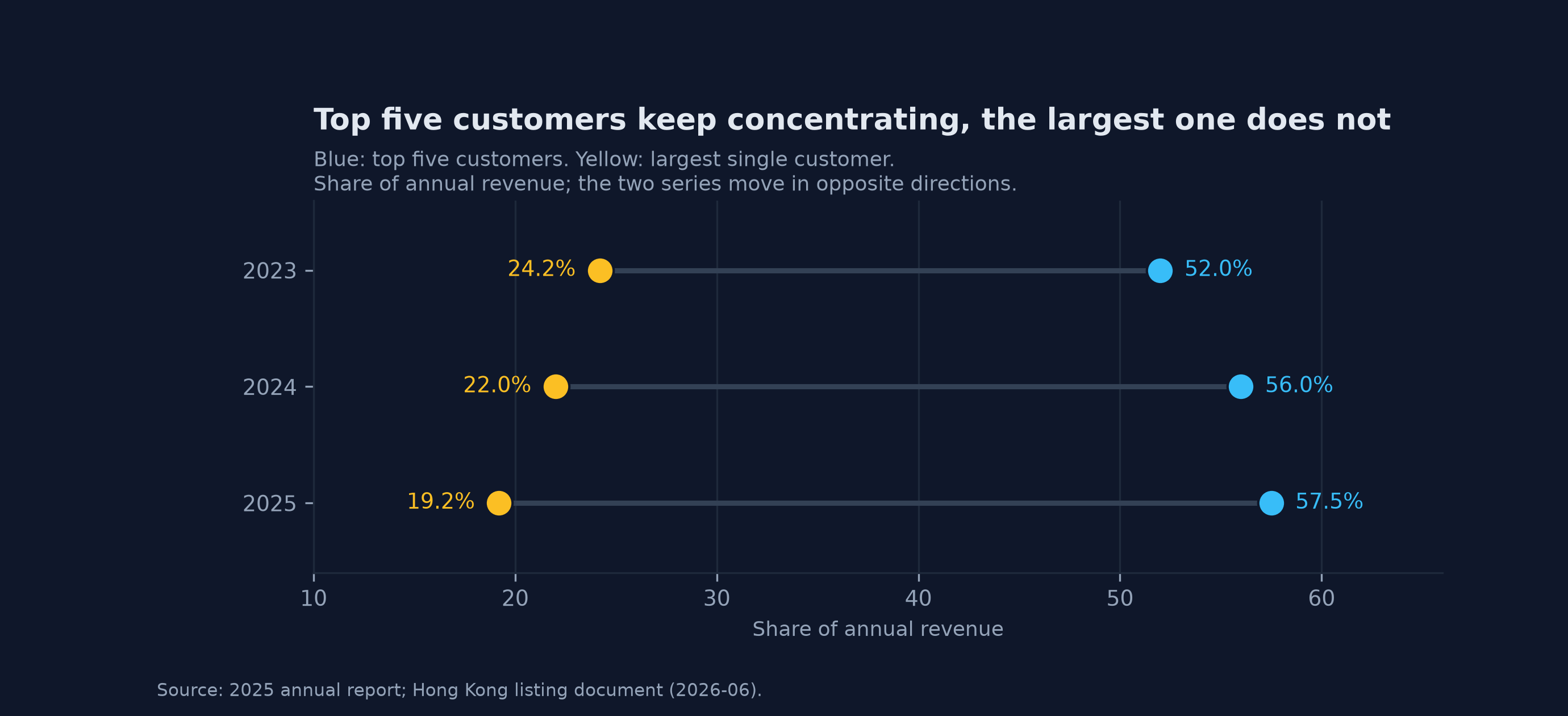
Fig 4 Top-five customer share and largest single customer share, 2023 to 2025. Source: company 2025 annual report; Hong Kong listing prospectus.
6. Suppliers and delivery
6.1 Upstream purchasing
The main raw materials are stainless steel, copper, aluminium, copper foil and other metals12026 Interim ReportView the entry below →9Lingyi iTech's robotics strategy: three pillars alongside consumer electronics and autosView the entry below →. The top five suppliers accounted for RMB 9.40 billion of 2025 purchases, or 29.75% of the total42025 Annual ReportView the entry below →. That is below the customer-side concentration, which means upstream substitution is easier than downstream substitution. Some steps are already covered in-house: the company says it has built several production lines for roller screws, coreless motors, reducers and dexterous-hand structural parts9Lingyi iTech's robotics strategy: three pillars alongside consumer electronics and autosView the entry below →. The 2026 interim report does not use the term coreless motor, so the product scope of those lines rests on what the company told reporters.
6.2 The delivery chain and how it sells
The chain runs eight fixed stages: chassis assembly, lift module and waist assembly, arm assembly, gripper and head assembly, electrical assembly, calibration, performance and fatigue testing, and shell assembly with packing9Lingyi iTech's robotics strategy: three pillars alongside consumer electronics and autosView the entry below →. The five bases have set roles, with Beijing as the benchmark, Chengdu-Chongqing as support, the Greater Bay Area as the hub and overseas sites as extension16First humanoids roll off Lingyi's Beijing super factoryView the entry below →. The sales model is not disclosed.
6.3 In-house deployment and complementary data
The company says it is building an embodied AI data asset platform that connects real-machine, simulation and internet data, and it has deployed industrial embodied robots in three tasks: loading and unloading, automated optical inspection, and CNC machining2Investor Relations Activity Record No. 2026-012View the entry below →12026 Interim ReportView the entry below →. Its own plants are therefore the first application site for the business and one of the deployment samples that can be checked on site. The company does not disclose how many units are deployed, and the media figure of a 40% labour saving has no reproducible basis.
7. The same layer's six names
7.1 Six companies with public evidence
Six companies in the same layer have public evidence (Figure 5). Luxshare Precision expects to ship 3,000 humanoids in 2026, all to outside customers24Luxshare Precision expects to ship 3,000 humanoids this yearView the entry below →. Lens Technology says its Kunshan base has reached 100 units a day and can support more than 10,000 a month19Lens Technology responds on structural-part supply for HONOR LightningView the entry below →. PIA Automation formed Ningbo PIA Future with AGIBOT; its Wuxi subsidiary reports capacity of 2,000-plus units and it became the first producer certified under AGIBOT's general-product manufacturing scheme25PIA Automation rolls out 200 embodied robotsView the entry below →11Humanoid robot lines run at full speed as the volume year meets its commercial testView the entry below →. Dongfang Precision's Foshan line with Leju Robotics runs a 30-minute takt. Wolong Electric Drive booked RMB 325 million in robot components revenue in the first half of 202611Humanoid robot lines run at full speed as the volume year meets its commercial testView the entry below →26Wolong Electric Drive robot components and systems revenueView the entry below →. Sanhua Intelligent Controls enters through actuator assemblies31Sanhua Intelligent Controls denies reports of a large robot orderView the entry below →.
7.2 How many layers each one covers
The six differ in how many process layers they hold. Lingyi keeps structural parts, core components, modules and assembly inside its own plants. Luxshare and Lens are strong in structural parts and final assembly but hold fewer in-house component layers. PIA comes from car-making equipment and supplies lines as well as complete units. Sanhua extends upward from the actuator layer toward modules9Lingyi iTech's robotics strategy: three pillars alongside consumer electronics and autosView the entry below →19Lens Technology responds on structural-part supply for HONOR LightningView the entry below →25PIA Automation rolls out 200 embodied robotsView the entry below →31Sanhua Intelligent Controls denies reports of a large robot orderView the entry below →.
Entry is happening on both sides. Downstream, brands building their own lines shrink the serviceable market directly: UBTECH's Liuzhou plant already has robots working on the line, and AGIBOT runs plants in Lingang and Zhangjiang and completed its 5,000th unit in December 202511Humanoid robot lines run at full speed as the volume year meets its commercial testView the entry below →. Upstream, component makers moving down enter modules and complete units from the core-component layer. Sanhua starts from electromechanical actuators31Sanhua Intelligent Controls denies reports of a large robot orderView the entry below →, and Zhenyu Technology's product list already includes linear actuators, planetary roller screws and dexterous-hand precision parts32Ningbo Zhenyu Technology: prospectus for convertible bond issueView the entry below →. The two routes meet at the module layer.
7.3 Buying by the stage
Splitting an order by component already happens. On HONOR's Lightning, Lingyi says it supplies the full structural-part set and surface treatment in volume, while Lens says all 132 core metal structural parts come from Lens. Neither discloses share18Behind HONOR Lightning's win: Lingyi supplied the full structural-part set and surface treatmentView the entry below →19Lens Technology responds on structural-part supply for HONOR LightningView the entry below →. Once per-stage purchasing becomes routine, quotes in this layer get compared stage by stage.
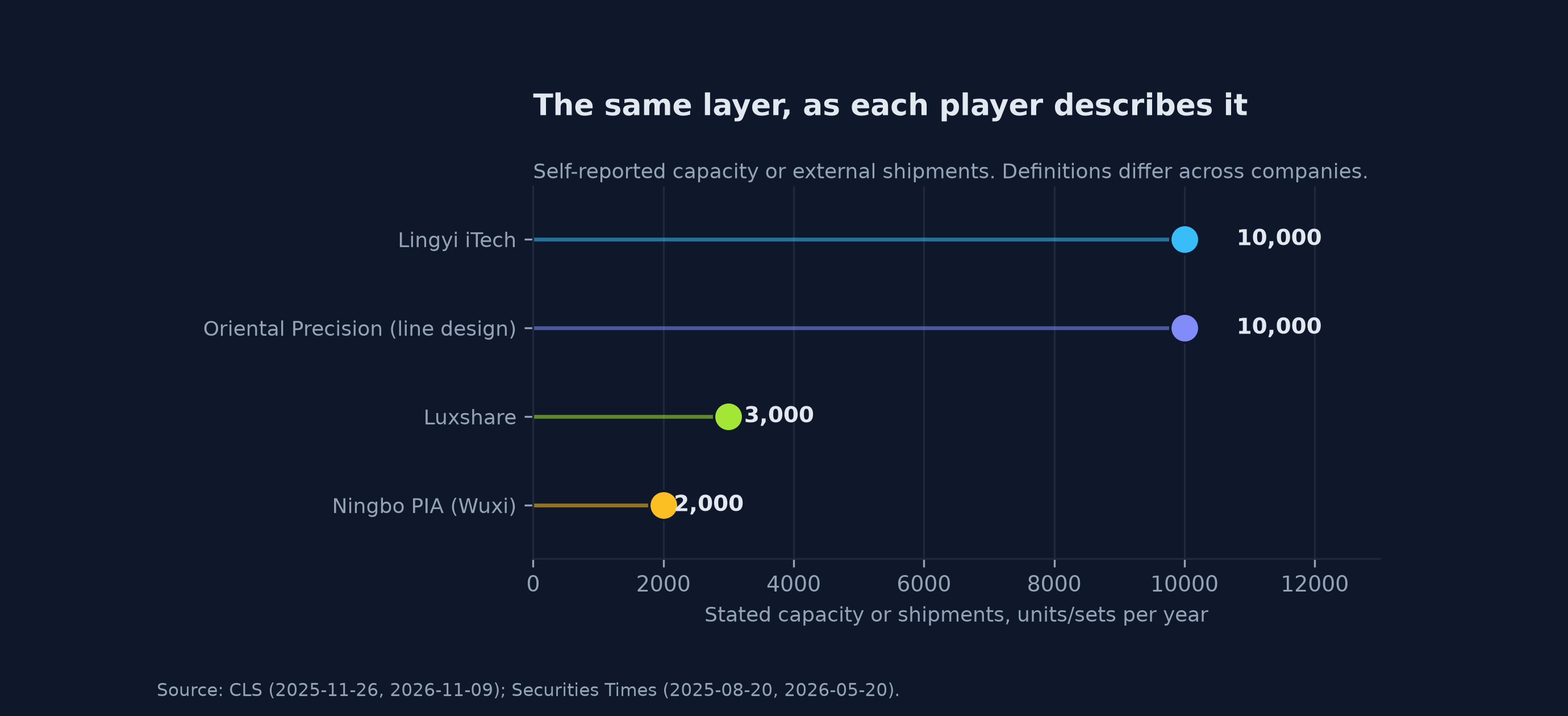
Fig 5 Named companies in the same layer and the third-party capacity each has disclosed. Source: Cailian Press; Securities Times; company announcements.
8. Financials and pricing
8.1 Three years of operations
Revenue was RMB 34.15 billion in 2023, RMB 44.26 billion in 2024 and RMB 51.43 billion in 2025, up 16.20% in 2025 on a restated basis for the two earlier years. Net profit attributable to shareholders was RMB 2.02 billion, RMB 1.76 billion and RMB 2.29 billion, up 30.34% in 2025, a figure that includes about RMB 540 million of non-recurring items; the non-recurring-adjusted figure was RMB 1.75 billion42025 Annual ReportView the entry below →.
8.2 First three quarters of 2026
Revenue for the first three quarters of 2026 was RMB 40.67 billion, up 8.20%, while attributable net profit was RMB 1.92 billion, down 1.27%. The third quarter alone posted revenue of RMB 15.52 billion, up 11.15%, and attributable net profit of RMB 1.15 billion, up 14.00%52026 Third-Quarter ReportView the entry below →. Gross profit rose 19.26% and the gross margin improved 1.70 percentage points2Investor Relations Activity Record No. 2026-012View the entry below →, yet attributable profit still fell slightly. The gap sits in expenses: financial expenses for the nine months were RMB 876 million, up 174.67%30Third-quarter net profit up more than 200% quarter on quarterView the entry below →, and within that the first half carried an exchange loss that widened from RMB 174 million to RMB 466 million and financial expenses up 446.35%12026 Interim ReportView the entry below →. Gross profit did not deteriorate while profit did, which means the two directions came from expenses rather than operations.
8.3 What sets the margin
Pricing levels differ between the manufacturing layer and the brand layer. The overall gross margin for 2025 was 15.2% against UBTECH's overall 37.7%10The company building robots for UBTECH and HONOR heads for a Hong Kong listingView the entry below → (Figure 6), and the gap comes from how each is billed. Manufacturing is charged by process and unit count; branding is charged by finished-unit price, which carries software, brand and service premiums. The company also pushes own-brand machines alongside contract work, a move tied to where it sits on settlement: a complete unit is what carries the company into the brand layer.
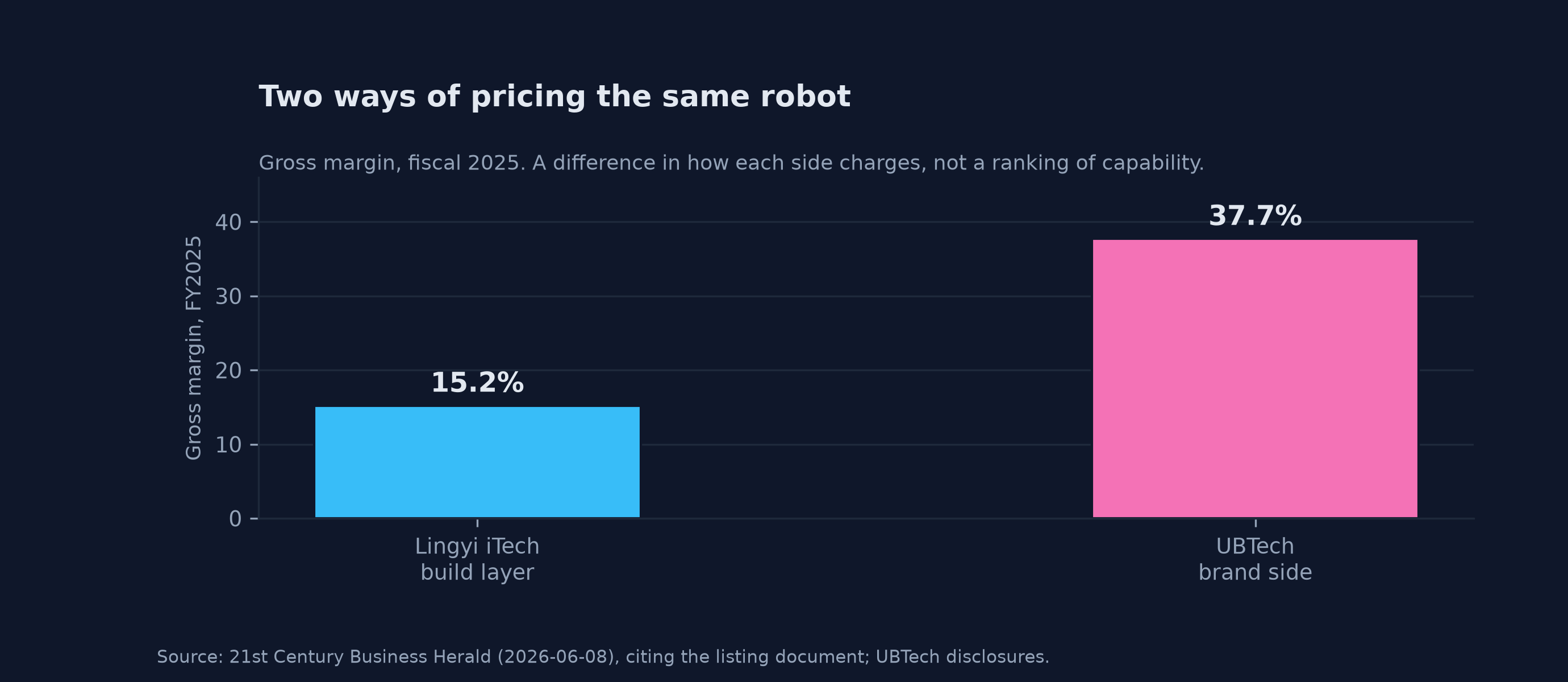
Fig 6 Gross margin at the manufacturing layer and at the brand layer, 2025. Source: 21st Century Business Herald citing the Hong Kong prospectus; UBTECH public disclosure.
8.4 Research spending and the listing proceeds
Research spending was RMB 1.44 billion in the first half of 2026, up 27.86%, and RMB 2.24 billion for the first three quarters, up 25.72%12026 Interim ReportView the entry below →52026 Third-Quarter ReportView the entry below →. For a business billed by process, research determines which process stages it can take on next; it does not set the price.
The Hong Kong listing issued 811.8 million shares at HKD 10.18, raising net proceeds of about HKD 8.15 billion, with 19 cornerstone investors (institutions committing to hold for a set period) subscribing about HKD 3.19 billion3Hong Kong Listing ProspectusView the entry below →. The prospectus sets no separate robotics line. The quantifiable item tied directly to robotics is 15.0% of the emerging-market capacity upgrade, or HKD 1.22 billion, and that tranche sits alongside server power, thermal management components and structural-part lines, with the robot assembly line only one item inside it. Counting all three places that name humanoid robots pushes the figure to 67.6%, which is the widest reading rather than a dedicated allocation3Hong Kong Listing ProspectusView the entry below →.
9. The cost of switching
9.1 Replacing the whole layer against replacing one stage
Replacing the whole layer is expensive. A customer assembling on its own would work across three or four suppliers, each needing line requalification, recalibration and a rerun of more than 200 factory tests, which take 8 to 12 hours per unit on site8A visit to the Beijing super factory as volume production beginsView the entry below →. The number of steps is itself the friction.
Replacing a single stage is much cheaper. On HONOR's Lightning, Lingyi and Lens both claim structural-part supply, which shows that splitting suppliers by stage is workable18Behind HONOR Lightning's win: Lingyi supplied the full structural-part set and surface treatmentView the entry below →19Lens Technology responds on structural-part supply for HONOR LightningView the entry below →. Quotes in this layer will therefore be compared stage by stage, which is the structural reason the margin cannot be lifted from one side.
9.2 Where cost can still move
Scale has not yet turned into a cost advantage. Five bases are running, CNC tolerance is in the micron range and joint-module testing covers 1 to 500 newton-metres6Inside Lingyi's Beijing super factory: breaking the "many prototypes, few production-ready units" deadlockView the entry below →, while overall automation runs at 10% to 20%, against a target of 30% to 40% and about 90% on high-volume steps such as joint motors6Inside Lingyi's Beijing super factory: breaking the "many prototypes, few production-ready units" deadlockView the entry below →. Among the measurable cost levers in this layer, automation carries the most weight. Until it arrives, scale shows up as capacity rather than cost.
9.3 The data asset
The embodied AI data platform is the one direction where the business could build something exclusive. The company presents it as a differentiator but gives no figure for data volume, labelling volume or reusability2Investor Relations Activity Record No. 2026-012View the entry below →, so what can be verified stops at the direction. Customer confirmation is thin: one public instance, an award AGIBOT gave the company at its 2026 partner conference in the customer category. Among the sources reviewed, that is the only confirmation from a customer side, and it lines up with a joint pilot base built with the Beijing Humanoid Robot Innovation Center and the Tiangong 3.0 roll-off at the Beijing plant12026 Interim ReportView the entry below →16First humanoids roll off Lingyi's Beijing super factoryView the entry below →.
10. Tracking indicators
10.1 Reporting lines and orders
Whether the 2026 annual report breaks out robotics revenue for the first time is the direct test of whether the business has reached an auditable stage. If revenue stays inside the premium assembly line, the business is still running on a capacity narrative12026 Interim ReportView the entry below →. On orders, the 2026 overseas ODM pre-development projects become disclosable orders only if the customer hands over unit interface and appearance definition rather than ordering parts alone2Investor Relations Activity Record No. 2026-012View the entry below →.
10.2 Capacity against parts
The Beijing plant is planned at 10,000 unit sets for 2026, against a stated delivery figure of several thousand7Beijing Yizhuang builds a benchmark super factory for embodied intelligenceView the entry below →12026 Interim ReportView the entry below →. The two cannot be divided: the delivery figure covers several bases and does not separate complete units from parts, while the capacity figure is a single plant's plan. They work as an order-of-magnitude comparison only. On parts, a verifiable volume figure for roller screws or coreless motors would settle whether this layer is thickening or thinning. The more it absorbs upward, the harder per-stage substitution becomes for customers9Lingyi iTech's robotics strategy: three pillars alongside consumer electronics and autosView the entry below →.
10.3 Cost and competition
The pace from 10% to 20% automation toward 30% to 40%, and whether the 90% target on joint motors lands, decide whether the margin has room to rise. Both can be checked each quarter6Inside Lingyi's Beijing super factory: breaking the "many prototypes, few production-ready units" deadlockView the entry below →. On competition, whether upstream self-build and downstream extension accelerate together, and whether Luxshare, Lens and PIA start publishing third-party assembly volumes, decides when the layer gains a comparable benchmark11Humanoid robot lines run at full speed as the volume year meets its commercial testView the entry below →24Luxshare Precision expects to ship 3,000 humanoids this yearView the entry below →.
Taken together, the indicators point to one testable judgement. The company's position in the chain was established in 2026 by its customer list and its running lines. What remains unverified is the pricing power of that position, and the first hard evidence will be a segment line and a margin movement in the annual report12026 Interim ReportView the entry below →42025 Annual ReportView the entry below →.
Sources
All figures and facts in this report come from publicly verifiable sources. The main references are listed below.