Live Briefs 2026-10-03 · Full coverage of embodied AI
Video Friday: Humanoid Robot Takes On Monkey Bars and More
IEEE Spectrum's Video Friday highlights a humanoid robot traversing monkey bars, Unitree's open-source embodied model, and other robotics demos. The roundup also covers disaster robotics, aerial manipulation, industrial certification, and applications from dishwashing to burrito delivery.
How to Choose the Right Rack and Pinion System for High-Precision Linear Motion
Rack and pinion systems convert rotary motion to linear motion, but selecting the wrong size can hurt performance and cost. GAM's Matt Ruggles explains how to size racks, pinions, gearboxes, and motors based on feed force, speed, precision, and inertia matching.
AGIBOT releases GE-Act 2.0, first native World Action Model
AGIBOT released GE-Act 2.0, which it calls the first native World Action Model to validate a pretraining and scaling path for embodied AI. The model was trained entirely from scratch on embodied manipulation data: visual representation, future generation and action prediction all start from random initialization, with no inherited video generators and no task-specific fine-tuning. It was then put through a zero-shot real-robot test covering unseen scenes, unseen objects and 100 atomic tasks.

Robot Dog Buys Groceries: Risk Control Before Payment in Embodied AI
At the Bund Conference, a robot dog named Tutu demonstrated autonomous ordering and payment, but the real challenge for embodied AI payment is liability, not perception. Risk-control models can identify over 230 scenarios, yet regulation and responsibility rules lag behind agent-driven transactions.
Gene-Edited Tomato Helps Robot Pollinate in GEAIR 2.0 Demo
At the Beijing Seed Industry Conference on Sept. 7, the Chinese Academy of Sciences' GEAIR 2.0 demonstrated robotic pollination, completing a flower in under 10 seconds. The article argues its real breakthrough is not the robot arm but a gene-edited tomato designed to cooperate with machines, an approach called crop-robot co-design.

Fukushima's 22-Meter Robot Arm Stalls on a Single Motor
A 22-meter robotic arm built to retrieve Fukushima fuel debris has been delayed five years and postponed four times, and is now stuck because a motor brake will not release. Analysis argues the real obstacle is not engineering but a nuclear decommissioning system that has never treated the job as urgent.

Four AI Models Rank Human Misuse as Top Extinction Risk
Business Insider asked ChatGPT, Gemini, Claude, and Grok to rank paths to human extinction. The models agreed that killer robots are the least likely threat; the real danger is humans using AI for bioweapons and cyberattacks.
Humanlike Robot Charm Boosts Trust—Until It Starts Making Mistakes
A Drexel University study found that expressive, humanlike robots can influence people more, but their mistakes trigger a steeper trust collapse. The effect appears tied to social judgment, not mechanical failure, and oxytocin may amplify attention rather than trust.
Sanctuary AI Highlights Episodes 60-64 on Dexterous Manipulation
Sanctuary AI has published highlights from episodes 60 through 64 of its Robots Doing Stuff series. The five episodes cover different sides of automating complex physical work, including welding, failure recovery, bimanual threading, power tool use and delicate object handling. The company says the episodes showcase a range of Physical AI and dexterous manipulation capabilities under development at Sanctuary AI.
Boston Dynamics posts corrected software update notes
Boston Dynamics published a corrected notice pointing robot owners to its software update and release notes, asking users to refresh their robots' software and check the notes.
Humanoid Robot Learns to Sprint and Spin Kick via AI Trained on Human Motion
A humanoid robot has learned to sprint and perform spin kicks using AI trained on human motion data. This advancement could lead to more versatile robots capable of handling a broader range of tasks in real-world settings.
PaXiniTech builds data, tech foundation for Physical AGI at scale
PaXiniTech says it is building the data and technology foundation needed to scale Physical AGI, with the goal of bringing embodied intelligence closer to real-world deployment. The company positions large-scale data and technology infrastructure as the prerequisite for moving embodied AI out of the lab and into practical applications at scale.
LimX podcast: RAI's Vera Kovaleva on memory and autonomous robots
LimX Dynamics shared an episode featuring RAI founder Vera Kovaleva, who gives an independent technical view on persistent memory, continuous learning and autonomous decision-making. She also discusses why open robotic platforms matter for developing and validating new intelligence, and how a sensing and acting body closes the loop from understanding to execution in changing physical environments.

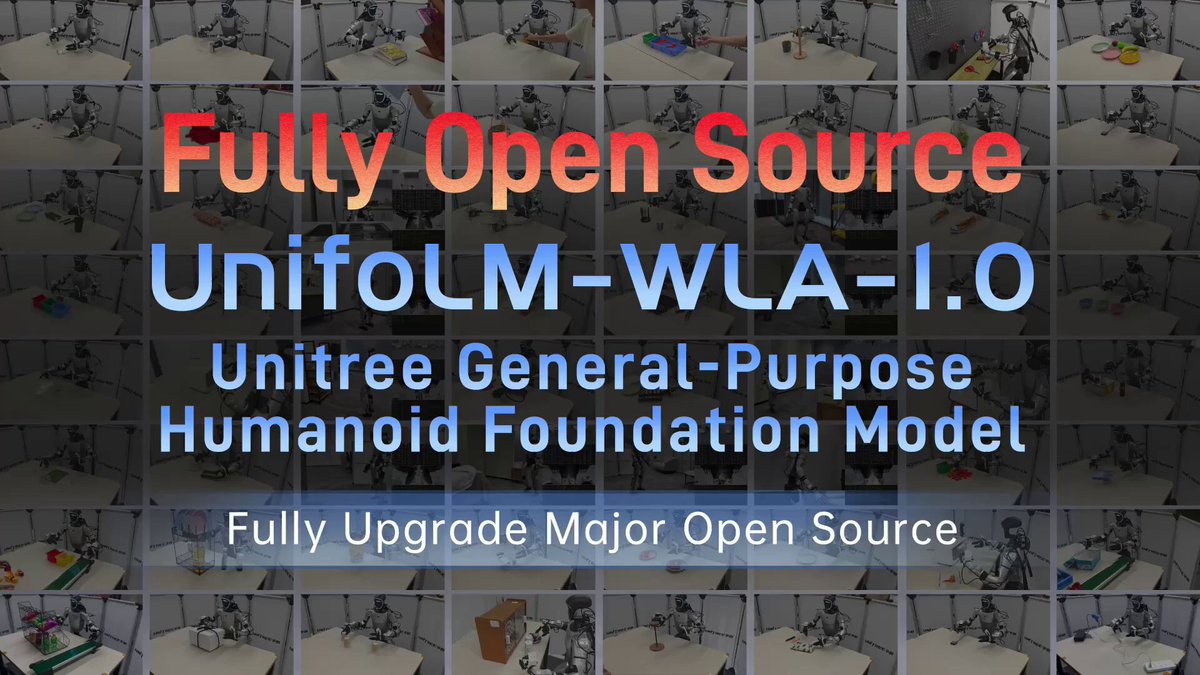
Unitree open-sources UnifoLM-WLA-1.0 embodied model
Unitree has fully open-sourced its UnifoLM-WLA-1.0 embodied foundation model, claiming new SOTA results across multiple benchmarks among open-source models worldwide. A single model coordinates desktop and whole-body mobile manipulation, and supports cross-task and cross-end-effector generalization.
Unitree Open-Sources UnifoLM-WLA-1.0 Embodied Foundation Model for Robot Manipulation
Unitree Robotics has open-sourced UnifoLM-WLA-1.0, an embodied foundation model that unifies tabletop and whole-body mobile manipulation and supports cross-task and cross-end-effector generalization.
Unitree Robot Learned to Fight, But That May Not Be the Point
Unitree's G1 humanoid robot was shown fighting a human in a fully autonomous demo, but independent analysis suggests the AI may run on an external computer. The real concern is not the fight itself, but the lack of safety frameworks for increasingly capable humanoid robots after a G1 kicked a child at an amusement park.
CyberHero Robot League: A Flashy Arena, Not a Fast Track for Tech Iteration
The CyberHero humanoid robot sports league launched in Riyadh, with plans for an eight-city global tour. However, an analysis argues that the entertainment-focused competition is unlikely to drive core breakthroughs in humanoid robotics technology.
InHand Networks Advances Embodied AI Robot Research for Industrial Flexible Manufacturing
InHand Networks (688080.SH) is conducting forward-looking research on embodied AI robots, focusing on 3D vision, dexterous actuators, motion control, and autonomous learning for industrial flexible manufacturing.
When Code Bugs Become Physical Harm: Embodied AI's Perilous Leap
In an April 2026 security demonstration, a commercial quadruped robot was hijacked remotely and turned on a human dummy, prompting 360 founder Zhou Hongyi to warn that embodied AI converts code flaws into physical destruction. Research by DARKNAVY and others found a well-known humanoid robot could be fully compromised in under eight hours, and the Unitree G1's "UniBLEed" flaw chain may even be wormable, while standards and security investment race to catch up.