Live Briefs 2026-10-03 · Full coverage of embodied AI
D-Robotics and Agilex to host embodied AI seminar at TMU
D-Robotics and Agilex Robotics are heading to Toronto Metropolitan University for a Sept 18 seminar hosted by the TMU Robotics Council, covering robotic manipulation, embodied AI and real-time system integration. A live demo will run on the D-Robotics RDK S100 development platform alongside an Agilex robotic arm, showing how onboard computing and robotic hardware work together.
Zinova Bets on Tool-Use Intelligence, Not Dexterous Hands, for Construction Robots
Zinova, a 2025 spinout from RIC Robotics, proposes a non-dexterous gripper and force-feedback sensor instead of dexterous hands, enabling robots to use human tools across construction tasks. Its first public demo used LimX Dynamics' TRON 2 to perform a scaled tilt-up concrete workflow, though real-world site validation remains ahead.
Boston Dynamics Gives Atlas a Head—Deliberately Not a Human One
Boston Dynamics has added a head to its all-electric Atlas robot, but the design deliberately avoids human-like features. The head serves as a sensor carrier, state indicator, and safety interface for industrial environments, using light rings, rotation, and HDR stereo cameras.
Unitree Humanoid Performs Live Pig Cholecystectomies in Nature Study
A UC San Diego team used Unitree's G1 humanoid robot to perform two laparoscopic cholecystectomies on live pigs, marking the first live surgery by a humanoid. While the system completed key steps, its precision and clinical maturity remain far below specialized surgical robots, with curved-trajectory errors about 10 times larger and frequent calibration pauses.
Dutch Scientists Build a Tickle Robot to Study Why Humans Are Ticklish
Researchers at Radboud University in the Netherlands have built a robot that uses a metal needle to tickle participants, aiming to quantify the phenomenon. A survey of 448 people found that tickling mostly occurs at home and targets predictable body parts like the sides, armpits, belly, and feet.
Robot Inspired by Star-Nosed Mole Feels Its Way Without Vision
University of Southern Denmark researchers have proposed a concept robot that substitutes vision with a fluid-filled tactile sensor inspired by the star-nosed mole. The prototype remains conceptual, but it highlights a shift toward multimodal robot perception that combines touch with sight.
Turing Laureate Sutton's Team Opens Robot Kindergarten in Beijing
A robot kindergarten co-founded by Tashi Tech and Turing laureate Richard Sutton's Openmind has opened in Beijing's Shijingshan district. Robots from various companies learn through trial and error, tactile sensing, and autonomous charging, aiming for continuous autonomous learning.
Robot Runs 100m in 8.64 Seconds; Usain Bolt Responds with a Laugh
Tiangong Ultra clocked 8.64 seconds over 100 meters at the second World Humanoid Robot Games, nearly a second quicker than Usain Bolt's 2009 world record of 9.58 seconds. Asked about it in Budapest, Bolt laughed and offered a comment on the direction of technology.
How China's Car Industry Became a Humanoid Robot Supply Chain
XPeng's humanoid robot walked off its own automated line on September 8, 2026. Who is building China's robots, and can the EV supply chain deliver them?

Robbyant Launches Inaugural Embodied AI Challenge
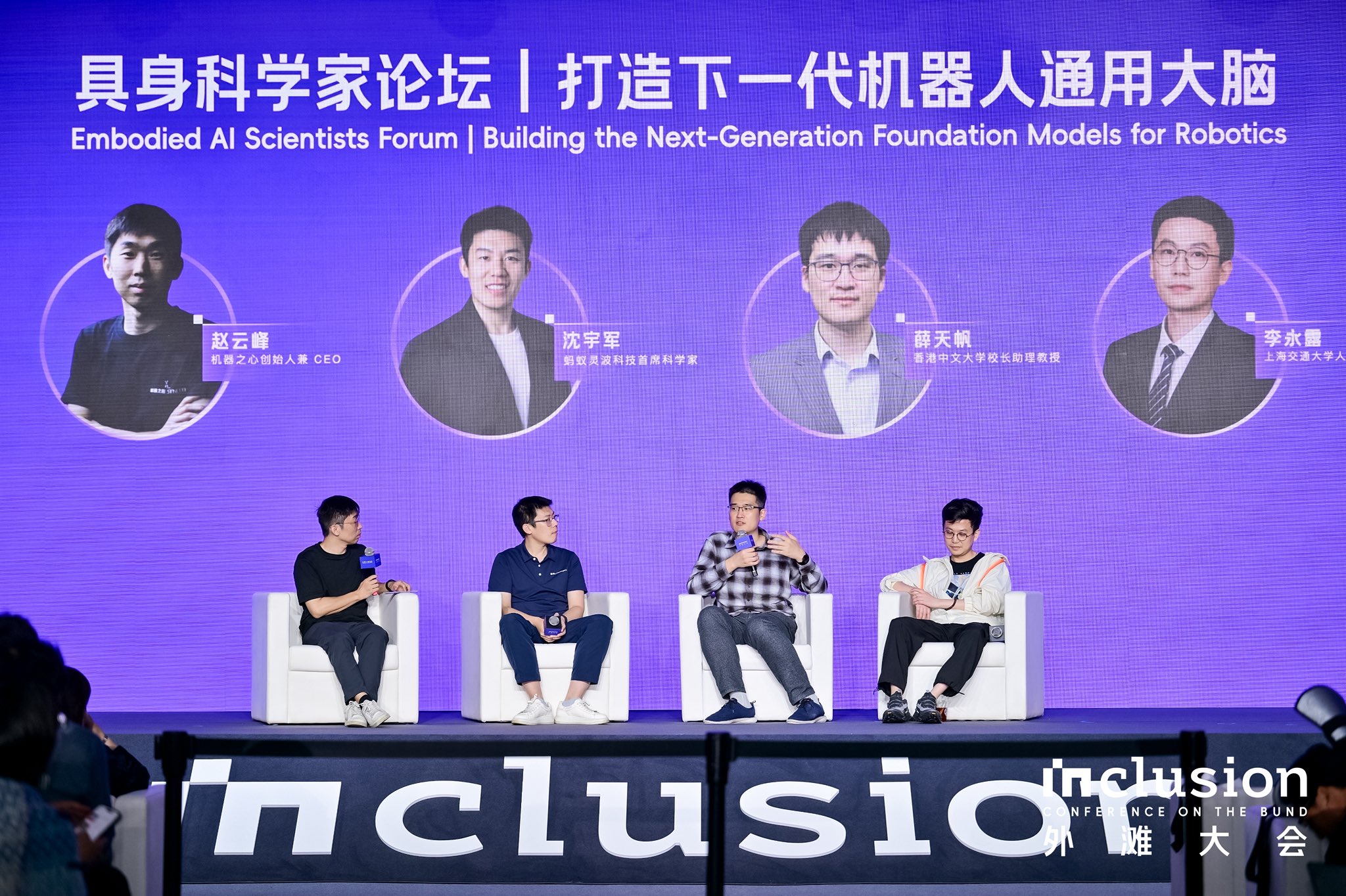
Robbyant hosted talks with young scientists and CEOs from leading embodied AI companies, covering data, models and real-world deployment. The company also launched the inaugural Robbyant Embodied AI Challenge and invited the community to take part.
After Learning to Twist Waist, Robots Eye Whole-Body Intelligence
Recent advancements have enabled robots to learn waist-twisting motions, marking a step toward whole-body intelligence. This could enhance balance and task execution in humanoid robots.