Live Briefs 2026-10-03 · Full coverage of embodied AI
Snapping elastic rods power frog-like robot to outrun rigid legs across six terrains
Researchers at UCLA and the University of Michigan have shown that elastic rods can snap between shapes to power small robots. A frog-like robot using this mechanism reportedly hops, flips, swims, and outruns rigid-legged designs across six terrains.
Tsinghua-led Team Open-Sources RPent Embodied Agent Infrastructure, Boosting Task Speed 7x
Tsinghua University, Infinigence, and Zhengxing Innovation have jointly open-sourced RPent, an embodied agent infrastructure that connects general large models with expert VLA models, memory, tools, and robot interfaces. RPent achieves 92.6% success on LIBERO-PRO and over 7x end-to-end speedup, enabling robots to understand tasks, invoke capabilities, and adapt in open-world scenarios.
Figure AI Claims Robot Scaling Law; Peers Say 56% Success Proves No Generalization
Figure AI's Helix 2.5 claims a human-to-robot scaling law after testing in 30 real homes, achieving 56% success on household tasks. But critics say the mixed results show imitation learning still fails to generalize reliably.
D-Robotics RDK kit powers Goostriever voice-controlled retrieval robot
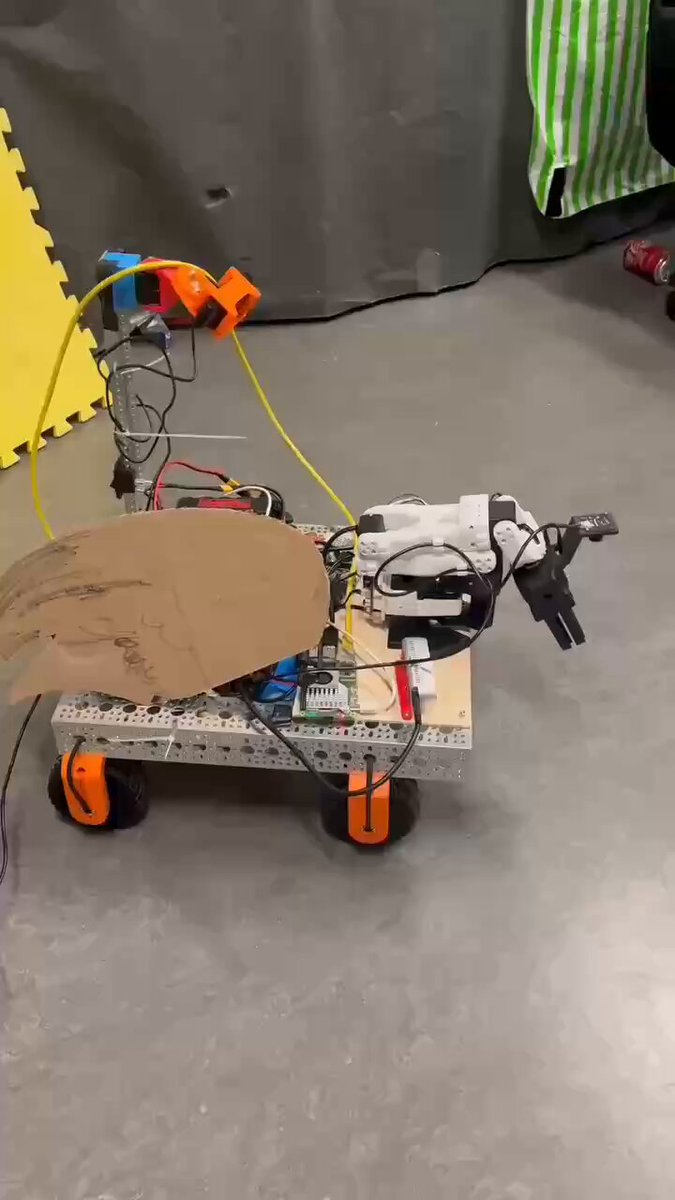
At @HackTheNorth, the @darksorceror_ team built Goostriever in just 36 hours on D-Robotics' RDK dev kit. The voice-controlled robot takes a spoken command, identifies the target object, plans a route around the room, drives over, grasps the item and brings it back. Its stack combines vision, navigation and an LLM planner, with an RDK S100 board running ACT inference locally for the grasping action.
Inspire Robots and Universities Open-Source HandEdit With 200M Image Samples
Inspire Robots has joined Fudan University, Shanghai Jiao Tong University and other institutions to open-source the HandEdit dataset and benchmark for first-person human-to-dexterous-hand image editing. The release contains over 200 million editing samples across 26 URDF configurations, with Inspire's DFX and G2 hands included in the data conversion pipeline.
Jensen Huang: Everything That Moves Can Have FSD, but Robots' Hardest Problem Is Not Motion
Jensen Huang argues that every moving thing will gain autonomy, but the core challenge for robots is manipulation rather than navigation. Nvidia's physical AI stack and the partial transfer from autonomous driving show progress, yet contact-rich operations remain the missing half before physical AI's ChatGPT moment.
Wang Xingxing: Humanoid Robots' Biggest Shortcoming Is Alignment, Errors in Last Few Centimeters
Wang Xingxing, speaking at the 2026 Private Economy Innovation Development Conference, identified alignment as the biggest shortcoming of humanoid robots. He noted that errors in the last few centimeters or millimeters block generalization and practical deployment, while envisioning a future where robots can tidy unfamiliar rooms without prior training.
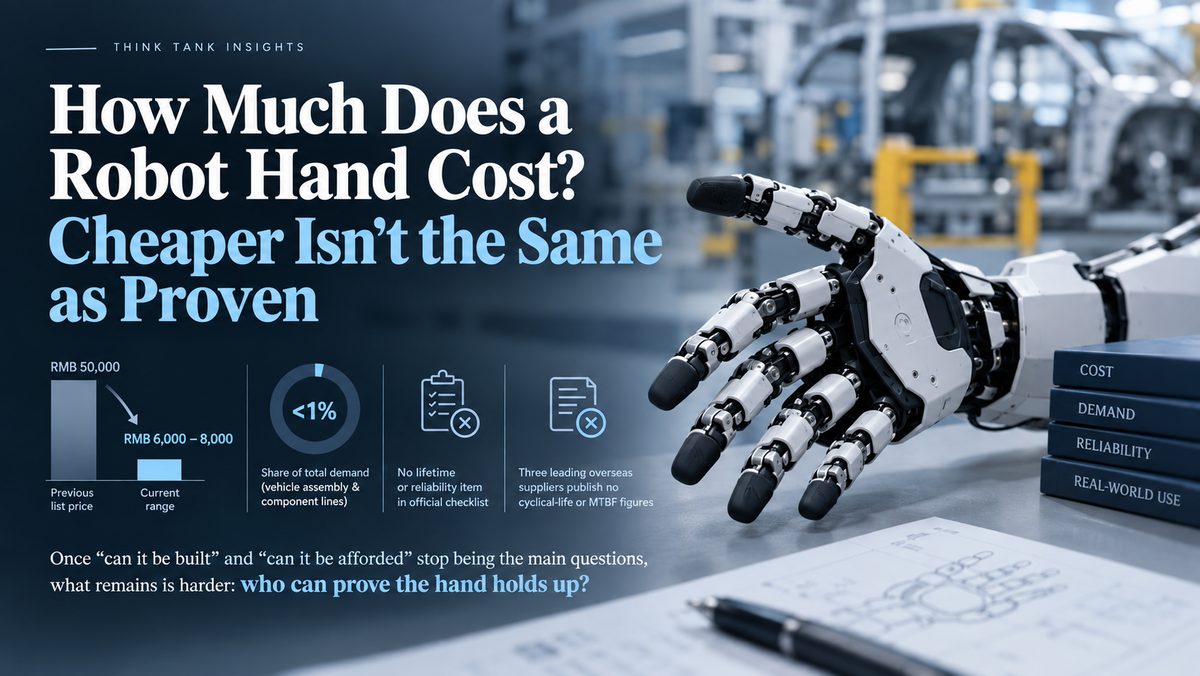
How Much Does a Robot Hand Cost? Cheaper Isn't the Same as Proven.
Chinese robot hands now cost a fraction of their 2025 prices, yet fewer than 1% of them work on automotive lines. The industry has three separate ways of judging a hand, and the one that measures lifespan has no common scale.