Live Briefs 2026-11-22 · Full coverage of embodied AI
Agile Robots Raises $500M Series F at $8.5B Valuation to Scale Production
Agile Robots has raised $500 million in Series F funding, bringing its valuation to $8.5 billion and total funding to $2 billion. The company plans to expand production capacity and key markets, including a new German site capable of building up to 10,000 humanoid robots annually.
Agility: AI stack takes on robotics' grand challenge
Agility's Chief Robot Officer Jonathan Hurst calls perceiving, reasoning and doing useful work in environments a robot has never encountered before the grand challenge of robotics. Agility says its AI stack is built to solve exactly that, and points to a video for demonstration. No performance metrics or deployment figures were disclosed in the post.
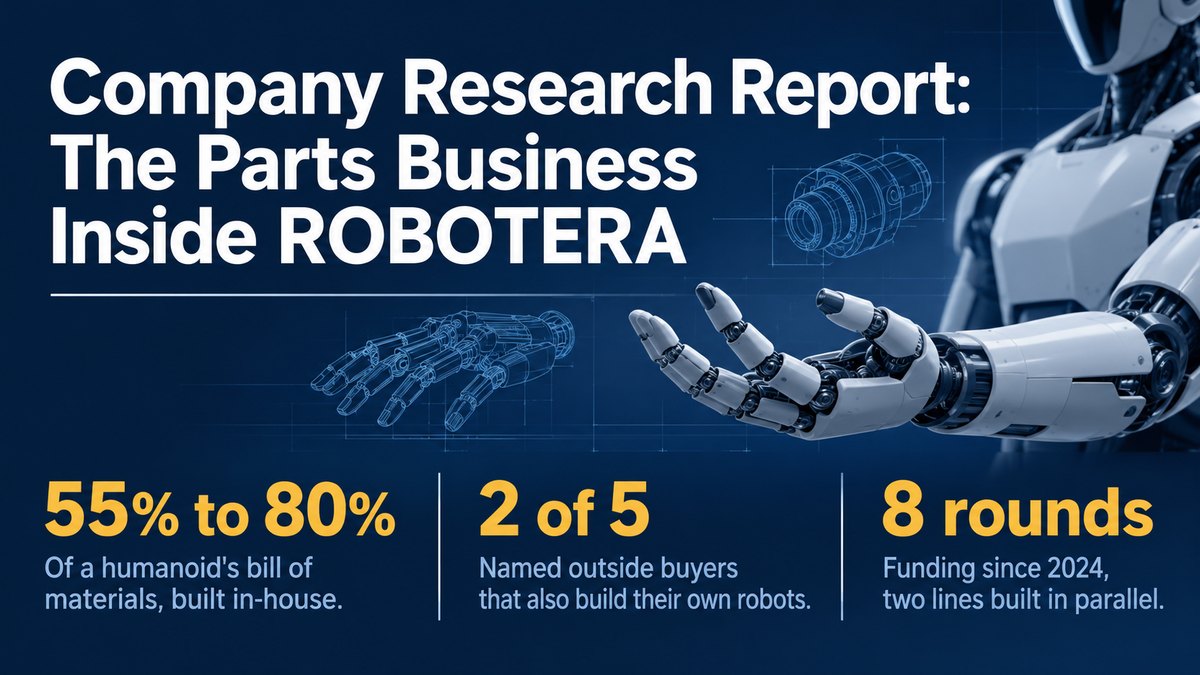
Company Research Report: The Parts Business Inside ROBOTERA
ROBOTERA builds the two most expensive modules of a humanoid robot as well as the machine. Two of its five named outside buyers also build robots, and revenue is never disclosed.
D-Robotics PickBot sweeps up tennis balls with on-device YOLO26n
D-Robotics showed off PickBot, a small tennis-ball-collecting robot built on its RDK X5 board. The robot runs Ultralytics YOLO26n for on-device ball detection, tracks the target and sweeps the balls into an onboard basket, completing the see-approach-collect sequence as one autonomous loop. The company shared footage of the robot at work in its post.

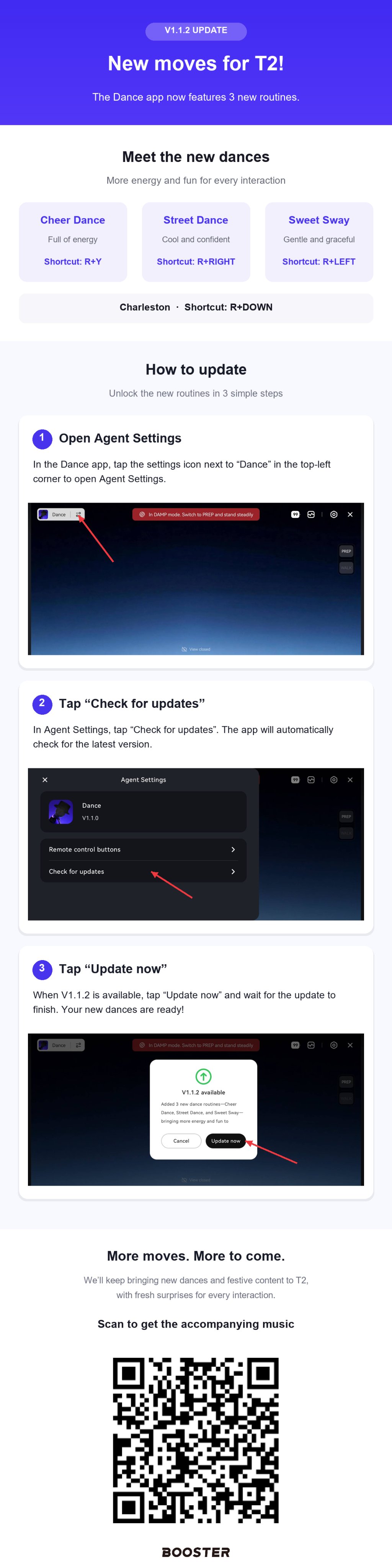
Booster Robotics ships Dance app V1.1.2 for Booster T2
Booster Robotics has released version 1.1.2 of its Dance app for the Booster T2 humanoid robot. The update adds three new dance routines: Cheer Dance, Street Dance and Sweet Sway. The company says users can update now to try the new features. No technical details or rollout schedule were disclosed.
Huachangda Says Physical AI Deployments Cover AMR Path Planning and Warehouse Scheduling
Huachangda (300278.SZ) said it has deployed physical-AI capabilities for autonomous mobile robot path planning and WMS+WCS warehouse scheduling, though commercial applications remain in market expansion.
Chongda Technology Tracks Humanoid Robot Applications with PCB Tech Reserve
Chongda Technology (002815.SZ) said on its investor interaction platform that it continues to monitor emerging applications such as humanoid robots and has relevant PCB technology reserves.
Zhenyu Technology: Robot Business Covers Humanoid Robot Precision Parts, Assemblies
Zhenyu Technology said on an investor interaction platform that its robot business products are precision components and assemblies for humanoid robots. The company did not disclose customer, capacity or financial details.
Jinlong Machinery Says Some Motor Products Ship for Robots, Drone Controllers
Jinlong Machinery & Electronics said some motor products are now shipping for robots and drone remote controllers, but related sales remain a small share of its motor segment and have minimal impact on overall revenue.
Longsheng Technology Says Humanoid Robot, Commercial Space Units Still Ramping
Longsheng Technology (300680.SZ) said its humanoid robot and commercial aerospace businesses remain in a cultivation and ramp-up phase, with revenue still small and not separately reported. The company said it cannot provide standalone third-quarter 2026 financial data for those segments.
Yonggui Electric Forms Project Team for Embodied Robot Connector Development
Yonggui Electric said on an investor interaction platform that its collaboration with Zhiyuan focuses on humanoid-robot connector manufacturing and core components, and that it has formed a project team to develop connectors for embodied robots.
Zhongchen Co. Says It Currently Does Not Supply to Robot Manufacturers
Zhongchen Co., Ltd. (300933.SZ) has stated that it currently does not supply products to robot manufacturers. The wire and cable company's brief clarification addresses market speculation about its involvement in the robotics supply chain.
Dongyue Silicon Materials Says It Does Not Directly Produce Robot Skin Products
Dongyue Silicon Materials (300821.SZ) said on an investor interactive platform that it focuses on silicone materials and does not directly produce finished simulated robot skin, though its products can be reprocessed for end uses.
Zoomlion Says Multiple Self-Developed Robots Have Completed Iterative Upgrades
Zoomlion said on Nov. 16 that several self-developed robot products have completed multiple rounds of iteration and that it has been building an embodied AI humanoid robot business since 2024.
World Models Can Predict the Future, but Why Do Robots Still Move Poorly?
World models can forecast future states, yet robots still struggle to move well in the real world. Compounding prediction errors and the mismatch between generated actions and actual dynamics explain much of the gap.
Dahuan Robotics Starts IPO Coaching in Shenzhen, Targets May 2027 Acceptance
Shenzhen-based Dahuan Robotics has filed IPO coaching registration with local regulators and plans an A-share listing, targeting coaching acceptance in May 2027. The humanoid robotics sector remains in early commercialization, leaving the timetable subject to regulatory and market validation.
Zhejiang Shibao Clarifies It Has No Robot Component Business
Zhejiang Shibao (002703.SZ) stated that it currently has no business related to robot components, clarifying its market position.
Shenzhen APEC: Chinese Robots Go Global to Connect Asia-Pacific
At the Shenzhen APEC meeting, a report highlights Chinese humanoid robots taking on service roles across APEC economies, with "Moyin" working as a sales guide in a Malaysian Chery dealership. It illustrates how China's embodied AI and robotics are entering overseas commercial settings.
Molding Technology's Robot Business Relies on Existing Production Lines, High Compatibility
Molding Technology (000700.SZ) announced that its robot business leverages existing production lines with high compatibility, as injection molding and automotive exterior parts lines are highly interchangeable.
Huayan Robotics Repurchases 185,000 Shares for HK$1.23 Million
Huayan Robotics (01021.HK) repurchased 185,000 shares on November 16 for HK$1.232 million, at prices between HK$6.6137 and HK$6.689647 per share.
Ruicheng Intelligent Plans Up to 96 Million Yuan Raise for Handling Robots
Ruicheng Intelligent has proposed raising up to 96 million yuan through a simplified private placement to fund an intelligent logistics handling robot industrialization project. Its shares fell 9.13% on the day the plan was disclosed.
Chery's Humanoid Robot Moyin Guides Customers at Malaysian Dealership
At a Chery dealership in Malaysia, the humanoid robot Moyin serves as a sales guide, communicating in English and handling greetings, model introductions and standardized training. The deployment illustrates how Chinese-made robots are expanding into Asia-Pacific markets and fostering complementary advantages.
BioMARS 2.0 Lets Robots Join Scientific Decision-Making, From Papers to Next Steps
BioMARS 2.0 is an embodied AI system that connects paper reading, experiment planning and robotic execution, allowing robots to help choose the next research step.
Kstar Says No Current Plans to Invest in Humanoid Robotics
Kstar told investors on an interactive platform that it currently has no plans to invest in or build a humanoid robotics business, despite recent strength in related sectors.
Rongqi Technology Says It Is Not Involved in Physical AI or Humanoid Robot R&D
Rongqi Technology said it is not currently engaged in research and development of physical AI or humanoid robots, responding to questions about whether its automation and inspection equipment fall within the broader industrial robotics field.
Zhaomin Technology's Humanoid Robot Parts Enter Mass Production, PEEK Boosts Growth
On Nov 16, Zhaomin Technology disclosed investor-relations records showing it has co-developed multiple precision humanoid-robot components with customers and is gradually moving new robot parts into mass production. The company is also promoting PEEK-based "plastic-for-steel" substitution as a growth driver.
Suzhou Shangsheng Electronics: Digital Speaker Chips Not Used in Humanoid Robots
Suzhou Shangsheng Electronics (688533.SH) said on an investor interaction platform that its digital speaker chips are not currently used in humanoid robots or similar products. The company noted that its technology reserves include MEMS speakers, which may be applied to wearable devices in the future.
Dawn Polymer Signals Tech Breakthroughs in Tire and Robotics Materials, Flags Risks
Dawn Polymer (002838) fielded investor questions on Nov. 13 about DV tire material industrialization and bionic materials for robots, signaling technical progress while cautioning on risks.
XHAND 1 Pro-U Limited Sale: Official Hand for NVIDIA GR00T 2, GEAR DexUMI
XHAND 1 Pro-U has entered limited sale as the official five-fingered dexterous hand for NVIDIA's GR00T 2 and GEAR DexUMI. The launch follows Jim Fan's CoRL announcement of GR00T 2 and its open-source plan under the theme "Summer of Robotics."
Huawei Cloud to Open-Source Ascend-Based CloudRobo World Model for Robots
Huawei Cloud plans to release and open-source CloudRobo-WM1.2, a robotics world model built for its Ascend computing platform, during an online event on November 16. The model is designed to help robots predict environmental changes and is part of Huawei Cloud’s broader CloudRobo developer platform.
Noetix Robotics directs Xiaoyue robot inquiries to private messages
Noetix Robotics thanked followers for their interest in its Xiaoyue robot and said product information and pre-order details are available by private message. The post gave no pricing, release date or specifications for the robot.
Rongqi Technology Says It Is Not Involved in Physical AI or Humanoid Robot R&D
Rongqi Technology (301360.SZ) stated on November 16 that it is not currently involved in the research and development of physical AI or humanoid robots. The company made the disclosure on an investor interaction platform.
Kstar Says It Has No Current Plans to Invest in Humanoid Robots
Kstar (002518.SZ) said on an investor interaction platform that it currently has no plans to invest in humanoid robots. The company said it will keep focusing on its data-center and new-energy core businesses.
Zibo Linzi Robot Cluster Selected for National SME Characteristic Cluster List
MIIT's 2026 fifth batch of SME characteristic industrial clusters includes 97 nationwide, with Zibo's Linzi robot cluster selected for the first time. The cluster hosts 35 firms and produces 70% of China's humanoid robot joint modules.
EngineAI Targets Hong Kong IPO as Joint Peak Torque Reaches 450 Nm
EngineAI, formed by former XPeng robotics team members, has completed a shareholding reform and is targeting a Hong Kong IPO in Q4 2026. Its high-performance humanoid claims 14 kW instantaneous joint power and up to 450 Nm peak torque.
Robot Era Deploys 42nd-Gen Embodied Model in Logistics, Sorting 1,500 Parcels/Hour
Robot Era has deployed its 42nd-generation embodied model in logistics, where five-finger dexterous-hand robots at China Post and SF Express sort more than 1,500 parcels per hour. The company, which raised 1 billion yuan in July, develops robot brains, motion control, humanoid bodies and dexterous hands.
Chinese Startup’s Humanoid Robot Wins Free Gymnastics Silver at 2025 Games
Haibaichuan Technology’s humanoid robot placed second in free gymnastics at the 2025 World Humanoid Robot Games, demonstrating agile running and balance. CEO Sun Bo says small firms treat hardware development like research, and Haibaichuan is exploring detachable face accessories to make robots less intimidating.
Heshi Siwei Cleaning Robot Deployed in Beijing Public Restrooms
A general-purpose wheeled-arm cleaning robot from Heshi Siwei has begun working in a public restroom at a district park in Beijing, handling urinal cleaning, trash pickup, and surface wiping. Priced at RMB 200,000–250,000 and able to serve two to three restrooms, it is expected to replace about 70% of cleaning labor.
Lingyu Deploys Wheeled Service Robots in Beijing Supermarkets at RMB 100,000–200,000
Lingyu Intelligence has deployed wheeled, gripper-equipped service robots in Beijing 7Fresh supermarkets, where they work eight-hour shifts moving goods and offering samples. The robots cost RMB 100,000–200,000 each and run under autonomous operation with remote human takeover.
Yuequan Bionic's wheeled humanoid robot deployed for live-line power grid operations
Yuequan Bionic's wheeled humanoid robot has been deployed by State Grid Hefei to assist in live-line maintenance, separating workers from hazardous environments. The application aligns with Beijing's push for robots in dull, difficult, dangerous, and dirty tasks.
Dexterous Hand Prices Fall as Tactile Sensors Drop to 199 Yuan
Yinshi Technology's dexterous hands now span dozens of models priced from 10,000 to 50,000 yuan, while domestic tactile sensors have fallen to as little as 199 yuan from previous per-unit prices above 100,000 yuan.
Shuanghuan Driveline's Robot Reducer Revenue Exceeds 100 Million Yuan in First Three Quarters
Shuanghuan Driveline's robot reducer business generated over 100 million yuan in the first three quarters of 2026, with management projecting 150-200 million yuan for the full year. The company is developing a new reducer for a major North American client, highlighting the broader shift among auto parts makers toward precision transmission.
China October Output: 3D Printing Equipment +85.9%, Li-ion Batteries +30.0%, Industrial Robots +26.0%
China's National Bureau of Statistics reported that in October, production of 3D printing equipment, lithium-ion batteries, and industrial robots increased by 85.9%, 30.0%, and 26.0% year-on-year, respectively.