Live Briefs 2026-11-22 · Full coverage of embodied AI
Agility: Digit's onboard safety envelope resists remote override
Agility Robotics says its humanoid Digit carries its safety envelope onboard and runs independently of network connectivity. No network condition, remote command or external access can override what the robot's safety system determines it must not do. CTO Pras Velagapudi describes this as one of the most important design decisions behind deploying a humanoid.

Agility's Jonathan Hurst Answers Questions on Digit 5 Engineering
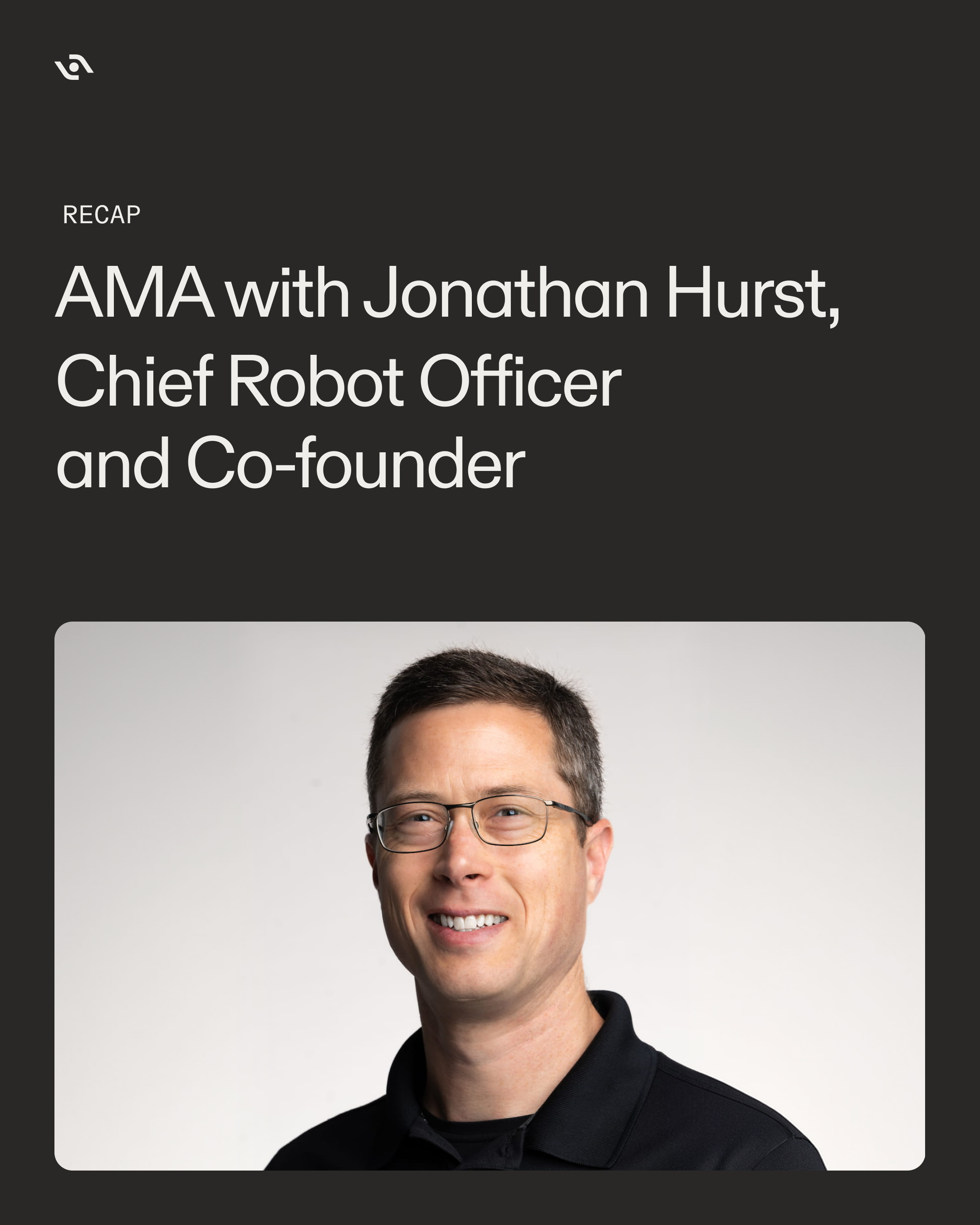
Agility Robotics co-founder and Chief Robot Officer Jonathan Hurst answered fan questions about the engineering behind Digit 5, the company's latest humanoid robot. The full AMA was published on the company's website, where Hurst walks through how the robot was built and the engineering decisions behind it.
Quadruped Robot Solves Giant Rubik’s Cube in IEEE Spectrum Video Roundup
IEEE Spectrum’s Video Friday roundup features a quadruped robot solving a giant Rubik’s Cube with its feet, along with humanoid control research and new robot hands. The collection also covers biohybrid actuators, motion-tracking efficiency, agricultural robots, lunar rovers, and event previews.
LimX TRON2 picks tennis ball in browser sim, OpenCV on CPU
LimX Dynamics showed a browser-based simulation in which a TRON2 robot spots a tennis ball, walks up, kneels, grasps it and stands back up. The full cycle runs about 20 seconds after a git clone, using only OpenCV on CPU with no learned model. The mission code is the same one that runs on the physical robot; only the drivers are simulated.

Robot Talk Episode 167 Explores Novel Robot Designs for Construction Automation
Robot Talk Episode 167 features Jan Petrš of EPFL and Déploya Robotics discussing novel robot designs for construction and architecture. The conversation covers his work on deployable façade-installation systems, tensegrity robotics, and reconfigurable soft robotic approaches developed through his PhD.
AGIBOT open-sources WORLD 2026 Release 4 physical reasoning dataset
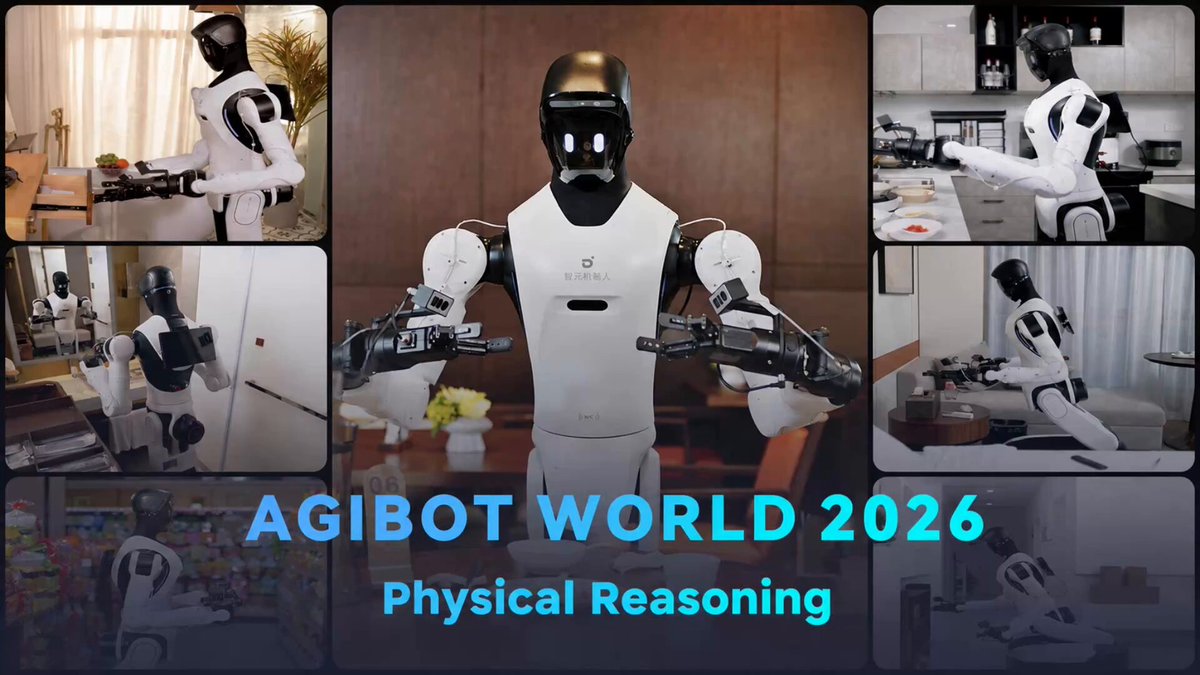
AGIBOT has officially open-sourced AGIBOT WORLD 2026 Release 4: Physical Reasoning, a real-world dataset intended to help robots reason before acting. The data records how robots decide what to do when object quantity, occlusion relationships, spatial occupancy and task progress change, linking those decisions to execution on real robots. The same task is captured across different states and different resulting actions.
Embodied AI's Decisive Factor May Lie in Harness, Not Model
Two mid-October studies show that the external harness around an AI model can sharply change task performance, with one raising bug-fix success from 24.4% to 48.3% on the same lightweight base.
Agility: nearly every Digit 5 part changed from Digit 4
Asked which mechanical parts changed most between Digit versions as deployment widens, Agility said nearly every part changed from Digit 4 to Digit 5. Digit 4 was the first commercially deployed humanoid robot, and field experience fed hundreds of customer requirements into a full, formal product design process.
Agility explains why Digit dropped Cassie's leaf springs
Asked about the trade-offs from leaf springs in Digit 3 to rigid links in Digit 4, Agility said leaf springs absorb harsh impacts in running gaits but add complex dynamics and mechanical complexity for standing and manipulation. Cassie was optimized for walking and running, Digit for locomanipulation, and Digit 5 moves toward a human-style design.
Agility: balancing power and natural motion is Digit's hardest task
Asked what was hardest about making Digit move naturally around people, Agility's JH said the challenge is priorities. Natural gaits are straightforward on a lighter robot like Cassie, but Digit 5 weighs over 120 kg and needs special actuators and leg configurations to deliver power and strength while keeping natural dynamic motion.
Agility: Digit 5 to move like animals, not position-control robots
Agility Robotics took up a question about reflected inertia and gearbox lag in warehouse robots. Jonathan Hurst argued that Digit 5 must move in a fundamentally different way from traditional position-control machines, acting more like an animal, with exceptional force control and compliant interaction. The design tradeoff was framed as pure compliance versus raw payload.
Agility: Digit fleet variance needs calibration plus robust policies
Agility Robotics answered a question on robot-to-robot variation across a fleet. Jonathan Hurst said both routes are needed: fixed differences in motor constants or component mass can be calibrated per unit, while features that drift with time, temperature or other factors require policies robust enough to cope with the randomness.
Agility: Digit 5 compute in upgradable box, 9-min battery
Agility's Jonathan Hurst says Digit 5 is designed as an upgradable platform, with most compute contained in a single box. The new battery needs only 9 minutes to charge, while battery degradation and thermal safety remain part of operations planning.
Agility: Digit 5 stop decision stays onboard with IGX Thor
Agility's Jonathan Hurst says moving Digit 5 to NVIDIA IGX Thor does not change much: the decision to stop remains onboard the robot. Cloud software Arc handles fleet orchestration and workflow integration, but a dropped connection will not remove the robot's ability to do its task.
Agility: safety was hardest challenge for Digit deployment
Agility's Jonathan Hurst says safety was the biggest surprise and a hard blocker for deploying Digit. Agility had to design a system-level safety strategy for a 129 kg dynamically stable robot that works around people.
Agility's Jonathan Hurst takes questions on Digit engineering
Agility co-founder and Chief Robot Officer Jonathan Hurst hosted a Q&A on how Digit works, covering legs, balance and safety design, plus what robots still cannot do. He said the session was limited to engineering questions and invited followers to ask away.
XPeng’s IRON Robot Responds to Gestures Without Voice Commands in New Demo
XPeng released an interaction test video showing its humanoid robot IRON adjusting handshake, fist-bump and high-five responses to a tester’s gestures without voice commands. The robot re-infers from visual frames every 0.2 seconds and predicts motion changes over the next six seconds, supported by XPeng’s “One Infra, Two Products” physical AI system.
Wang Xingxing Shows GPT-6 Zero-Training Robot Control as Market Misreads Shoucheng
Unitree's Wang Xingxing demonstrated GPT-6 controlling robots with zero training to draw and play Go, while outlining plans for 10 million hardware units a year and self-sufficient physical-AI compute. The market, however, still values Shoucheng Holdings (0697.HK) through its robotics investment rather than this industrial shift.
Industry Begins Rewriting Robots With Physical AI; Market Still Prices First Cheng as Robot Investment
Wang Xingxing demonstrated GPT-6 controlling robots without prior training to paint and play Go, while outlining plans for 10 million hardware units a year, physical-AI model deployment, and self-sufficient compute and chips. The market still values First Cheng Holdings through a conventional robot-investment lens.
Unitree's Wang Xingxing: Robot-AI Alignment Is Key to Embodied Intelligence's ChatGPT Moment
At the 2026 World Physical AI Conference in Hangzhou, Unitree Robotics' Wang Xingxing said the key challenge for embodied intelligence is aligning AI model inputs and outputs with real robots. He also noted that top model developers have largely achieved internal self-evolution, though broad diffusion may take 5–10 years.