Live Briefs 2026-10-02 · Full coverage of embodied AI
KAIST Four-Legged Robot Completes Marathon on Single Battery Charge
A KAIST team has demonstrated a four-legged robot that completed the Sangju Marathon in South Korea in 4 hours and 19 minutes on a single battery charge. The robot traveled three times as far per charge as existing legged robots, suggesting potential improvements in battery life for legged machines.
ETH Zurich's New Robotic Hand Can Walk, Press Keys, and Move Objects
Engineers at ETH Zurich's Soft Robotics Lab have adapted an off-the-shelf detached robotic hand to crawl, balance, and interact with its environment. TechXplore Robotics reports that the hand can walk, press keys, and move objects on its own, echoing the fictional character Thing.
Skild AI brings AlphaGo-style self-play to physical world
Skild AI says it is taking self-play, the method behind AlphaGo, out of games and into the physical world. The company argues self-play can produce emergent, superhuman behavior, and is now applying that idea to robot learning.
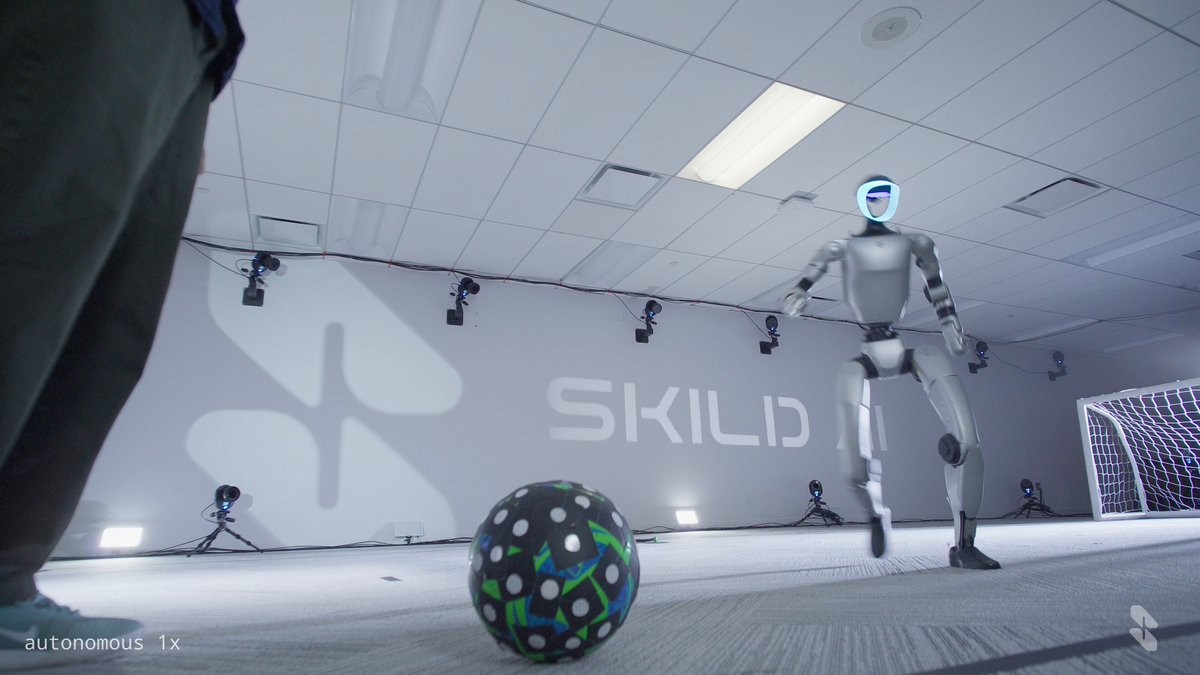
Skild AI trains robot to play football with 140 years of self-play
Skild AI says it trained a robot to play football using self-play. The system went through the equivalent of 140 years of a virtual World Cup during training before the policy was moved onto a real machine.
Boston Dynamics engineer on Stretch endurance testing
Boston Dynamics mechanical engineer Diane Heinle answers questions about endurance testing for the Stretch robot, explaining how her team simulates years of wear on robot parts during a short time in the lab, and why there are bird heads on the cable testers.

Humanoid Robots Use Whole-Body AI to Navigate Narrow Gaps and Obstacles
Humanoid robots could assist people in homes, offices, healthcare facilities, and public spaces. Before reliable deployment, they must safely navigate cluttered, dynamic environments using whole-body AI control that coordinates the entire body.
UCLA's 11-Centimeter Frog Robot Jumps Using Twisted Elastic Rods
Researchers at UCLA and the University of Michigan have developed an 11 cm, 98.2 g frog-inspired robot that stores energy in twisted elastic rods and releases it in sudden jumps. It achieves 2.46 body lengths per second on average across six surfaces and can swim with flexible fins, with design rules scalable to millimeter-scale robots.
Terminator-Style Robot Wins Cage Fight, but a Human Was Controlling It
A 44-second video shows internet personality Frankie LaPenna fighting an EngineAI T800 humanoid in an octagon cage at an event staged by San Francisco robotics company REK, which calls it the first human-versus-humanoid robot fight. The robot, styled to look like a Terminator, was teleoperated by a human, so the bout demonstrated physical capability under remote control rather than autonomous fighting skill.
WorldSkills 2024 Opens with Humanoid Robot Dances, Director Recalls 50m Safety Distance
The 48th WorldSkills Competition opened in Shanghai with a ceremony featuring full-size humanoid robots dancing with humans. Director Hou Jie revealed that in early rehearsals, dancers wore helmets and kept a 50-meter distance from the robots, which have since been refined for close interaction.
Ukraine Deploys Suicide Ground Robots Behind Russian Lines in Donetsk
Ukraine's military says it has for the first time airdropped suicide ground robots behind Russian front lines in northern Donetsk, in an operation that also blinded Russian drones.
Barbara Mazzolai Aims to Build a New Field of Robotics
Barbara Mazzolai, a former biologist turned roboticist, pioneered bioinspired robots based on octopuses, plant roots, and seeds. Now at the Italian Institute of Technology, she advocates for 'sustainability robotics,' a field that designs robots with minimal environmental impact and benefits for nature and people.
GPT-6 Astra Excels at Robot Control, but Real-World Safety Fails
GPT-6 Astra achieved 95% success in a robot-control task with far fewer tokens than Fable 5.1, but RoboDojo tests found it issued unsafe actions and damaged hardware, forcing early termination. Noematrix's RoboRSI framework uses four-agent loops and code solidification to improve continuous execution, diagnosis, and adaptation, raising LIBERO pass rates and cutting token use.
Chinese Robot Kicks American Fighter Down, but Humans Do the Fighting
At a Sept. 20 event in California, China's Zhongqing T800 humanoid robot fought an American boxer in the first human-versus-robot combat match, kicking him down before losing when its battery or cooling failed. The robot was remotely operated by a VR-equipped human, showing that humanoid motion control can handle impact but endurance, heat management, and autonomous decision-making remain limited.