Live Briefs 2026-10-02 · Full coverage of embodied AI
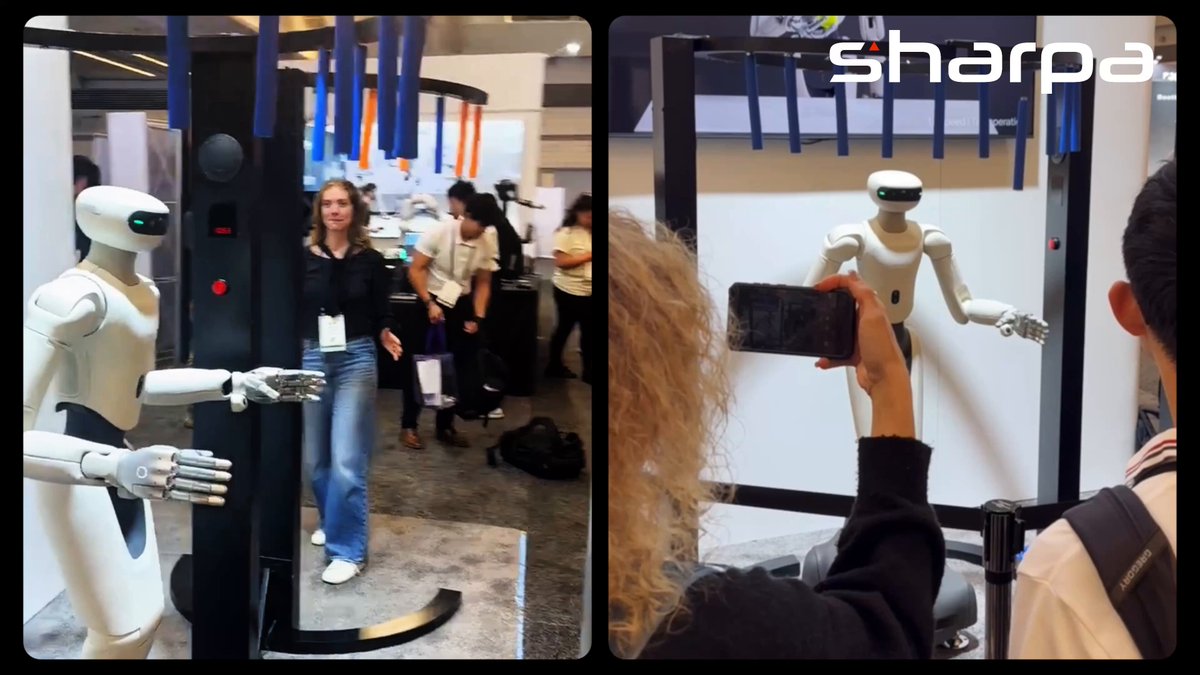
Sharpa D01 robot catches falling stick at over 10.5 m/s
Sharpa's D01 robot took on the Catch the Stick Challenge, detecting a falling stick, moving at high speed to intercept it and grasping it with precision. The demo highlights a maximum end-effector speed above 10.5 m/s, 0.2 mm repeatability and 1000 Hz communication frequency. Sharpa notes that speed alone is not enough: the robot must reach the right place at the right time and secure the grasp.
Gecko Robotics Adopts NVIDIA Agent Safety Layer for Inspection Robots
NVIDIA unveiled its Open Agent Safety Platform, built on the open-source OpenShell runtime and the Sentry watchdog, to govern robots running AI agents. Gecko Robotics is among more than 100 organizations testing the framework, applying enforceable boundaries to its climbing, crawling, flying and swimming inspection robots, including the U.S. Navy's Komodo.
Cambridge Team Explores Whether Soil Can Process Information Without a Brain
Cambridge researchers are investigating soil as an intelligent system, studying its structure, chemistry, and microbial networks. The work aims to inspire bio-inspired computing, precision agriculture, and environmental sensing.
Soft Exosuit Makes Standing Up Easier for Older Adults
A soft robotic exosuit is designed to assist older adults with standing up from a chair. The device aims to respond intuitively and stay synchronized with the user's hip and leg movements.
RoboSense E2 and EM4 LiDAR Support NVIDIA Holoscan Bridge
RoboSense says its E2 and EM4 digital LiDAR now support NVIDIA Holoscan Sensor Bridge (HSB), enabling low-latency sensor-to-compute connectivity with NVIDIA edge AI platforms. The company states it is the first shipping LiDAR maker to integrate with NVIDIA HSB, building on its existing presence across NVIDIA Jetson, DRIVE and Omniverse platforms.

Jingshi Technology's VIVA Hand Achieves Real-Time Human-Robot Four-Hand Piano Duet
Jingshi Technology has unveiled its VIVA dexterous hand, claiming the world's first real-time human-robot four-hand piano duet. The company also announced a VIVA × CADA milestone, shifting robots from executing preset motions to artistic expression and continuous learning.
Yuankee Vision's Chen Pu: Robot Training Data Must Upgrade from 2D to 4D with Sub-Millimeter Precision
At a seminar in Beijing, Chen Pu of Yuankee Vision emphasized that robot training data must evolve from 2D to 4D with sub-millimeter precision to build a 4D data foundation. He highlighted that current bottlenecks include single training scenarios, insufficient dynamic data, and inconsistent underlying foundations, and outlined Yuankee's approach to multimodal data collection.
ULTRA Framework Nominated for IROS 2026 Best Mobile Manipulation Paper
The ULTRA framework has been accepted to IROS 2026 and nominated for the Mobile Manipulation Paper Award. It enables a single controller to either track reference motions or generate whole-body loco-manipulation actions from just a target position and perception.
Ophthalmology Robot Restores Near-Blind Eye in 3 Minutes with Micron Precision
A surgical robot developed by the Eye Center of Zhejiang Provincial People's Hospital filters hand tremors to 10-micron precision. In July 2023, it completed Asia's first clinical ophthalmology robot surgery, performing a 3-minute macular injection on a nearly blind patient; 32 such procedures have been done to date.
Embodied AI Robot Challenge Enters Hardcore Competition Phase with Multi-Event, Multi-Scenario Format
According to Leaderobot, the Embodied AI Robot Challenge has entered a hardcore competitive phase, with multiple events running in parallel and linked scenarios that test robots in realistic conditions.
Viral Fighter Faces Humanoid Robot in 44-Second MMA Cage Bout
A viral video shows influencer Frankie LaPenna fighting a humanoid robot in a 44-second MMA-style cage match arranged by REK. Although the bout appears choreographed, it highlights rapid advances in robot locomotion, balance, and responsiveness.
Light Origins Releases Light-O1 Embodied Foundation Model Trained on Internet Human Motion
Light Origins has released Light-O1, its first general embodied foundation model, trained on human motions recovered from internet videos to provide a reusable starting point for robots across tasks and embodiments. The company also launched Light-O1-Preview, a text-to-motion model that accepts natural language and generates whole-body motion sequences.
Japan Study: Female Surgeons Get Fewer Robot-Assisted Surgery Opportunities
A survey by The Asahi Shimbun found that female surgeons in Japan receive fewer opportunities to perform robot-assisted surgery than male peers. Women led only 4% of robot-assisted gastric cancer operations and 5% of rectal tumor surgeries, compared with 8–12% for laparoscopic and open procedures.